
Leavenworth in Leavenworth County, Kansas — The American Midwest (Upper Plains)
"Trails"
Spirit of the Buffalo Community Art & History Project
| — | Artist: Alan Collins, Lansing | — |
Photographed by William Fischer, Jr., February 28, 2026
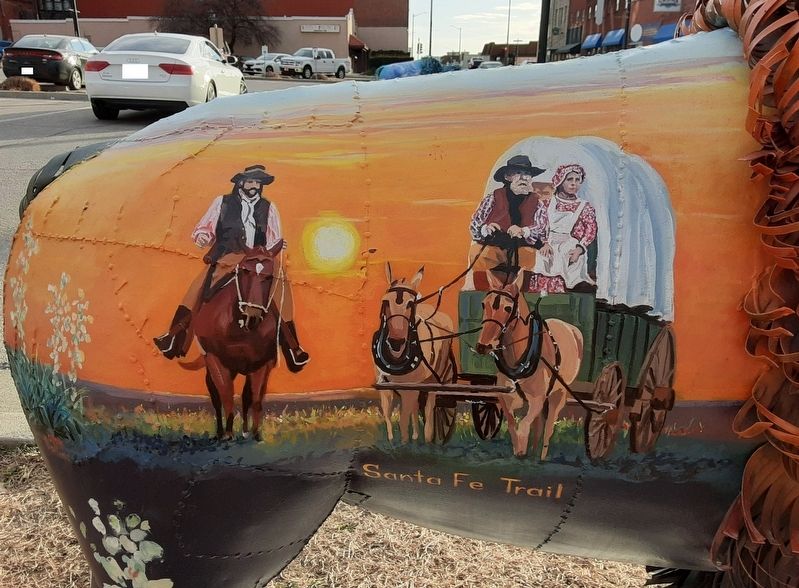
1. "Trails" Marker Santa Fe Trail Mural
Santa Fe Trail
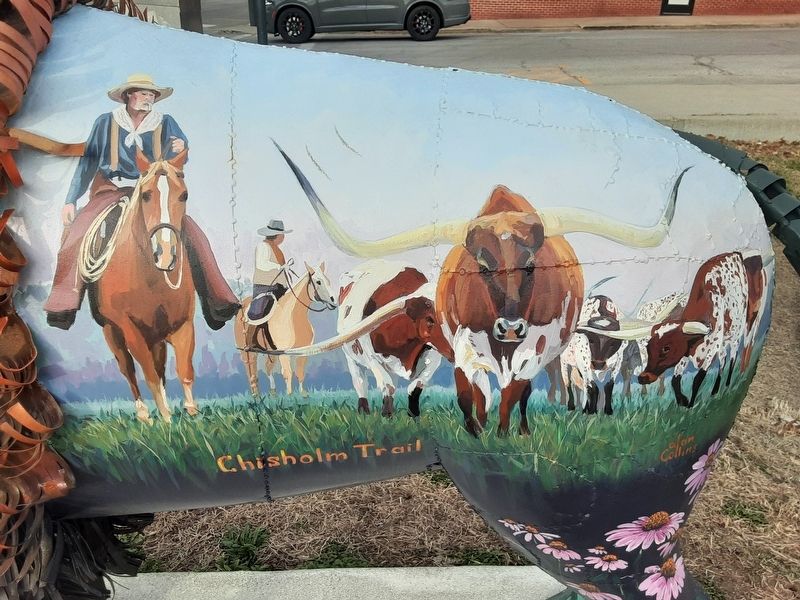
Chisholm Trail
Erected by Leavenworth County Historical Society.
Topics. This historical marker is listed in these topic lists: Immigration • Industry & Commerce • Roads & Vehicles • Settlements & Settlers. A significant historical month for this entry is September 1821.
Location. 39° 19.02′ N, 94° 54.995′ W. Marker is in Leavenworth, Kansas, in Leavenworth County. It is at the intersection of Cherokee Street and 6th Street, on the right when traveling west on Cherokee Street. Touch for map. Marker is at or near this postal address: 529 Cherokee Street, Leavenworth KS 66048, United States of America. Touch for directions.

Regionally, this marker is in Eastern Kansas and specifically in Greater Kansas City. It is also in the American Midwest, in the Lewis & Clark Corridor, in the Corn Belt, on the prairies, and on the Southern Plains. Globally, it is in North America, the Western Hemisphere, the Western World, and the Anglosphere. Historically, it finds itself in what was once the Louisiana Purchase.
Other nearby markers. At least 8 other markers are within walking distance of this
this page online
Regarding "Trails". Excerpt from the LCHS Spirit of the Buffalo Project website:
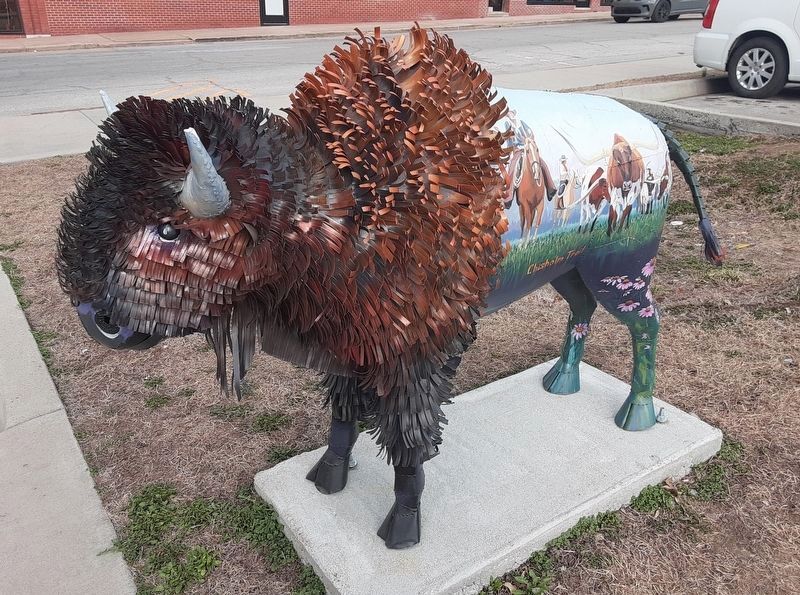
The Leavenworth County Historical Society is proud to present the “Spirit of the Buffalo” Community Art & History Project in Leavenworth County. The outdoor exhibit focuses on connecting residents and visitors to the region's early history, with an emphasis on Kansas Plains Natives and their co-habitation with the buffalo.
Noted Lansing artist, Alan Collins, has entitled his presentation as “Trails.”
While there are many readily identifiable historic trails in the United States, the earliest use of trails were for migration, exploration, or trade. Perhaps the earliest trails were
Photographed by William Fischer, Jr., February 28, 2026
2. "Trails" Marker Chisholm Trail Mural
Several historic trails passed through Leavenworth County, Kansas, primarily related to westward expansion. The most prominent included the Oregon Trail, the Santa Fe Trail, and the Pony Express Trail. These trails were vital routes for pioneers, traders, and settlers heading west as Leavenworth gained recognition as a major “jumping-off” point for pioneers heading west.
On one side of the buffalo statue, the artist shows a covered wagon with a side rider as they travel across the prairie on the Santa Fe Trail. The Santa Fe Trail was established in 1821, after Mexico gained its independence from Spain, and became a vital commercial route. The trail began in Missouri and passed through Kansas, Oklahoma, and Colorado, terminating in Santa Fe, New Mexico. A Santa Fe Trail marker can be seen at 100 Riverside Ave, Fort Leavenworth as well as swales
Photographed by William Fischer, Jr., February 28, 2026
3. Spirit of the Buffalo "Trails" Marker (east face)
On the reverse side of the buffalo the artist depicts what it may have looked like on the Chisholm Trail when cattle were driven from Fort Worth to Abilene. Drovers conducting a longhorn cattle drive on the long but significant route facilitated the transportation of millions of cattle from Texas to the expanding markets in the east. From Abilene, cattle were shipped by rail to eastern markets.
While Leavenworth held some importance in the cattle shipping industry, particularly in the earlier stages of the cattle drive era, it was eventually overshadowed by other Kansas cities that developed into major cow towns and railheads for the burgeoning cattle trade. With the expansion of railroads, the invention of barbed wire fencing, and overgrazing on the range, long-distance cattle drives came to an end.
Also see . . . Santa Fe Trail: A Brief History
Photographed by William Fischer, Jr., February 28, 2026
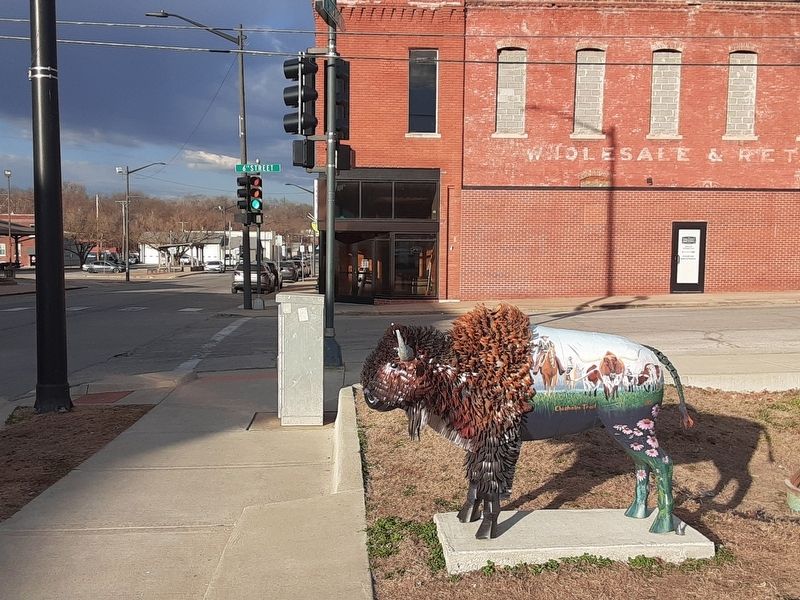
4. Spirit of the Buffalo "Trails" Marker
Looking west
Credits. This page was last revised on March 6, 2026. It was originally submitted on March 6, 2026, by William Fischer, Jr. of Reynoldsburg, Ohio. This page has been viewed 29 times since then. Photos: 1, 2, 3, 4. submitted on March 6, 2026, by William Fischer, Jr. of Reynoldsburg, Ohio.
