Leavenworth in Leavenworth County, Kansas — The American Midwest (Upper Plains)
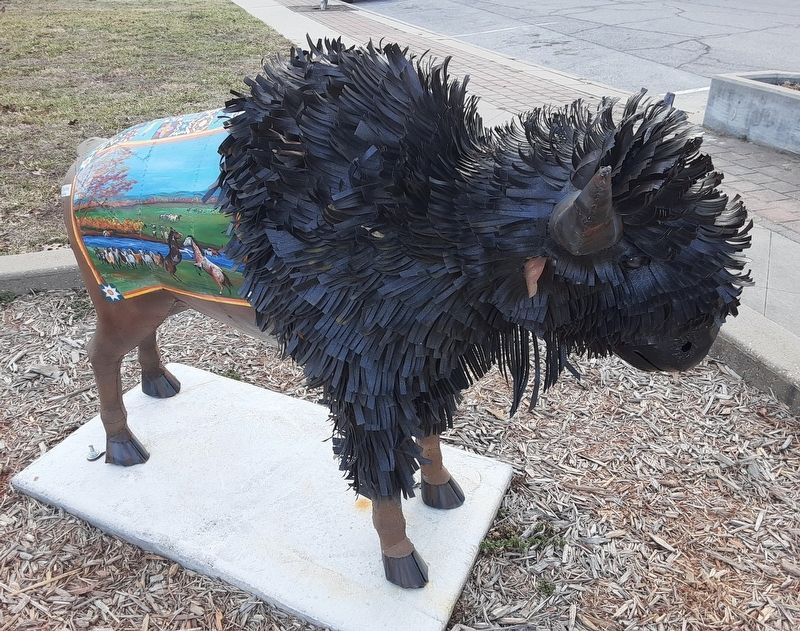
"Taming the West"
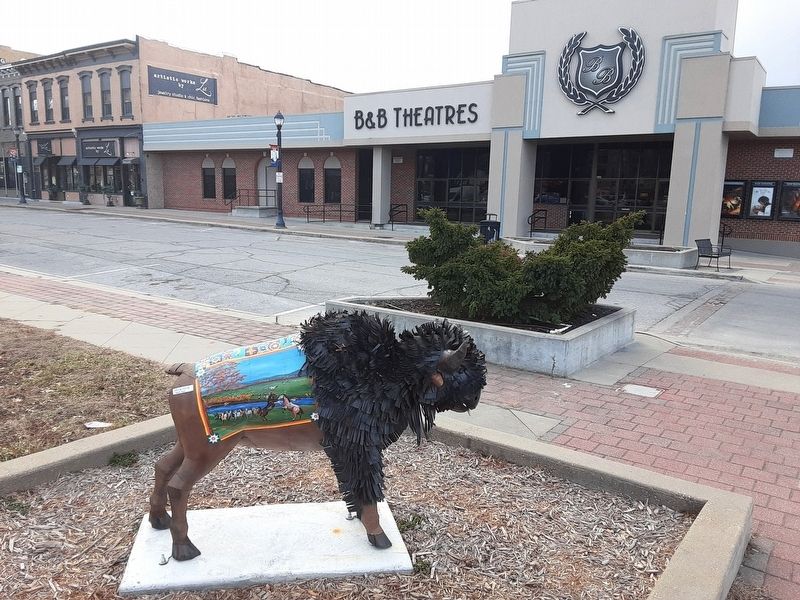
Spirit of the Buffalo Community Art & History Project
| — | Artist: Teresa Tomrell, Leavenworth | — |
Photographed by William Fischer, Jr., February 28, 2026
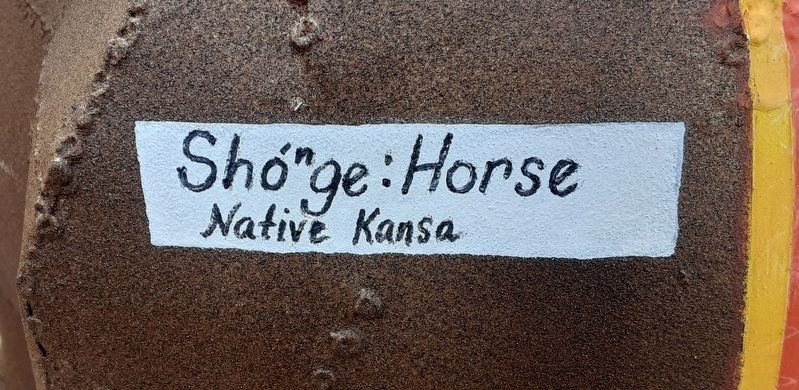
1. "Taming the West" Marker Detail
Shónge: Horse
Native Kansa
Erected by Leavenworth County Historical Society.
Topics. This historical marker is listed in these topic lists: Agriculture • Animals • Indigenous Peoples and Communities • Settlements & Settlers.
Location. 39° 19.108′ N, 94° 54.728′ W. Marker is in Leavenworth, Kansas, in Leavenworth County. It is at the intersection of Delaware Street and 3rd Street, on the left when traveling east on Delaware Street. Touch for map. Marker is at or near this postal address: 225 Delaware Street, Leavenworth KS 66048, United States of America. Touch for directions.

Regionally, this marker is in Eastern Kansas and specifically in Greater Kansas City. It is also in the American Midwest, in the Lewis & Clark Corridor, in the Corn Belt, on the prairies, and on the Southern Plains. Globally, it is in North America, the Western Hemisphere, the Western World, and the Anglosphere. Historically, it finds itself in what was once the Louisiana Purchase.
Other nearby markers. At least 8 other markers are within walking distance of
this page online
Regarding "Taming the West". Excerpt from the LCHS Spirit of the Buffalo Project website:
The Leavenworth County Historical Society proudly presents the "Spirit of the Buffalo" Community Art and History Project in Leavenworth County. The outdoor exhibit focuses on connecting residents and visitors to the region’s early history utilizing a hand-crafted metal sculpture of a buffalo.
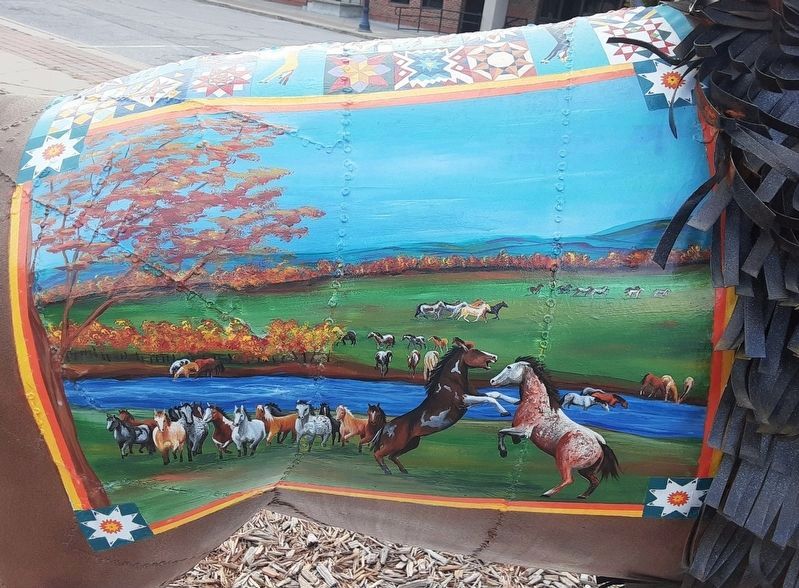
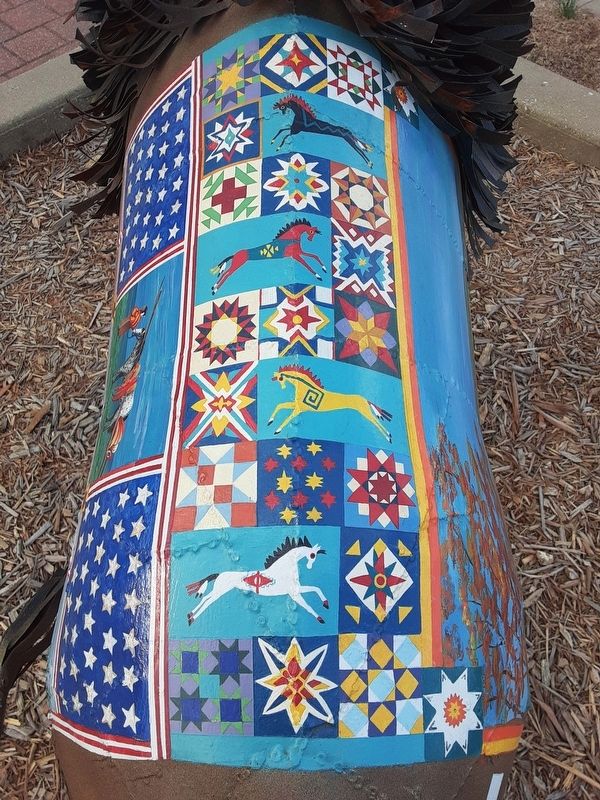
Local artist Teresa Tomrell traces the history of horses in Kansas with an intricate patchwork design. From their wild origins to their pivotal roles in transportation, hunting, and fieldwork, horses have been inextricably
Photographed by William Fischer, Jr., February 28, 2026
2. "Taming the West" Marker Mural
Wild herds roaming the Great Plains
Before Kansas was even a territory, the Plains Indians relied on dogs, using travois and carrying burdens themselves for movement and transport. However, the arrival of Spanish explorers like Francisco Vazquez de Coronado in the early 1500s marked a profound turning point, introducing Colonial Spanish horses to the North American plains. Native American groups, encountering horses for the first time, quickly acquired these animals through capture and trade, forever altering their culture and way of life. Horses revolutionized Native American mobility and hunting expeditions, providing unmatched speed and efficiency, especially in the pursuit of bison herds. This enhanced their economic opportunities and even led to a shift in social structures, with horse ownership becoming a measure of wealth and prestige.
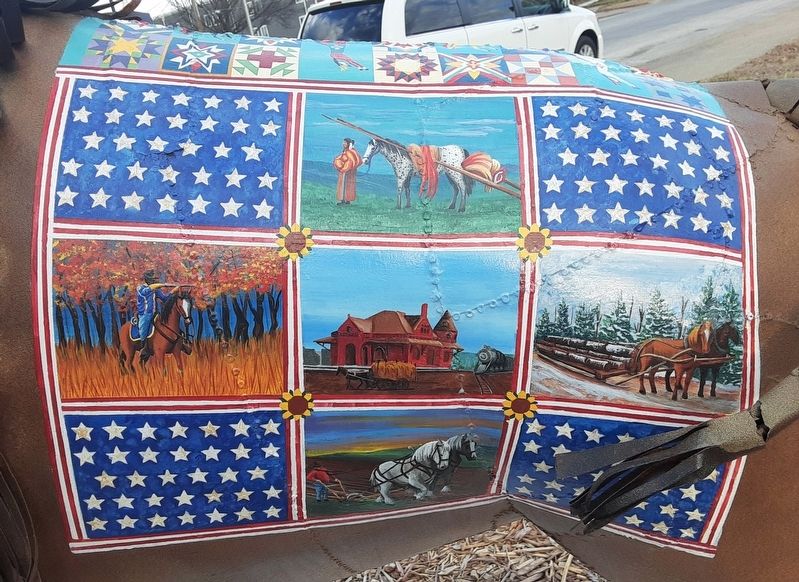
As European Americans pushed westward, horses were the primary means of swift travel and freight movement before the advent of railroads. Wagon caravans like those traversing the Santa Fe and Oregon Trails, relied on teams of horses, mules,
Photographed by William Fischer, Jr., February 28, 2026
3. "Taming the West" Marker Mural
Evolution of the use of horses on the Great Plains
Horses also played a vital role in agriculture, with draft horses rivaling oxen as the preferred animals for tasks like plowing and transporting goods. The legendary Pony Express, launched in 1860, further exemplified the power of horses, employing mustang ponies and skilled riders to rapidly deliver mail across nearly 2,000 miles, with horses being changed out every 10-15 miles to maintain speed.
The arrival of the railroad, dubbed the "iron horse" in Kansas and the West, gradually diminished the reliance on working horses for long-distance freight and passenger transport, but their importance for local transportation, ranching, and agriculture continued well into the 20th century. Horses served to establish the foundation for communities and economic development as an integral component in the lives of both Native American and pioneer settlers.
Also see . . . Horse Background and History (Theodore Roosevelt National Park).
Photographed by William Fischer, Jr., February 28, 2026
4. "Taming the West" Marker Mural
Photographed by William Fischer, Jr., February 28, 2026
5. "Taming the West" Marker
Photographed by William Fischer, Jr., February 28, 2026
6. "Taming the West" Marker
Credits. This page was last revised on March 6, 2026. It was originally submitted on March 6, 2026, by William Fischer, Jr. of Reynoldsburg, Ohio. This page has been viewed 47 times since then. Photos: 1, 2, 3, 4, 5, 6. submitted on March 6, 2026, by William Fischer, Jr. of Reynoldsburg, Ohio.
