Leavenworth in Leavenworth County, Kansas — The American Midwest (Upper Plains)
"Kansas Flag"
Spirit of the Buffalo Community Art & History Project
| — | Artist: Becky Gordon, Lansing | — |
Photographed by William Fischer, Jr., February 28, 2026
1. "Kansas Flag" Marker Mural
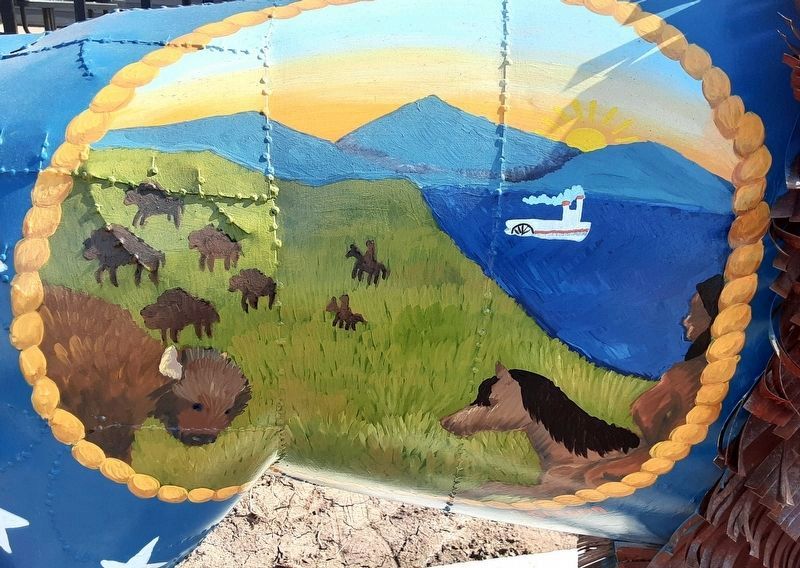
[Adaptation of symbols found in the Kansas State flag]
Topics. This historical marker is listed in these topic lists: Environment • Indigenous Peoples and Communities • Industry & Commerce • Settlements & Settlers.
Location. 39° 16.21′ N, 94° 53.978′ W. Marker is in Leavenworth, Kansas, in Leavenworth County. It is on 4th Street (U.S. 73) south of Commercial Street, on the left when traveling south. Touch for map. Marker is at or near this postal address: 4925 South 4th Street, Leavenworth KS 66048, United States of America. Touch for directions.

Regionally, this marker is in Eastern Kansas and specifically in Greater Kansas City. It is also in the American Midwest, in the Lewis & Clark Corridor, in the Corn Belt, on the prairies, and on the Southern Plains. Globally, it is in North America, the Western Hemisphere, the Western World, and the Anglosphere. Historically, it finds itself in what was once the Louisiana Purchase.
Other nearby markers. At least 8 other markers are within walking distance of this marker: Frontier Military Historic Byway
this page online
Regarding "Kansas Flag". Excerpt from the LCHS Spirit of the Buffalo Project website:
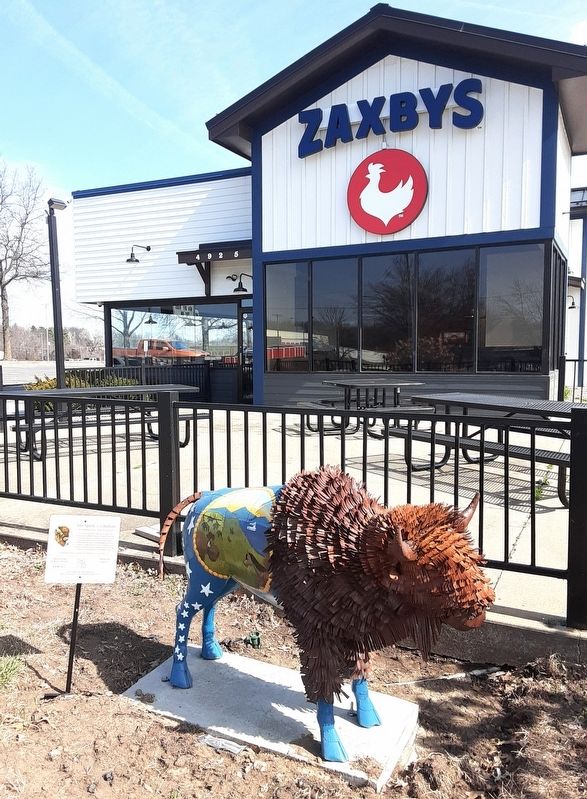
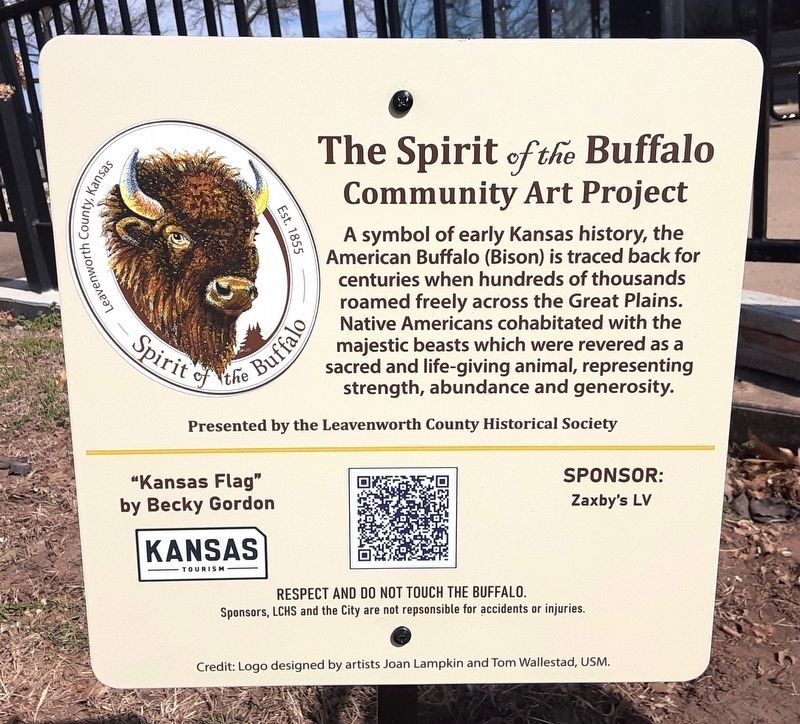
The Leavenworth County Historical Society is proud to present the “Spirit of the Buffalo” Community Art & History Project in Leavenworth County. The outdoor exhibit focuses on connecting residents and visitors to the region's early history, with an emphasis on Kansas Plains Natives, their co-habitation with the buffalo, and early settlement in the territory.
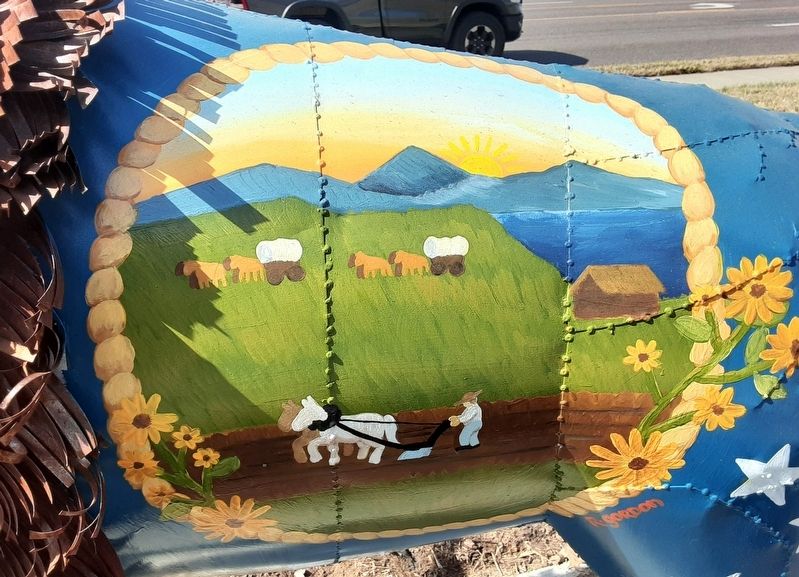
Local artist Becky Gordon chose as her design for this handcrafted metal sculpture, an adaptation of symbols found in the Kansas State flag. The intent of her design is
Photographed by William Fischer, Jr., February 28, 2026
2. "Kansas Flag" Marker Mural
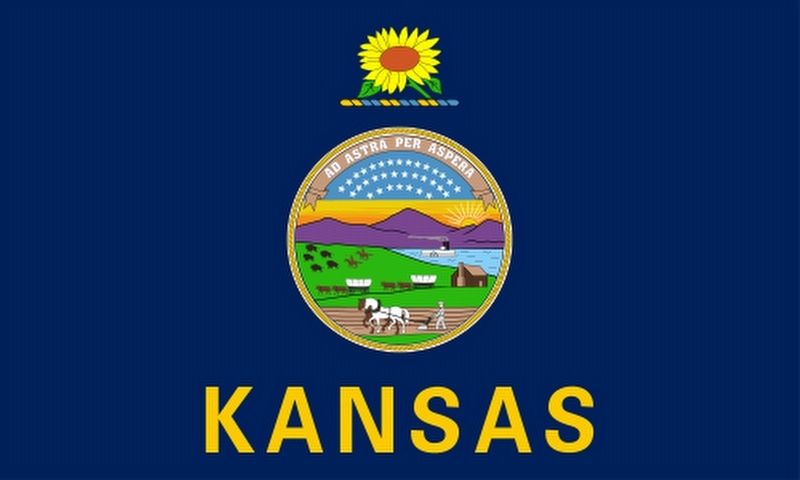
Back in 1916, a contest for a state flag was held but the winning design was not adopted. As a compromise, a state banner was adopted in 1925 and featured the state seal that had been adopted in 1861, surrounded by a sunflower, the state flower, and the word "Kansas" on a blue field. This banner was later rejected for display in Washington, D.C.
In 1925, a flag design was handcrafted by a young woman, Hazel Avery, who ran a dress shop in Lincoln, Kansas. When her appliqued flag was unfurled for Lincoln’s 1925 Fourth of July parade, residents were so impressed they showed it to their legislators. Her flag featured a dark blue background with the state seal in the center and the incorporation of symbols of Kansas –the state flower and 34 stars representing Kansas being the 34th state admitted to the union. This design was consequently adopted by the state legislature in 1927.
Images from the Seal of Kansas on the state flag were chosen by the artist to emphasize a Native American buffalo hunt, foreshadowing impending change. On the reverse side of the buffalo,
Photographed by William Fischer, Jr., February 28, 2026
3. "Kansas Flag" Marker
The sunflower, well represented here, became a significant symbol in the women's suffrage movement. It symbolizes the state’s agricultural heritage, frontier spirit, and the resilience of its people. During an 1867 campaign for women's suffrage, suffragists in Kansas adopted the sunflower as their emblem, and the color yellow (gold) became associated with the movement nationally. The overall design is completed with thirty-four stars cleverly sprinkled over the rear flank and legs of the buffalo.
By creating a historical tapestry, these scenes help viewers connect with the stories of the native tribes, pioneers, and other peoples who faced hardship and drove progress to build Leavenworth and Kansas. The legacy of their efforts is for all to appreciate.
Photographed by William Fischer, Jr.
4. Kansas State Flag
Photographed by William Fischer, Jr., February 28, 2026
5. “Spirit of the Buffalo” Community Art & History Project Sign
Credits. This page was last revised on March 7, 2026. It was originally submitted on March 7, 2026, by William Fischer, Jr. of Reynoldsburg, Ohio. This page has been viewed 41 times since then. Photos: 1, 2, 3, 4, 5. submitted on March 7, 2026, by William Fischer, Jr. of Reynoldsburg, Ohio.
