
College Point in Queens in Queens County, New York — The American Northeast (Mid-Atlantic)
Bringing Back Oysters
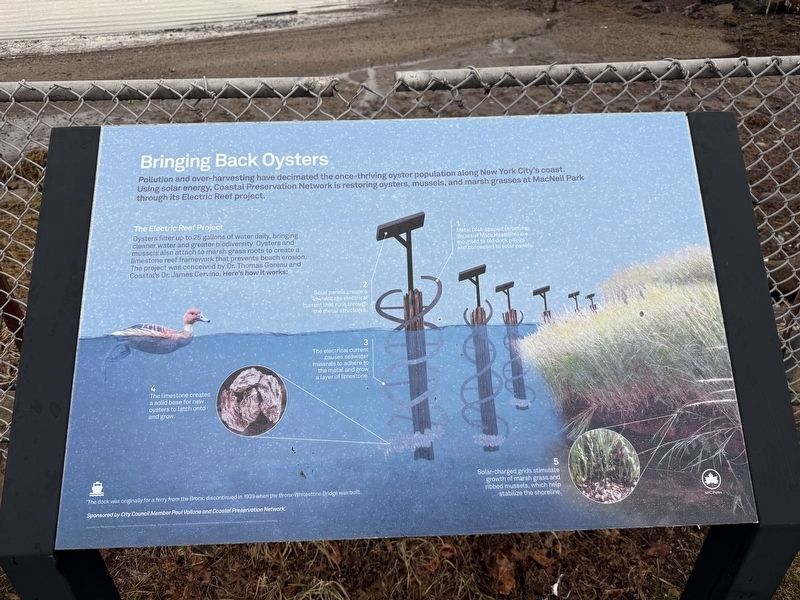
Pollution and over-harvesting have decimated the once-thriving oyster population along New York City's coast. Using solar energy, Coastal Preservation Network is restoring oysters, mussels, and marsh grasses at MacNeil Park through its Electric Reef project.
The Electric Reef Project
Oysters filter up to 25 gallons of water daily, bringing cleaner water and greater biodiversity. Oysters and mussels also attach to marsh grass roots to create a limestone reef framework that prevents beach erosion. The project was conceived by Dr. Thomas Goreau and Coastal's Dr. James Cervino. Here's how it works:
1 Metal DNA-shaped structures (by artist Mara Haseltine) are mounted to old dock pilings and connected to solar panels.
2 Solar panels create a low-voltage electrical current that runs through the metal structures.
3 The electrical current causes seawater minerals to adhere to the metal and grow a layer of limestone.
4 The limestone creates a sold base for new oysters to latch onto and grow.
5 Solar-charged grids stimulate growth of marsh grass and ribbed mussels, which helped stabilize the shoreline.
⛴️
*The dock was originally for a ferry from the Bronx, discontinued in 1939 when the Bronx-Whitestone Bridge was built.
Erected by NYC
this page online
Topics and series. This historical marker is listed in these topic lists: Animals • Bridges & Viaducts • Environment • Waterways & Vessels. In addition, it is included in the NYC Parks series list. A significant historical year for this entry is 1939.
Location. 40° 47.588′ N, 73° 50.935′ W. Marker is in Queens, New York, in Queens County. It is in College Point. It can be reached from Poppenhusen Avenue west of College Place, on the right when traveling west. Touch for map. Marker is at or near this postal address: 3-49A Park Cres, College Point NY 11356, United States of America. Touch for directions.

Regionally, this marker is in New York City and on Long Island. It is also in the American Northeast, in the Mid-Atlantic, and on the Eastern Seaboard. Globally, it is in the North Atlantic Region, North America, the Western Hemisphere, the Western World, and the Anglosphere. Historically, it finds itself in what was once New Netherland and also one of the original Thirteen Colonies.
Other nearby markers. At least 8 other markers are within 2 miles of this marker, measured as the crow flies: Hermon A. MacNeil Park
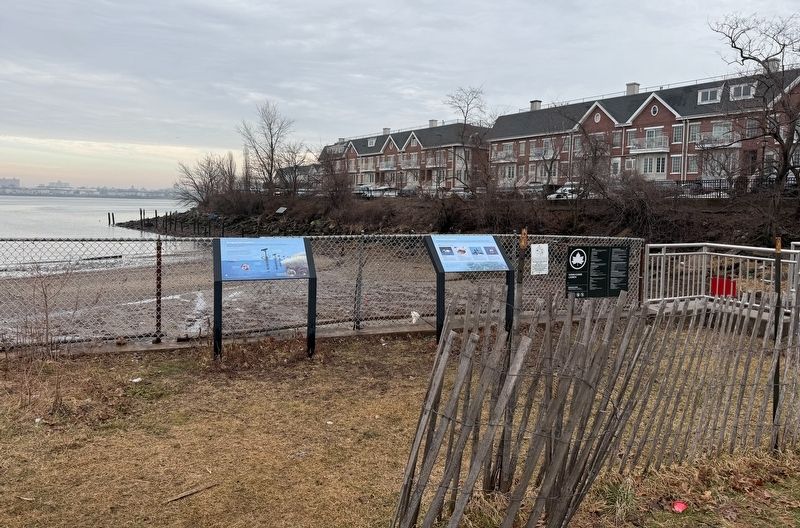

Photographed by Devry Becker Jones (CC0), March 8, 2026
3. Adjacent nature sign: Securing Our Coastline
The coastal wetlands at MacNeil Park are among the most important natural habitats in College Point, providing vital food and shelter to a wide range of seabirds and marine life. Wetlands also filter and trap pollution while buffering our coast from storms and erosion.
Can You Spot...
Great Egret
Ardea alba
These egrets wade through shallow water to hunt for fish, frogs, and other small aquatic animals. They typically watch for passing prey, then ambush their meal with a swift jab of their long necks and bills.
Horseshoe Crab
Limulus polyphemus
These ancient animals have been around for 300 million years. Their long, pointed tails may look intimidating but are harmless. Horseshoe crabs use their tails to right themselves if they flip onto their backs.
Double-crested Cormorant
Phalacrocorax auritus
Cormorants are expert fishers-their feathers absorb water instead of repelling it, allowing them to dive deeper to feed. You may see them with their wings spread out to dry, perched on pier pilings and jetties.
Mallard
Anas platyrhynchos
Male mallards have shiny green heads and yellow bills, while the females are typically brown and speckled. Listen for the female's standard quacking sound and the male's quiet, raspier call.
Coastal Preservation Network is a nonprofit dedicated to waterfront conservation in College Point. They help to preserve local wetlands by planting saltmarsh cordgrass, shown here, and cleaning the waterfront.
Can You Spot...
Great Egret
Ardea alba
These egrets wade through shallow water to hunt for fish, frogs, and other small aquatic animals. They typically watch for passing prey, then ambush their meal with a swift jab of their long necks and bills.
Horseshoe Crab
Limulus polyphemus
These ancient animals have been around for 300 million years. Their long, pointed tails may look intimidating but are harmless. Horseshoe crabs use their tails to right themselves if they flip onto their backs.
Double-crested Cormorant
Phalacrocorax auritus
Cormorants are expert fishers-their feathers absorb water instead of repelling it, allowing them to dive deeper to feed. You may see them with their wings spread out to dry, perched on pier pilings and jetties.
Mallard
Anas platyrhynchos
Male mallards have shiny green heads and yellow bills, while the females are typically brown and speckled. Listen for the female's standard quacking sound and the male's quiet, raspier call.
Coastal Preservation Network is a nonprofit dedicated to waterfront conservation in College Point. They help to preserve local wetlands by planting saltmarsh cordgrass, shown here, and cleaning the waterfront.
Credits. This page was last revised on March 9, 2026. It was originally submitted on March 9, 2026, by Devry Becker Jones of Washington, District of Columbia. This page has been viewed 12 times since then. Photos: 1, 2, 3. submitted on March 9, 2026, by Devry Becker Jones of Washington, District of Columbia.
