Coral Way in Miami in Miami-Dade County, Florida — The American South (South Atlantic)
Salvador Diaz-Verson
1905–1982
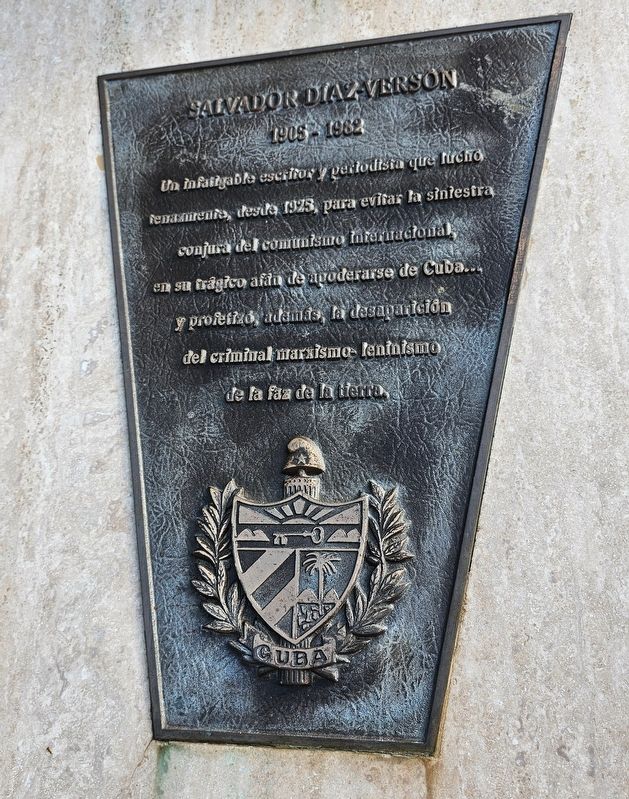
Photographed by Ian Lefkowitz, March 7, 2026
1. Salvador Diaz-Versón Marker

Un infatigable escritor y periodista que luchó tenazmente, desde 1925, para evitar la siniestra conjura del comunismo internacional, en su trágico afán de apoderarse de Cuba… y profetizó, además, la desaparición del criminal marxismo-leninismo de la faz de la tierra.
A tireless writer and journalist who fought tenaciously, since 1925, to prevent the sinister conspiracy of international communism, in its tragic desire to seize Cuba… and prophesied, moreover, of the disappearance of criminal Marxism-Leninism from the face of the earth.
Topics. This historical marker is listed in these topic lists: Government & Politics • Hispanic Americans • War, Cold. A significant historical year for this entry is 1925.
Location. 25° 45.752′ N, 80° 12.979′ W. Marker is in Miami, Florida, in Miami-Dade County. It is in Coral Way. It can be reached from Southwest 13th Avenue south of Southwest 11th Street. Touch for map. Marker is at or near this postal address: 1133 SW 13th Ave, Miami FL 33135, United States of America. Touch for directions.

Regionally, this marker is in South Florida
this page online
Other nearby markers. At least 8 other markers are within walking distance of this marker: Exiled Cuban Journalists Plaza (here, next to this marker); Al Martirologio del Presidio Político Cubano (a few steps from this marker); Cuban Anticommunist Political Prisoners' Plaza (a few steps from this marker); Lt. General Antonio Maceo Grajales Plaza (about 600 feet away, measured in a direct line); Operation Pedro Pan (about 600 feet away); Calle de las Presas Politicas Cubana (about 700 feet away); José Martí Plaza (about 700 feet away); Cruceiro Xacobeo Monument (approx. 0.2 miles away). Touch for a list and map of all markers in Miami.
Other markers no longer nearby. General Antonio Maceo (was about 600 feet away but

Photographed by Ian Lefkowitz, March 7, 2026
2. Salvador Diaz-Verson Marker
The plaque is located beneath a bust of Salvador Diaz-Verson. A separate marker nearby recognizes the work of exiled Cuban journalists, including that of Diaz-Verson.
Also see . . . When Castro Became a Communist: The Impact on U.S.-Cuba Policy.
Salvador Diaz-Verson was born in 1905 on November 3rd in Matanzas, Cuba, and became a journalist early in life immediately following the untimely death of his father in July of 1918. He began his newspaper career as a cub reporter working for El Imparcial later going on to write for the Heraldo de Cuba in 1921 and El Pais in 1930. Diaz-Verson dedicated himself to the study of communism and communist activities in the Americas. Shortly after the creation of the Communist Party (Popular Socialist Party - PSP), he founded the Anti-Communist League of Cuba which was inaugurated at the University of Havana on May 14, 1925. In 1934, he became Chief of the Cuban National Police. Throughout World War II, Diaz-Verson served as secretary of the Committee for the Defense of Democracy formally created in 1940...From 1948 until(Submitted on March 15, 2026, by Ian Lefkowitz of New York, New York.)March 10, 1952, he served as Cuba's Chief of Military Intelligence during the government of Dr. Carlos Prio Socarras (deposed by Batista in 1952). Beginning in May 1954, he participated in the First through Fourth Congress Against Soviet Intervention in Latin America and was present at the creation of the Inter-American Organization of Anti-Communist Newspapermen on April 10, 1957. Prior to Castro's takeover, while working for the newspaper Excelsior, Diaz-Verson also served as the organization's first president...While living in exile in Miami, Diaz-Verson was a frequent contributor to Diario de las Americas (Miami), La Nacion (Miami), The 20th of May (Los Angeles), La Tribuna (New Jersey), Hola (Spain), and La Cronica (Puerto Rico). Salvador Diaz-Verson died in exile in Miami on February 15, 1982.Photographed by Ian Lefkowitz, March 7, 20263. Cuban Exiled Journalists PlazaA 2025 redesign dedicated this monument and location to exiled Cuban journalists.

Credits. This page was last revised on March 17, 2026. It was originally submitted on March 15, 2026, by Ian Lefkowitz of New York, New York. This page has been viewed 25 times since then. Photos: 1, 2, 3. submitted on March 15, 2026, by Ian Lefkowitz of New York, New York. • Devry Becker Jones was the editor who published this page.
