Little Havana in Miami in Miami-Dade County, Florida — The American South (South Atlantic)
Plaza de la Cubanidad
Photographed by Ian Lefkowitz, March 7, 2026
1. Plaza de la Cubanidad Marker

[English:]
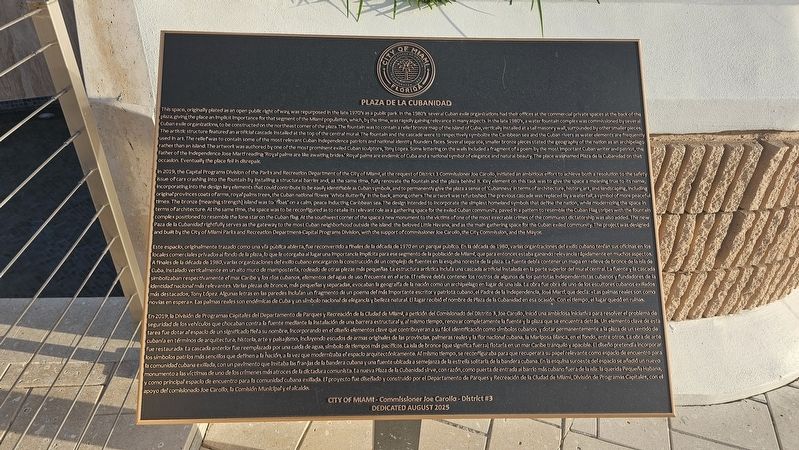
This space, originally plated as an open public right of way, was repurposed in the late 1970’s as a public park. In the 1980’s several Cuban exile organizations had their offices at the commercial private spaces at the back of the plaza, giving the place an implicit importance for that segment of the Miami population, which, by the time, was rapidly gaining relevance in many aspects. In the late 1980’s, a water fountain complex was commissioned by several Cuban exile organizations, to be constructed on the northeast corner of the plaza. The fountain was to contain a relief bronze map of the island of Cuba, vertically installed at a tall masonry wall, surrounded by other smaller pieces. The artistic structure featured an artificial cascade installed at the top of the central mural. The fountain and the cascade were to respectively symbolize the Caribbean sea and the Cuban rivers as water elements are frequently used in art. The relief was to contain some of the most relevant Cuban independence patriots and national identity founders faces. Several separate, smaller bronze pieces stated the geography
this page online
In 2019, the Capital Programs Division of the Parks and Recreation Department of the City of Miami, at the request of District 3 Commissioner Joe Carollo, initiated an ambitious effort to achieve both a resolution to the safety issue of cars crashing into the fountain by installing a structural barrier and, at the same time, fully renovate the fountain and the plaza behind it. Key element on this task was to give the space a meaning true to its name, incorporating into the design key elements that could contribute to be easily identifiable as Cuban symbols, and to permanently give the plaza a sense of ‘Cubanness’

Photographed by Ian Lefkowitz, March 7, 2026
2. Plaza de la Cubanidad
The plaza's centerpiece, created by Cuban-American sculptor Tony Lopez.

Photographed by Ian Lefkowitz, March 7, 2026
3. Plaza de la Cubanidad Marker
A view of the plaza from across the street. The marker can be seen from Flagler Street, located next to the monument.
Este espacio, originalmente trazado como una vía pública abierta, fue reconvertido a finales de la década de 1970 en un parque público. En la década de 1980, varias organizaciones del exilio cubano tenían sus oficinas en los locales comerciales privados al fondo de la plaza, lo que le otorgaba al lugar una importancia implícita a ese segmento de la población de Miami, que para entonces estaba ganando relevancia rápidamente en muchos aspectos. A finales de la década de 1980, varias organizaciones del exilio cubano encargaron la construcción de un complejo de fuentes en la esquina noreste de la plaza. La fuente debía contener un mapa en relieve de bronce de la isla de Cuba, instalado verticalmente en un alto muro de mampostería, rodeado de otras piezas más pequeñas. La estructura artística incluía una cascada artificial instalada en la parte superior del mural central. La fuente y la cascada simbolizaban respectivamente

Photographed by Ian Lefkowitz, March 7, 2026
4. Plaza de la Cubanidad Marker
The marker as seen from Flagler Street facing NW 17th Ave.
En 2019, la División de Programas Capitales del Departamento de Parques y Recreación de la Ciudad de Miami, a petición del Comisionado del Distrito 3, Joe Carollo, inició una ambiciosa iniciativa para resolver el problema de la seguridad de los vehículos que chocaban contra la fuente mediante la instalación de una barrera estructural y, al mismo tiempo, renovar completamente la fuente y la plaza que se encuentra detrás. Un elemento clave de esta tarea fue dotar al espacio de un significado fiel a su nombre, incorporando en el diseño elementos clave que contribuyeran a su fácil identificación como símbolos cubanos, y dotar permanentemente a la plaza de un sentido de cubanía en términos de arquitectura, historia, arte y paisajismo, incluyendo escudos de armas originales de las provincias, palmeras reales y la flor nacional cubana, la Mariposa Blanca, en el fondo, entre otros. La obra de arte fue restaurada. La cascada anterior fue reemplazada por una caída de agua, símbolo de tiempos más pacíficos. La isla de bronce (que significa fuerza) flotaría en un mar Caribe tranquilo y apacible. El diseño pretendía incorporar los símbolos patrios más sencillos que definen a la nación, a la vez que modernizaba el espacio arquitectónicamente. Al mismo tiempo, se reconfiguraba para que recuperara su papel relevante como espacio de encuentro para la comunidad cubana exiliada, con un pavimento que imitaba las franjas de la bandera cubana y una fuente ubicada a semejanza de la estrella solitaria de la bandera cubana. En la esquina suroeste del espacio se añadió un nuevo monumento a las víctimas de uno de los crímenes más atroces de la dictadura comunista. La nueva Plaza de la Cubanidad sirve, con razón, como puerta de entrada al barrio más cubano fuera de la isla: la querida Pequeña Habana, y como principal espacio de encuentro para la comunidad cubana exiliada. El proyecto fue diseñado y construido por el Departamento de Parques y Recreación de la Ciudad de Miami, División de Programas Capitales, con el apoyo del comisionado Joe Carollo, la Comisión Municipal y el alcalde.
Erected 2025 by The City of Miami.
Topics. This historical marker is listed in these topic lists: Hispanic Americans • Parks & Recreational Areas. A significant historical year for this entry is 2019.
Location. 25° 46.378′ N, 80° 13.381′ W. Marker is in Miami, Florida, in Miami-Dade County. It is in Little Havana. It is at the intersection of West Flagler Street and Northwest 17th Avenue, on the right when traveling east on West Flagler Street. Touch for map. Marker is at or near this postal address: 1700 W Flagler St, Miami FL 33135, United States of America. Touch for directions.

Regionally, this marker is in South Florida and on the Gold Coast. It is also in the American South and on the Eastern Seaboard. Globally, it is in the North Atlantic Region, North America, a Gulf of Mexico state, the Western Hemisphere, the Western World, and the Anglosphere. Historically, it finds itself in what was once New Spain, the territory of the Mississippian Culture, one of the Confederate States of America, and the Antebellum South.
Other nearby markers. At least 8 other markers are within walking distance of this marker: General Máximo Gómez (approx. 0.6 miles away); Little Havana Honors Our Veterans (approx. 0.6 miles away); Impact of the "Bay of Pigs" on Miami (approx. 0.6 miles away); Impact of the Bay of Pigs Invasion in Miami (approx. 0.6 miles away); Bay of Pigs Monument (approx. 0.7 miles away); A la lucha guerrillera anticomunista / To the Anti-Communist Guerrilla (approx. 0.7 miles away); Nestor Izquierdo Plaza (approx. 0.7 miles away); Cruceiro Xacobeo Monument (approx. 0.7 miles away). Touch for a list and map of all markers in Miami.
Another marker is no longer nearby. Nestor A. Izquierdo (was approx. 0.7 miles away but has been permanently removed).
Credits. This page was last revised on March 16, 2026. It was originally submitted on March 15, 2026, by Ian Lefkowitz of New York, New York. This page has been viewed 38 times since then. Photos: 1, 2, 3, 4. submitted on March 15, 2026, by Ian Lefkowitz of New York, New York. • Devry Becker Jones was the editor who published this page.
