Welcome to El Valle de San Luis
— The San Luis Valley —
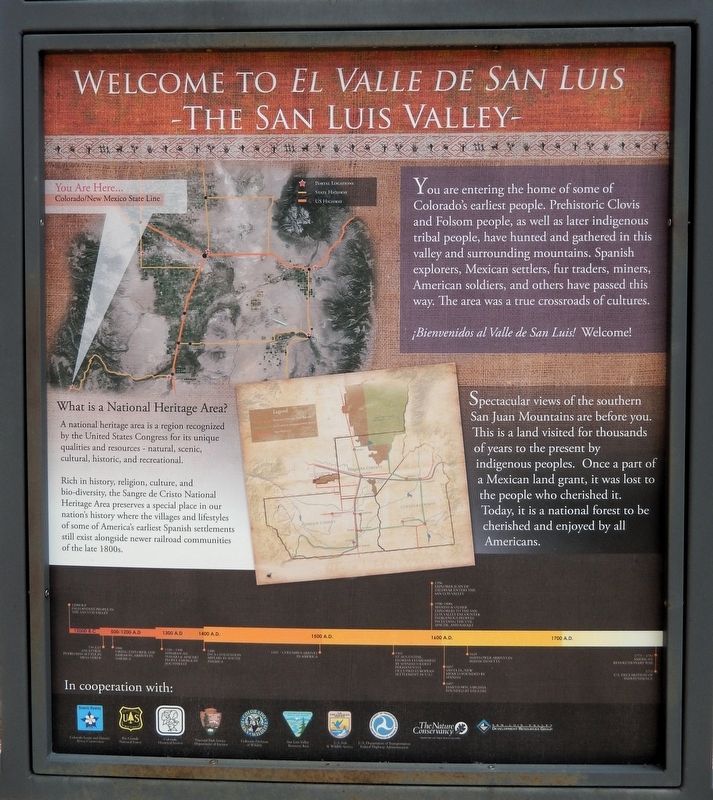
What is a National Heritage Area?
A national heritage area is a region recognized by the United States Congress for its unique qualities and resources — natural, scenic, cultural, historic, and recreational.
Rich in history, religion, culture, and bio-diversity, the Sangre de Cristo National Heritage Area preserves a special place in our nation's history where the villages and lifestyles of some of America's earliest Spanish settlements still exist alongside newer railroad communities of the late 1800s.
You are entering the home of some of Colorado's earliest people. Prehistoric Clovis and Folsom people, as well as later indigenous tribal people, have hunted and gathered in this valley and surrounding mountains. Spanish explorers, Mexican settlers, fur traders, miners, American soldiers, and others have passed this way. The area was a true crossroads of cultures.
¡Bienvenidos al Valle de San Luis! Welcome!
Spectacular views of the southern San Juan Mountains are before you. This is a land visited for thousands of years to the present by indigenous peoples. Once a part of a Mexican land grant, it was lost to the people who
this page online
Timeline [across bottom of the interpretive panel]
12000 B.C. • Paleoindian people in the San Luis Valley
550 A.D. • Ancestral Puebloans settle in Mesa Verde
1000 • Viking explorer, Leif Eriksson, arrives in America
1350-1500 • Athabascan (Navajo & Apache) people emerge in Southwest
1400 • Inca civilization appears in South America
1492 • Columbus arrives in America
1565 • St. Augustine, Florida established by Spanish (oldest permanently occupied European settlement in U.S.)
1596 • Explorer Juan de Zaldívar enters the San Luis Valley
1596-1800s • Spanish & other explorers to the San Luis Valley encounter indigenous peoples including the Ute, Apache, and Navajo
1607 • Santa Fe, New Mexico founded by Spanish
1607 • Jamestown, Virginia founded by English
1620 • Mayflower arrives in Massachusetts
1775-1783 • American Revolutionary War
1776 • U.S. Declaration of Independence
Erected by Colorado Scenic and Historic Byways Commission, Colorado Historical Society, Colorado Department of Transportation, and The Nature Conservancy.
Topics. This historical
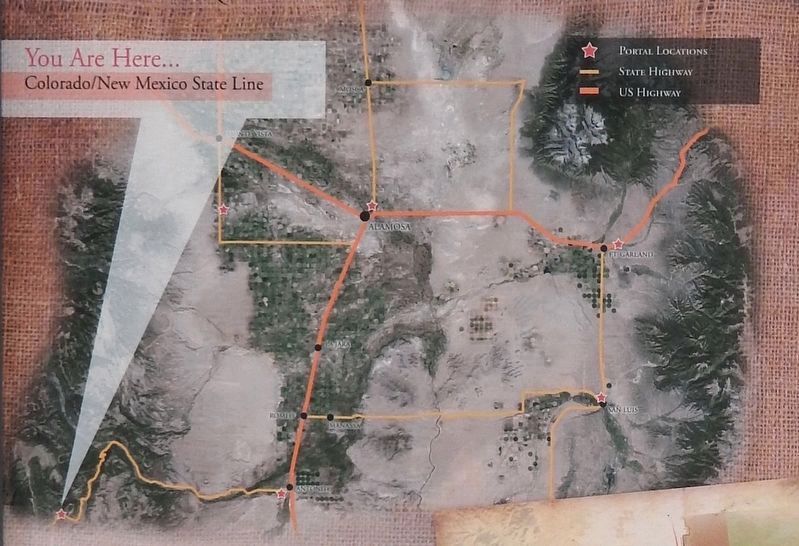
Location. 36° 59.948′ N, 106° 29.422′ W. Marker is near Antonito, Colorado, in Archuleta County. It is on State Highway 17 at milepost 0.7, on the right when traveling north. The marker is 0.7 miles north of the Colorado/New Mexico state line. Touch for map. Marker is in this post office area: Antonito CO 81120, United States of America. Touch for directions.

Regionally, this marker is on the Continental Divide. It is also in the American Mountain West and at the Four Corners. Globally, it is in North America, the Rocky Mountains, the Western Hemisphere, the Western World, and the Anglosphere. Historically, it finds itself in what was once the territory of the Ancestral Puebloans.
Other nearby markers. At least 8 other markers are within 4 miles of this marker, measured as the crow flies: This is Our land (here, next to this marker); Nurturing Forest (here, next to this marker); Who Owns This Land? (here, next to this marker); Cumbres Pass (approx.
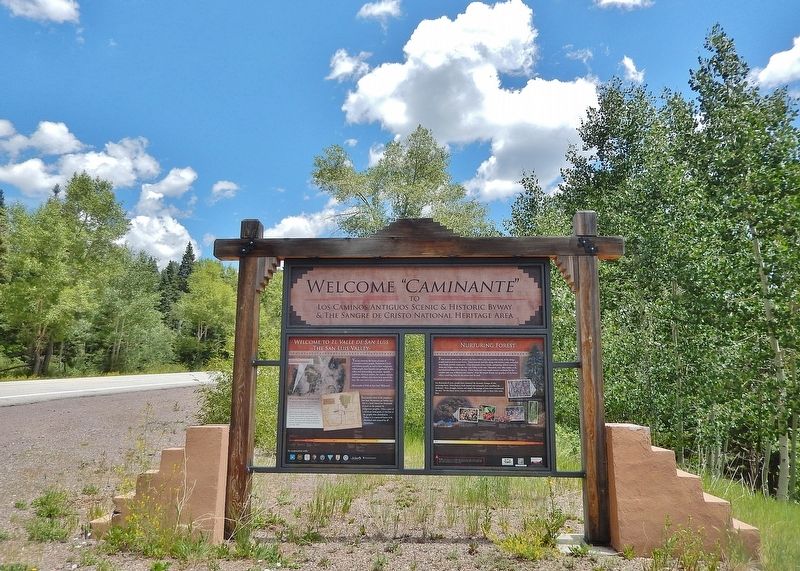
This marker is the leftmost of two interpretive panels on the south side of the Los Caminos Antiguos Scenic & Historic Byway kiosk just north of the Colorado/New Mexico state line.
Looking north; Colorado Highway 17 is on the left.
Also see . . .
1. Sangre de Cristo National Heritage Area.
Excerpt: With 11,000 years of documented human habitation, the Sangre de Cristo National Heritage Area is a crossroads of the centuries. Here a unique blend of Native American, Hispano and Anglo settlement is reflected in the diversity of the people, art and traditions. The geographic isolation of our high desert valley and the peoples’ enduring ties to the land have given rise to a rich cultural heritage and ensured its preservation. Interwoven with the Valley’s natural history is a very long and rich human history. The San Luis Valley served prehistoric and Native American cultures as a seasonal hunting ground where fowl, game, and edible and medicinal plants were bountiful.(Submitted on March 19, 2026, by Cosmos Mariner of Cape Canaveral, Florida.)The San Luis Valley is a place where different peoples have converged for thousands of years.
The Valley’s profound historical, religious, and cultural convergence remains visible in the landscape and can be experienced in its communities, art, food, lodging, and events.
2. Land grants in New Mexico and Colorado (Wikipedia).
Excerpt: Land grants in New Mexico and Colorado were awarded to individuals and communities by the Spanish and Mexican governments to encourage settlement and expansion of the Territorio de Nuevo Mexico, which included southern Colorado. Land grants by the Spanish and Mexicans between 1692 and 1846 numbered 291 in New Mexico, four partly in New Mexico and partly in Colorado, and three in Colorado. The land area of grants totaled tens of thousands of square miles. The two major types of land grants were private grants made to individuals, and communal grants made to groups of people for the purpose of establishing settlements. Communal land grants were also made to Pueblos for the lands they inhabited. The principal objectives of the land grants were to encourage the foundation of new communities and to expand the settled area on the frontiers of New Mexico for defense from Native American raids.(Submitted on March 19, 2026, by Cosmos Mariner of Cape Canaveral, Florida.)After its conquest of New Mexico in 1846, the United States adjudicated the grants and confirmed 157 as valid. The peace treaty between the U.S. and Mexico in 1848 guaranteed the right of former Mexican citizens to their land, but the adherence to that language was inconsistent and compromised by U.S. legal actions which were often corrupt and biased in favor of White claimants and White land practices. By the early 20th century, the Hispano grantees and their descendants had lost a large percentage of the grant land to Whites and public domain national forests. Hispano protests, legal action, and occasional violence to regain or retain their traditional rights to usage of grant lands continued into the 21st century.
Credits. This page was last revised on March 19, 2026. It was originally submitted on March 18, 2026, by Cosmos Mariner of Cape Canaveral, Florida. This page has been viewed 24 times since then. Photos: 1, 2, 3. submitted on March 19, 2026, by Cosmos Mariner of Cape Canaveral, Florida.
