Downtown in Cleveland in Cuyahoga County, Ohio — The American Midwest (Great Lakes)
Erie Street Cemetery
Photographed by Mike Wintermantel, April 12, 2017
1. Erie Street Cemetery Marker
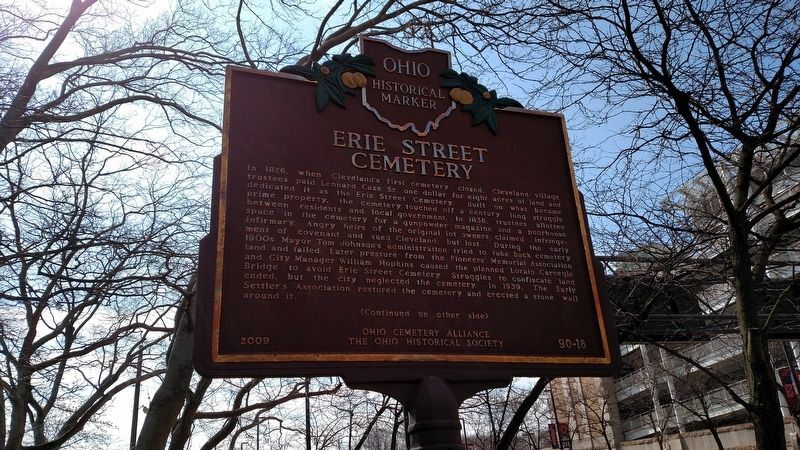
In 1826, when Cleveland's first cemetery closed, Cleveland village trustees paid Leonard Case Sr. one dollar for eight acres of land and dedicated it as the Erie Street Cemetery. Built on what became prime property, the cemetery touched off a century long struggle between residents and local government. In 1836, trustees allotted space in the cemetery for a gunpowder magazine and a poorhouse infirmary. Angry heirs of the original lot owners claimed infringement of covenant and sued Cleveland, but lost. During the early 1900s Mayor Tom Johnson's administration tried to take back cemetery land and failed. Later pressure from the Pioneers' Memorial Association and City Manager William Hopkins caused the planned Lorain Carnegie Bridge to avoid Erie Street Cemetery. Struggles to confiscate land ended, but the city neglected the cemetery. In 1939, The Early Settler's Association restored the cemetery and erected a stone wall around it.
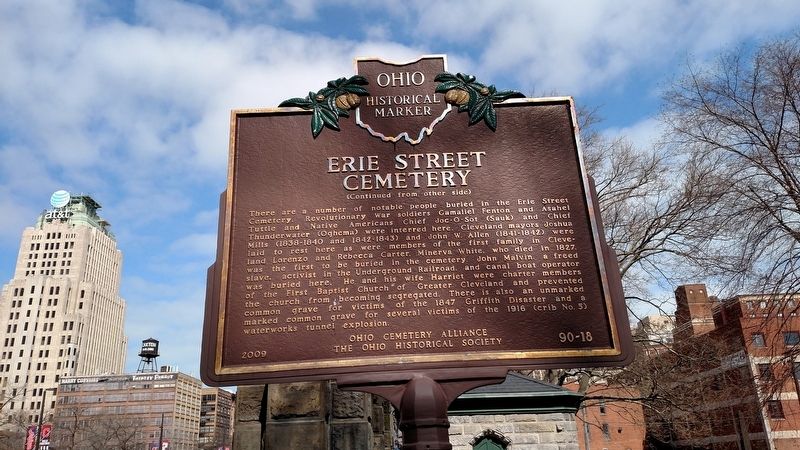
There are a number of notable people buried in the Erie Street Cemetery. Revolutionary War soldiers Gamaliel Fenton and Asahel Tuttle and Native Americans Chief Joc-O-Sot (Sauk) and Chief
this page online
Erected 2009 by Ohio Cemetery Alliance, The Ohio Historical Society. (Marker Number 90-18.)
Topics and series. This historical marker is listed in these topic lists: Cemeteries & Burial Sites • Indigenous Peoples and Communities • War, US Revolutionary. In addition, it is included in the Ohio Historical Society / The Ohio History Connection series list. A significant historical year for this entry is 1826.
Location. 41° 29.811′ N,
Photographed by Mike Wintermantel, April 12, 2017
2. Erie Street Cemetery Marker

Regionally, this marker is on the Lake Erie Shore and in the Western Reserve. It is also in the American Midwest. Globally, it is in North America, on the Great Lakes, in the Western Hemisphere, in the Western World, and in the Anglosphere. Historically, it finds itself in what was once the Haudenosaunee (Iroquois) Confederacy, the territory of the Mississippian Culture, and the Northwest Territory.
Other nearby markers. At least 8 other markers are within walking distance of this marker: Lorenzo and Rebecca Carter (within shouting distance of this marker); Unknown Early Settlers (within shouting distance of this marker); 1997 American League Champions (within shouting distance of this marker); Gamaliel Fenton (within shouting distance of this marker); Manny vs. Eckersley = Wow! (within shouting distance of this marker); Alomar Saves Season (within
Photographed by Mike Wintermantel, April 12, 2017
3. Erie Street Cemetery
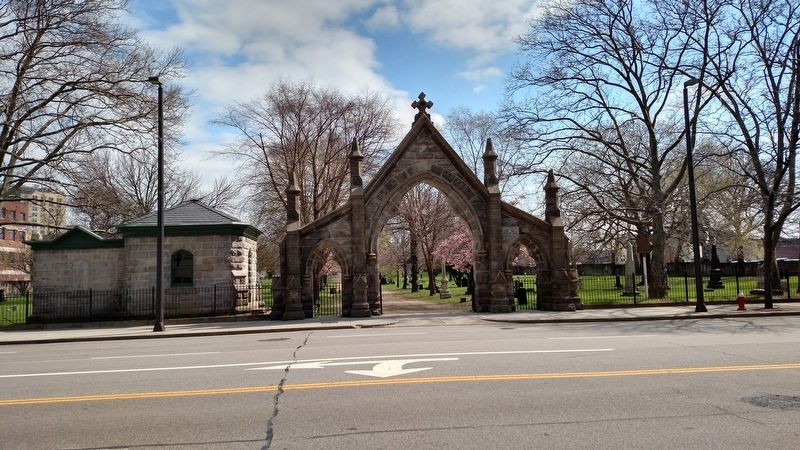
Marker is to the right of the gate
Photographed by Craig Doda, March 7, 2026
4. Erie Street Cemetery Marker
Credits. This page was last revised on March 31, 2026. It was originally submitted on April 12, 2017, by Mike Wintermantel of Pittsburgh, Pennsylvania. This page has been viewed 936 times since then and 119 times this year. Last updated on March 22, 2026, by Craig Doda of Napoleon, Ohio. Photos: 1, 2, 3. submitted on April 12, 2017, by Mike Wintermantel of Pittsburgh, Pennsylvania. 4. submitted on March 22, 2026, by Craig Doda of Napoleon, Ohio. • Devry Becker Jones was the editor who published this page.
