
Wessagusset in Weymouth in Norfolk County, Massachusetts — The American Northeast (New England)
The Incorporation of Weymouth
Wessagusset Historic Woodlot
Photographed by G.W.Bartlett
1. The Incorporation of Weymouth Marker
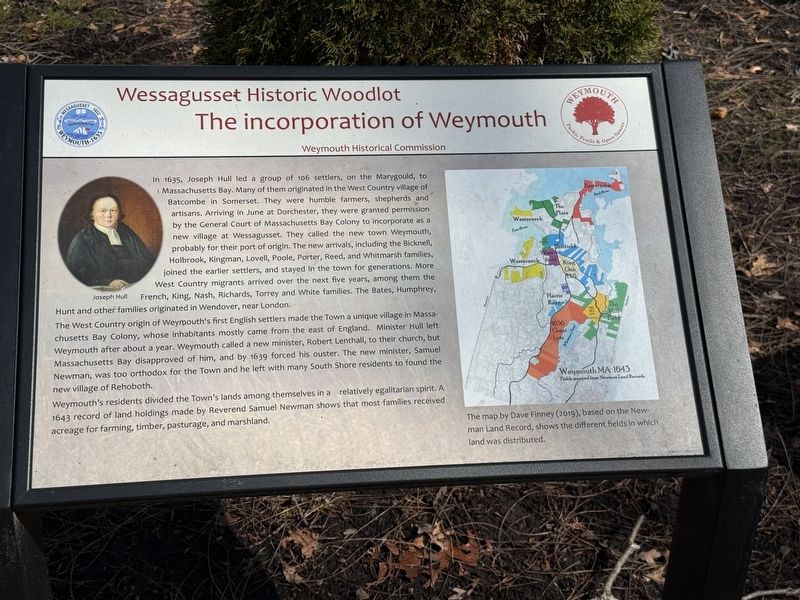
In 1635, Joseph Hull led a group of 106 settlers, on the Marygould, to Massachusetts Bay. Many of them originated in the West Country village of Batcombe in Somerset. They were humble farmers, shepherds and artisans. Arriving in June at Dorchester, they were granted permission by the General Court of Massachusetts Bay Colony to incorporate as a new village at Wessagusset. They called the new town Weymouth, probably for their port of origin. The new arrivals, including the Bicknell, Holbrook, Kingman, Lovell, Poole, Porter, Reed and Whitmarsh families, joined the earlier settlers and stayed in the town for generations. More West Country migrants arrived over the next five years, among them the French, King, Nash, Richards, Torrey and White families. The Bates, Humphrey, Hunt and other families originated in Wendover, near London.
The West Country origin of Weymouth's first English settlers made the Town a unique village in Massachusetts Bay Colony, whose inhabitants mostly came from the east of England. Minister Hull left Weymouth after about a year. Weymouth called a new minister, Robert Lenthall, to their church,
this page online
Weymouth's residence divided the Town's lands among themselves in a relatively egalitarian spirit. A 1643 record of land holdings made by Reverend Samuel Newman shows that most familied received acreage for farming, timber, pasturage and marshland. The may by Dave Finney (2019), based on the Newman Land Record, shows the different fields in which land was distributed.
Erected 2001 by Weymouth Historical Commission.
Topics. This historical marker is listed in these topic lists: Colonial Era • Parks & Recreational Areas • Settlements & Settlers. A significant historical year for this entry is 1635.
Location. 42° 14.793′ N, 70° 57.177′ W. Marker is in Weymouth, Massachusetts, in Norfolk County. It is in Wessagusset. It is at the intersection of Sea Street and Willow Avenue, on the left when traveling north on Sea Street. Touch for map. Marker is in this post office area: North Weymouth MA 02191, United
Photographed by G.W.Bartlett, April 5, 2026
2. The Incorporation of Weymouth Marker (wide)

Regionally, this marker is in Greater Boston. It is also in the American Northeast, in New England, and on the Eastern Seaboard. Globally, it is in the North Atlantic Region, North America, the Western Hemisphere, the Western World, and the Anglosphere. Historically, it finds itself in what was once one of the original Thirteen Colonies.
Other nearby markers. At least 8 other markers are within walking distance of this marker: First English Settlement (here, next to this marker); Puddingstone Memorials (a few steps from this marker); The Massachusett Tribe (a few steps from this marker); Settlement of Weymouth (approx. 0.6 miles away); Abigail Adams to John Adams, August 14, 1776 (approx. 0.8 miles away); Abigail Adams to John Adams, July 21, 1776 (approx. 0.9 miles away); Abigail Adams to John Adams, July 14, 1776 (approx. 0.9 miles away); Abigail Adams to John Adams, August 29, 1776 (approx. 0.9 miles away). Touch for a list and map of all markers in Weymouth.
Also see . . . Wessagussett Wetland and Woodland - Historic Conservation Site.
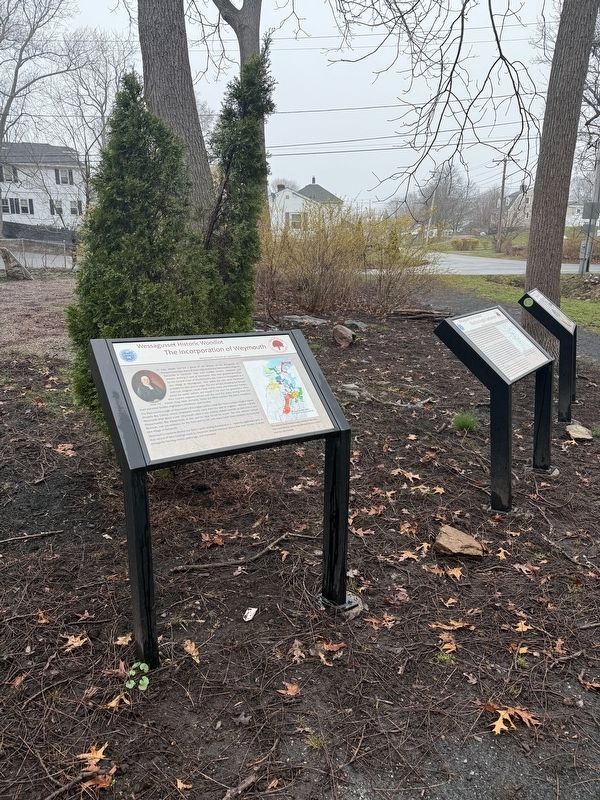
The Wessagusset Wetland and(Submitted on March 25, 2026, by G.W.Bartlett of Hingham, Massachusetts.)Woodland is a small historic site with a grassy area and short woodland trails, located in a neighborhood setting in North Weymouth. Interpretive signage shares Native American and Colonial history.Photographed by G.W.Bartlett, April 5, 20263. Historic Woodlot & Markers from Sea Street

Credits. This page was last revised on April 9, 2026. It was originally submitted on March 25, 2026, by G.W.Bartlett of Hingham, Massachusetts. This page has been viewed 15 times since then. Photos: 1. submitted on March 25, 2026, by G.W.Bartlett of Hingham, Massachusetts. 2, 3. submitted on April 5, 2026, by G.W.Bartlett of Hingham, Massachusetts. • Michael Herrick was the editor who published this page.
