
Brewery District in Columbus in Franklin County, Ohio — The American Midwest (Great Lakes)
A Hive's Lifecycle
exploring the nature of change
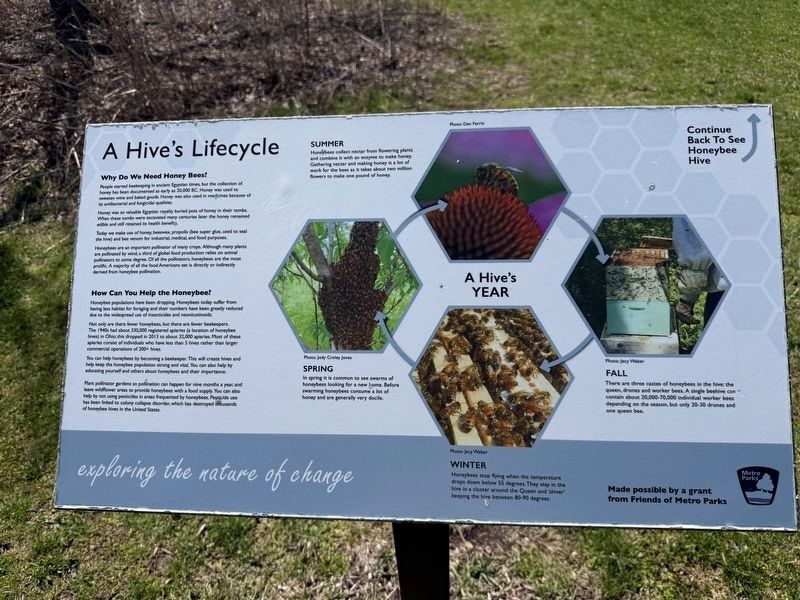
Why Do We Need Honey Bees?
People started beekeeping in ancient Egyptian times, but the collection of honey has been deocuemnted as early as 20,000 BC. Honey was used to sweeten wine and baked goods. Honey was also used in medicines because of its antibacterial and fungicidal qualities.
Honey was so valuable Egyptian royalty buried pots of honey in their tombs. When these tombs were excavated many centuries later the honey remained edible and still retained its health benefits.
Today we make use of honey, beeswax, propolis (bee super glue, used to seal the hive) and bee venom for industrial, medical, and food purposes.
Honeybees are an important pollinator of many crops. Although many plants are pollinated by wind, a third of global food production relies on animal pollinators to some degree. Of all the pollinators, honeybees are the most prolific. A majority of all the food Americans eat is directly or indirectly derived from honeybee pollination.
How Can You Help the Honeybee?
Honeybee populations have been dropping. Honeybees today suffer from having less habitat for foraging and their numbers have been
this page online
Not only are there fewer honeybees, but there are fewer beekeepers. The 1940s had about 330,000 registered apiaries (a location of honeybee hives) in Ohio; this dropped in 2013 to about 32,000 apiaries. Most of these apiaries consist of individuals who have less than 5 hives rather than larger commercial operations of 200+ hives.
You can help honeybees by becoming a beekeeper. This will create hives and help keep the honeybee population strong and vital. You can also help by educating yourself and others about honeybees and their importance.
Plant pollinator gardens so pollination can happen for nine months a year, and leave wildflower areas to provide honeybees with a food supply. You can also help by not using pesticides in areas frequented by honeybees. Pesticide use has been linked to colony collapse disorder, which has destroyed thousands of honeybee hives in the United States.
Honeybees collect nectar from flowering plants and combine it with an enzyme to make honey. Gathering nectar and making honey is a lot of work
Fall
There are three castes of honeybees in the hive: the queen, drones, and worker bees. A single hive can contain about 20,000-70,000 individual worker bees depending on the season, but only 20-30 drones and one queen bee.
Winter
Honeybees stop flying when the temperature drops down below 55 degrees. They stay in the hive in a cluster around the Queen and 'shiver' keeping the hive between 80-90 degrees.
Spring
In spring it is common to see swarms of honeybees looking for a new home. Before swarming honeybees consume a lot of honey and are generally very docile.
Erected by Friends of Metro Parks.
Topics. This historical marker is listed in these topic lists: Animals • Anthropology & Archaeology • Environment. A significant historical year for this entry is 2013.
Location. 39° 56.821′ N, 83° 0.662′ W. Marker is in Columbus, Ohio, in Franklin County. It is in the Brewery District. It can be reached from Lower Scioto Greenway west of West Whittier Street, on the right when traveling west. Touch for map. Marker is at or near this postal address: Lower Scioto Greenway, Columbus OH 43215, United States of America. Touch for directions.

Regionally, this marker is in Ohio’s Scioto Valley. It is also in the American Midwest and in the Corn Belt. Globally, it is in North America, the Western Hemisphere, the Western World, and the Anglosphere. Historically, it finds itself in what was once the Haudenosaunee (Iroquois) Confederacy, the territory of the Mississippian Culture, and the Northwest Territory.
Other nearby markers. At least 8 other markers are within walking distance of this marker: Heather’s Tree (about 300 feet away, measured in a direct line); An Ecological Restoration Story (about 600 feet away); Columbus Civic Center Historic District (approx. 0.6 miles away); The Main Street Bridge (approx. 0.7 miles away); a different marker also named The Main Street Bridge (approx. 0.7 miles away); a different marker also named The Main Street Bridge (approx. 0.7 miles away); Trinity Lutheran Seminary (approx. 0.7 miles away); Columbus Feeder Canal / The Ohio-Erie Canal (approx. 0.7 miles away). Touch for a list and map of all markers in Columbus.
Credits. This page was last revised on March 30, 2026. It was originally submitted on March 30, 2026, by Devry Becker Jones of Washington, District of Columbia. This page has been viewed 5 times since then. Photos: 1, 2. submitted on March 30, 2026, by Devry Becker Jones of Washington, District of Columbia.
