Downtown in Columbus in Franklin County, Ohio — The American Midwest (Great Lakes)
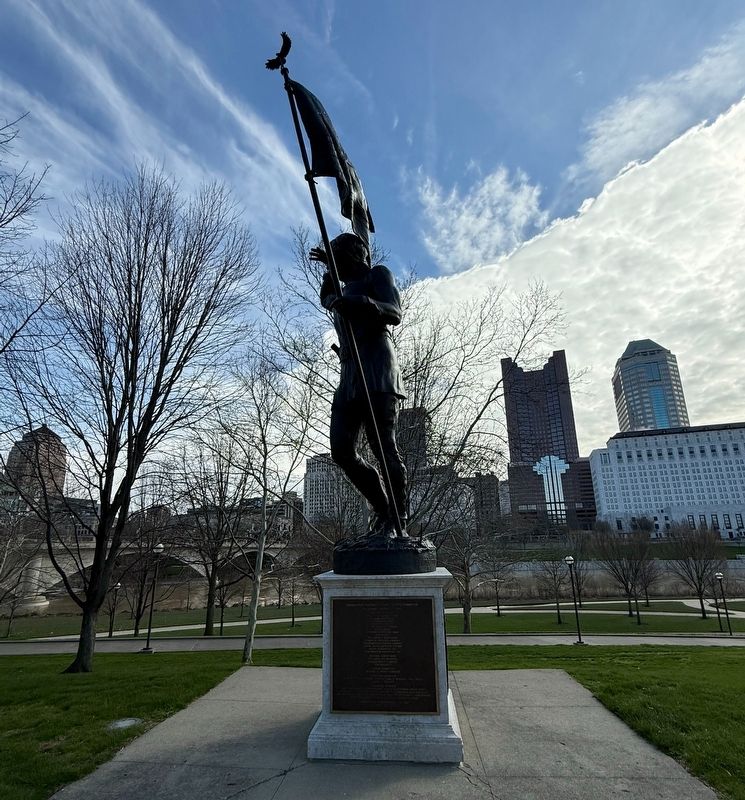
Franklinton Historical Society Statue
Photographed by Devry Becker Jones (CC0), March 29, 2026
1. Franklinton Historical Society Statue
Inscription.
Lucas Sullivan
1765 - 1823
Founder of Franklinton, where Columbus began.
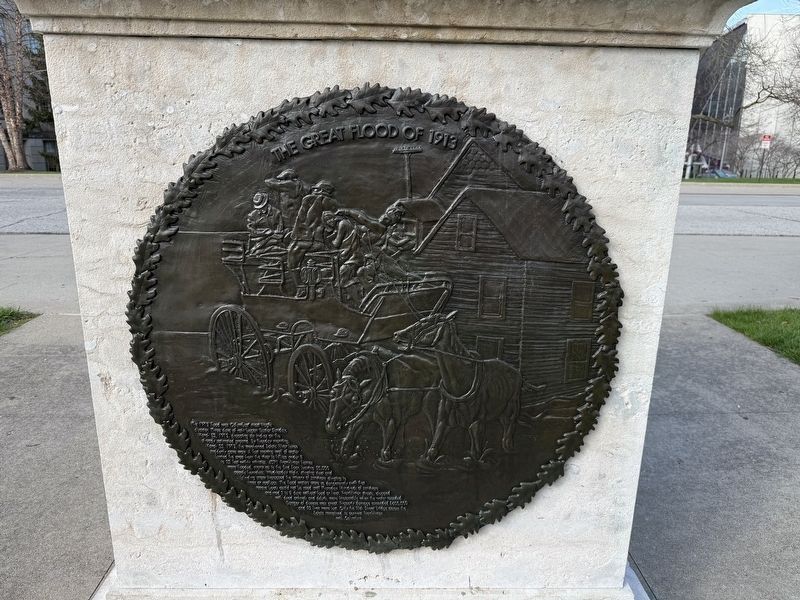
The Great Flood of 1913
The 1913 flood was Columbus' most tragic disaster. Three days of rain began Easter Sunday, March 23, 1913, dropping six inches on the already saturated ground. by Tuesday morning, March 25, 1913, the weakened Scioto River levee suddenly gave way. A last moving wall of water buried the area from the river to hilltop under 8 to 22 feet within minutes. 4072 Franklinton homes were flooded, many up to the 2nd floor, leaving 20,000 people homeless. Wednesday night, stinging sleet and blinding snow increased the misery of survivors clinging to trees or rooftops. The flood waters were so dangerously swift that rescue boats could not be used until Thursday. Hundreds of survivors endured 2 to 3 days without food or heat. Franklinton streets, clogged with dead animals and debris, were impassable when the water receded. Danger of diseases was great. Property damage succeeded $400,000 and 93 lives were lost. Only the Rich Street Bridge across the Scioto remained, to connect Franklinton with Columbus.
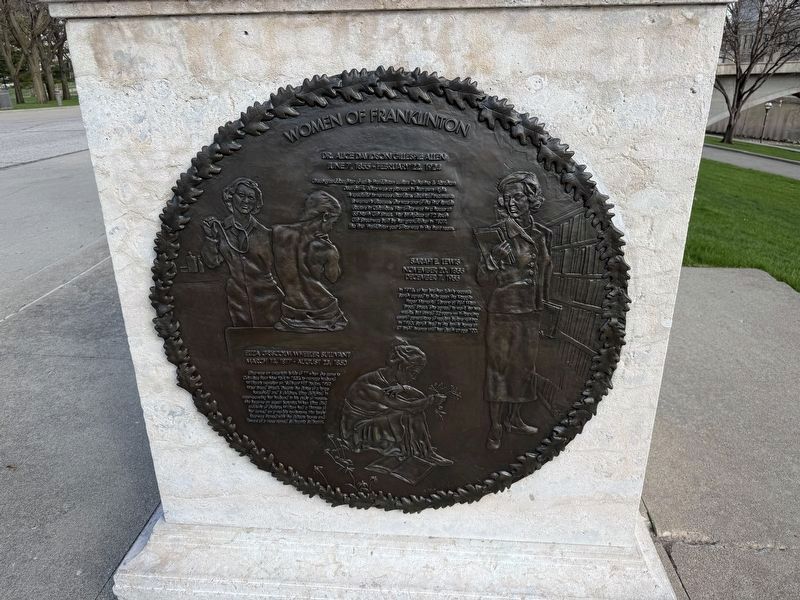
Women of Franklinton
Dr. Alice Davidson Gillespie Allen
June 7, 1855 - February 22, 1924
Great-granddaughter
Click or scan to see this page online
of early Franklinton settlers Catherine & Abraham Deardorff, Alice was a pioneer in her own right. A specialist in nervous disorders, electrical treatments & women's diseases, she was one of the first female doctors in Columbus. Her office was in a house at 55 North Gift Street. Her birthplace at 72 South Gift Street was built by her grandfather in 1807. The first Franklinton post office was in the front room.
Sarah E. Lewis
November 20, 1866 - December 7, 1966
In 1918, at her brother Joh's request, Sarah agreed to help open the Maggie Fager Memorial Library at 969 West Broad Street. She agreed to work for two weeks, but stayed 32 years — influencing several generations of readers before retiring in 1950. Sarah lived in the family home at 67 Brehl Avenue until her death at age 100.
Eliza Griscolm Wheeler Sullivant
March 14, 1817 - August 23, 1850
Eliza was an uncertain bride of 17 when she came to Columbus to New York in 1834, to manage husband William's mansion on 'Sullivant Hill' (today, 1960 West Broad Street). Despite the clothes of a large household and 5 children, Eliza delighted in accompanying her husband in his study
Photographed by Devry Becker Jones (CC0), March 29, 2026
2. The Great Flood of 1913 Medallion
of mosses. She became an expert botanist. When Eliza died suddenly of cholera, William had a likeness of her carved on a marble tombstone. Her lovely face was framed with the delicate leaves and flowers of a moss named Sullivanfra Sullivanfri.
Erected 2000 by Franklinton Historical Society Statue Committee.
Location. 39° 57.642′ N, 83° 0.352′ W. Marker is in Columbus, Ohio, in Franklin County. It is in Downtown. It is on Washington Boulevard 0.1 miles south of West Broad Street (U.S. 40), on the left when traveling south. Touch for map. Marker is at or near this postal address: 187 W Broad St, Columbus OH 43215, United States of America. Touch for directions.
Regionally, this marker is in Ohio’s Scioto Valley. It is also in the American Midwest and in the Corn Belt. Globally, it is in North America, the Western Hemisphere, the Western World, and the Anglosphere. Historically, it finds itself in what was once
Photographed by Devry Becker Jones (CC0), March 29, 2026
3. Women of Franklinton Medallion
the Haudenosaunee (Iroquois) Confederacy, the territory of the Mississippian Culture, and the Northwest Territory.
Credits. This page was last revised on March 30, 2026. It was originally submitted on March 30, 2026, by Devry Becker Jones of Washington, District of Columbia. This page has been viewed 19 times since then. Photos:1, 2, 3. submitted on March 30, 2026, by Devry Becker Jones of Washington, District of Columbia.