
Museum District in Richmond, Virginia — The American South (Mid-Atlantic)
Bridled Veterans
| — | Virginia Museum of History & Culture | — |
Photographed by Evan Dwyer, January 3, 2026
1. Bridled Veterans Marker
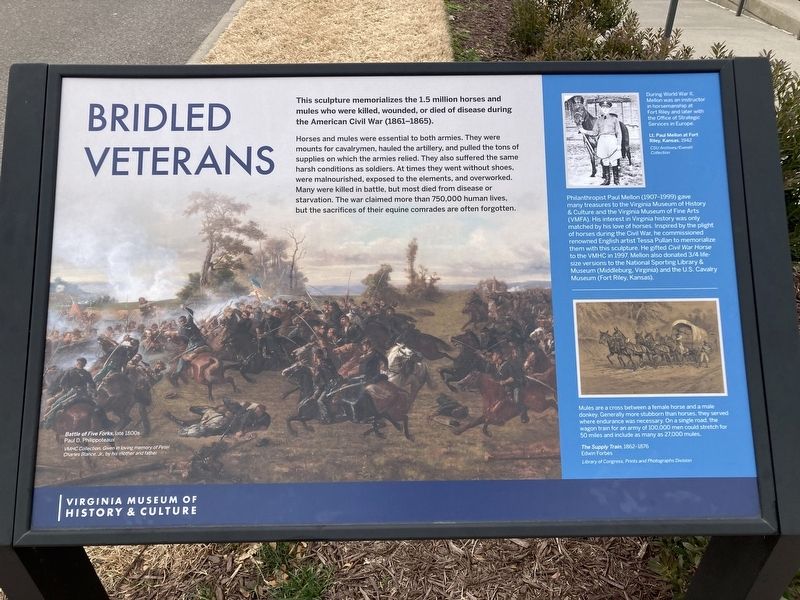
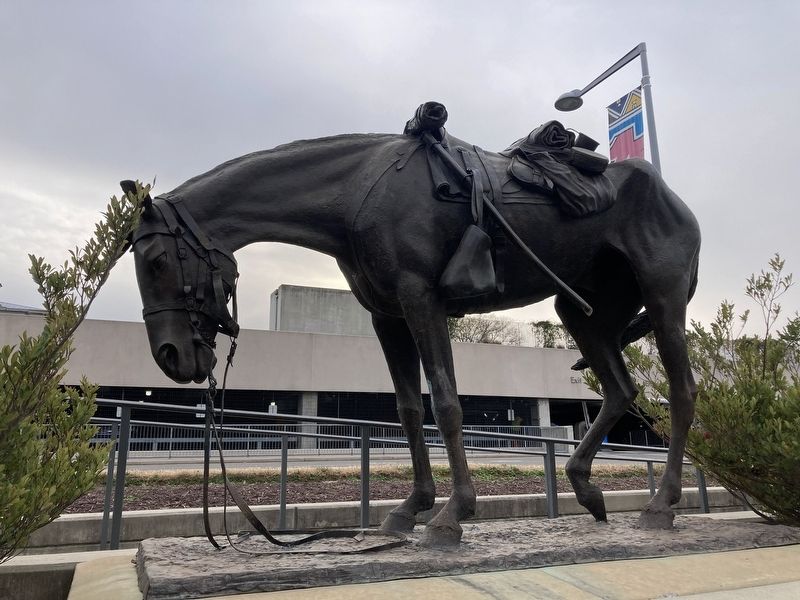
This sculpture memorializes the 1.5 million horses and mules who were killed, wounded, or died of disease during the American Civil War (1861-1865).
Horses and mules were essential to both armies. They were mounts for cavalrymen, hauled the artillery, and pulled the tons of supplies on which the armies relied. They also suffered the same harsh conditions as soldiers. At times they went without shoes, were malnourished, exposed to the elements, and overworked. Many were killed in battle, but most died from disease or starvation. The war claimed more than 750,000 human lives, but the sacrifices of their equine comrades are often forgotten.
(caption) Battle of Five Forks, late 1800s
Paul D. Philippoteaux
VMHC Collection, Given in loving memory of Peter Charles Blance, Jr., by his mother and father
(Sidebar)
Philanthropist Paul Mellon (1907-1999) gave many treasures tot he Virginia Museum of History & Culture and the Virginia Museum of Fine Arts (VMFA). His interest in Virginia history was only matched by his love of horses. Inspired by the plight of horses during the Civil War, he commissioned renowned English artist Tessa Pullan to memorialize them with this sculpture. He gifted Civil War Horse to the VMHC in 1997. Mellon also donated 3/4 life-size versions to the National Sporting Library & Museum (Middleburg, Virginia) and the U.S. Cavalry Museum (Fort Riley, Kansas).
(caption) During World War II, Mellon was an instructor in horsemanship at Fort Riley and later with the Office of Strategic Services in Europe.
Lt. Paul Mellon at Fort Riley, Kansas, 1942 CSU Archives/Everett Collection
Mules are a cross between a female horse and a male donkey. Generally more stubborn than horses, they served where endurance was necessary. On a single road, the wagon train for an army of 100,000 men could stretch for 50 miles and include as many as 27,000 mules.
(caption) The Supply Train, 1862-1876
Edwin Forbes
Library of Congress, Prints and Photographs Division
Erected by Virginia
this page online
Topics. This historical marker is listed in these topic lists: Animals • War, US Civil • War, World II. A significant historical year for this entry is 1865.
Location. 37° 33.46′ N, 77° 28.454′ W. Marker is in Richmond, Virginia. It is in the Museum District. It can be reached from North Arthur Ashe Boulevard south of Stuart Avenue, on the right when traveling south. Touch for map. Marker is at or near this postal address: 428 North Arthur Ashe Boulevard, Richmond VA 23221, United States of America. Touch for directions.

Regionally, this marker is in Central Virginia. It is also in the American South and specifically in the Upper South. Globally, it is in North America, the Western Hemisphere, the Western World, and the Anglosphere. Historically, it finds itself in what was once the territory of the Mississippian Culture, one of the original Thirteen Colonies, one of the Confederate States of America, and the Antebellum South.
Other nearby markers. At least 8 other markers are within walking distance of this marker: Civil War Horse (a few steps from this marker); Robinson House (about
Photographed by Evan Dwyer, January 3, 2026
2. Bridled Veterans Marker
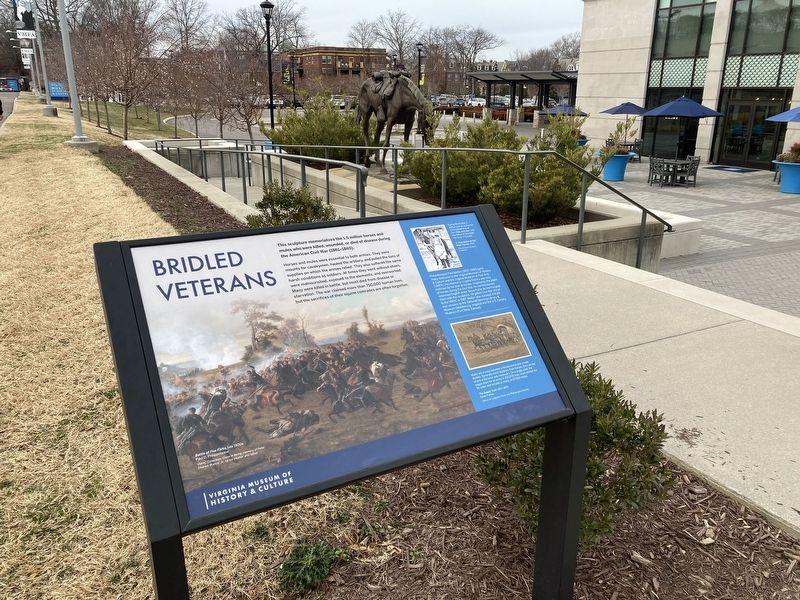
Civil War Horse is in the background.
Other markers no longer nearby. Robinson House (was about 300 feet away but has been replaced with another marker now near it); a different marker also named Virginia Historical Society (was about 400 feet away but has been replaced with another marker now near it); Residential Life at R. E. Lee Camp, No.1 (was about 600 feet away but has been replaced with another marker now near it).
Photographed by Evan Dwyer, January 3, 2026
3. Civil War Horse
The 1997 Sculpture. This was moved from the front of the museum in the early 2020s.
Credits. This page was last revised on May 4, 2026. It was originally submitted on March 30, 2026, by Evan Dwyer of Richmond, Virginia. This page has been viewed 19 times since then. Photos: 1, 2, 3. submitted on March 30, 2026, by Evan Dwyer of Richmond, Virginia. • Bernard Fisher was the editor who published this page.
