Central Business District in New Orleans in Orleans Parish, Louisiana — The American South (West South Central)
New Orleans Massacre Of 1866

Photographed by Sean P. Flynn, March 31, 2026
1. New Orleans Massacre of 1866 Marker, Side One
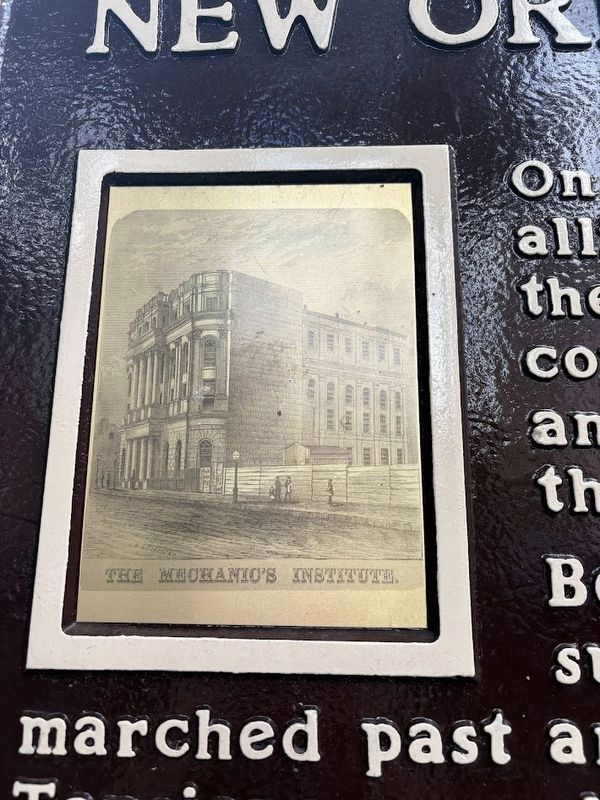
On July 30, 1866, a delegation of Black men and white allies assembled at the Mechanics Institute to reconvene the 1864 Louisiana constitutional convention. The Black community was determined to gain the electoral franchise, and the delegates hoped to secure their right to vote in the state constitution.
Before the meeting began, a large procession of Black supporters playing music and carrying the American flag marched past angry white opponents and gathered outside the Institute. Tensions were high and scuffles soon erupted. The police and an angry white mob opened fire, first attacking the gathering outside, and then invading the building.
More police and several companies of armed firefighters joined the fray. Upwards of one hundred Blacks were murdered. Three white convention delegates were killed. Over one hundred wounded Blacks were forced into city jails or sent to Marine Hospital.
"It was no riot," reported General Philip Sheridan. “It was an absolute massacre by the police”
this page online
The Mechanics' Institute massacre shocked the nation and helped initiate Radical Reconstruction in Louisiana. In 1867, Black men achieved the right to vote and championed a groundbreaking state constitution that included strong civil rights protections.
Erected by Plessy & Ferguson Initiative, NAACP New Orleans Branch & Roudane History & Legacy.
Topics. This historical marker is listed in these topic lists: African Americans • Civil Rights • Disasters

Photographed by Sean P. Flynn, March 31, 2026
2. New Orleans Massacre of 1866 Marker, Side Two
Location. 29° 57.274′ N, 90° 4.344′ W. Marker is in New Orleans, Louisiana, in Orleans Parish. It is in the Central Business District. It is on Roosevelt Way south of Canal Street, on the left when traveling north. Touch for map. Marker is in this post office area: New Orleans LA 70112, United States of America. Touch for directions.

Regionally, this marker is in one of Louisiana’s River Parishes. It is also in the American South, specifically in the Deep South, on the Gulf Coast, and in the Great River Road Region. Globally, it is in North America, a Gulf of Mexico state, the Western Hemisphere, the Western World, and the Anglosphere. Historically, it finds itself in what was once New Spain, the Viceroyalty of New France, the territory of the Mississippian Culture, the Louisiana Purchase, one of the Confederate States of America, and the Antebellum South.
Other nearby markers. At least 8 other markers are within walking distance of this marker: Sears Building (about 300 feet away, measured in a direct line); Shell Building (about 300 feet
Photographed by Sean P. Flynn, March 31, 2026
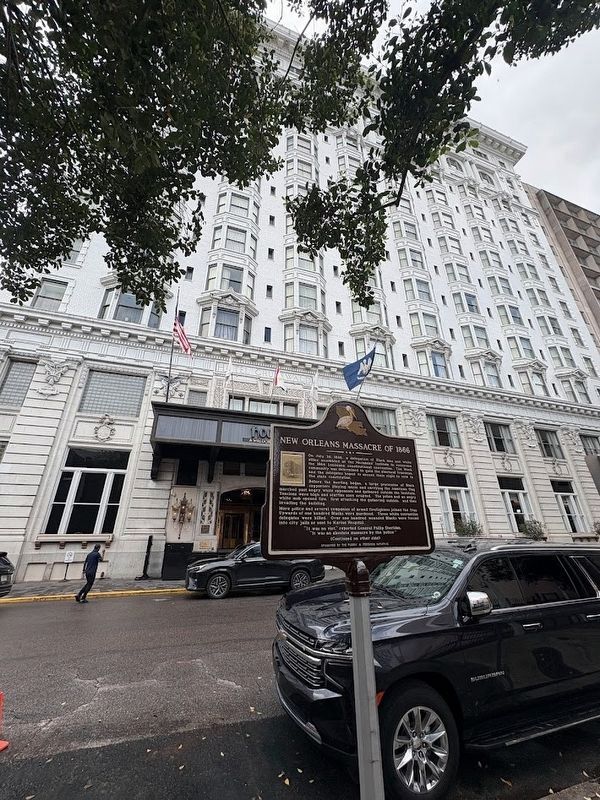
3. New Orleans Massacre Of 1866 Marker across from the Roosevelt Hotel
Also see . . . Harpers’ Weekly, “The Massacre in New Orleans,” (1866). From the National Constitution Center. (Submitted on April 4, 2026, by Sean P. Flynn of Oak Park, Illinois.)
Photographed by Sean P. Flynn, March 31, 2026
4. Close-up of the photo on the marker
Credits. This page was last revised on April 6, 2026. It was originally submitted on March 31, 2026, by Sean P. Flynn of Oak Park, Illinois. This page has been viewed 42 times since then. Photos: 1, 2. submitted on March 31, 2026, by Sean P. Flynn of Oak Park, Illinois. 3, 4. submitted on April 4, 2026, by Sean P. Flynn of Oak Park, Illinois. • Bernard Fisher was the editor who published this page.
