Melbourne , Victoria, Australia — Oceania
Photoheliograph House 8" South Equatorial House
| — | Melbourne Observatory | — |

Photographed by Dean Barton-Ancliffe, March 30, 2026
1. Photoheliograph House 8" South Equatorial House Marker
transit (def) : the apparent passage of a heavenly body across the disc of sun or planet
"Never perhaps, in the world's history, did morning dawn on so many waiting astronomers as it did on the 9th of December, 1874."
H C Russell, Sydney's Government Astronomer, 1874
This building in fact two connected observatories. The small dome housed the Photoheliograph, a special camera to photograph the Sun and the other is the 8 Inch South Equatorial telescope-house. On every clear day for over twenty years, a picture of the Sun was taken within the dome and those 1700 photographic plates still exist. But it was not solar dynamics that was originally under scrutiny here...
Both houses were actually built in anticipation of a more esoteric astronomical event - the transit of Venus. As the positions of Venus and the Earth aligned to allow observation of Venus passing in front of the Sun, 19th century astronomers were given a brief opportunity to calculate distances between the celestial bodies.
"The colour was very vivid during the early part of the transit, when the air was very steady. During the latter part when the sun began to boil the planet to my eye... [it turned] a dead black..."
A
this page online
Effectively, these buildings were constructed for scientific observations undertaken during six hours in two days in the entire 19th century. It may seem an expensive venture. However consider that in 1769, when the British Government sent James Cook and the 'Endeavour' on a journey of discovery, it spent 4,000 pounds to observe the previous transit of Venus - from Tahiti. The French were also rushing to the South Pacific. Whichever nation could calculate the distance between the Earth and the Sun could build a more accurate chronometer - a navigational device used to establish position at sea - and thus expand their empire. It was on this journey that Cook carried sealed instructions from the British Admiralty, to be opened only after the transit. Their request? To find the rumoured Great South Land - Terra Australis.
A transit of Venus occurred twice in the 19th century, in 1874 and 1882, after which the Photoheliograph was used to record surface behaviour of the sun, and the South Equatorial telescope for observation of comets and minor planets. Another 122 years would pass before Australians
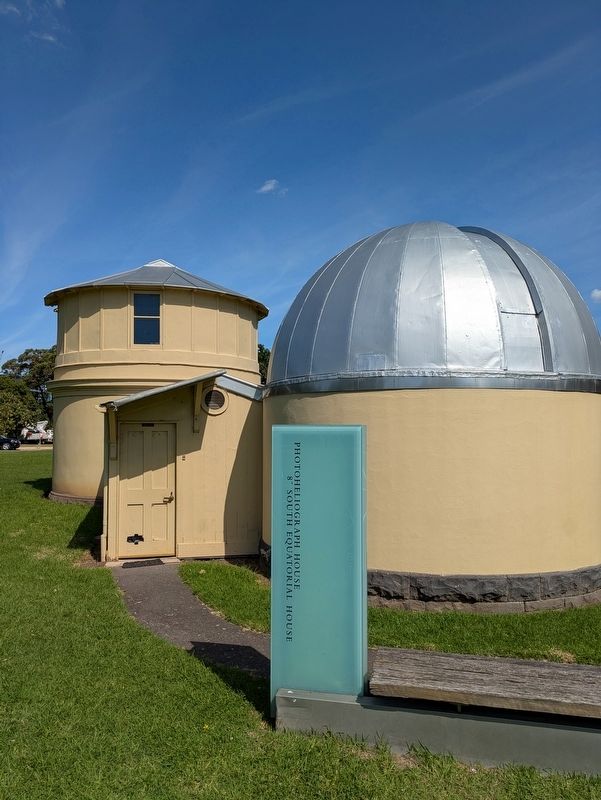
Photographed by Dean Barton-Ancliffe, March 30, 2026
2. Photoheliograph House 8" South Equatorial House at the Marker
Topics. This historical marker is listed in these topic lists: Colonial Era • Science & Medicine. A significant historical date for this entry is December 9, 1874.
Location. 37° 49.797′ S, 144° 58.507′ E. Marker is in Melbourne, Victoria. It can be reached from Birdwood Avenue 0.2 kilometers west of Dallas Brooks Drive. Touch for map. Marker is in this post office area: Melbourne VIC 3004, Australia. Touch for directions.

Regionally, it is in Oceania, in Australasia, in the Pacific Ocean, in South Pacific, on the Pacific Rim, in the Western World, and in the Anglosphere. Historically, it finds itself in what was once a British colony.
Other nearby markers. At least 8 other markers are within walking distance of this marker: Observatory Gate (within shouting distance of this marker); Observatory Building (within shouting distance of this marker); Gate Lodge (within shouting distance of this marker); Magnet House (within shouting distance of this marker); Astrograph House (within shouting distance of this marker); Edward George Honey (within shouting distance of this marker); Observatory House (within shouting distance of this marker); King's Domain - La Trobe's Cottage (within shouting distance of this marker). Touch for a list and map of all markers in Melbourne.
Related markers. Click here for a list of markers that are related to this marker.
Also see . . . Melbourne Observatory.
Dating back to 1863, the Melbourne Observatory holds a significant place in Victoria's history. Throughout its operational years, it provided invaluable contributions to the state. Although decommissioned from official government work in 1945, the Melbourne Observatory continues to hold great importance. Since the mid-1990s, the site has been under the stewardship of the Royal Botanic Gardens Victoria. Recognising its immense cultural value, the Melbourne Observatory and its surroundings were included in the National Heritage list in early 2018, as part of the esteemed "Melbourne Domain and Memorial Precinct." A visit to this remarkable site is a journey through time and an opportunity to appreciate a national treasure.(Submitted on April 2, 2026, by Dean Barton-Ancliffe of Rowville, Victoria.)
Credits. This page was last revised on April 2, 2026. It was originally submitted on April 1, 2026, by Dean Barton-Ancliffe of Rowville, Victoria. This page has been viewed 10 times since then. Photos: 1, 2. submitted on April 1, 2026, by Dean Barton-Ancliffe of Rowville, Victoria. • Andrew Ruppenstein was the editor who published this page.
