Melbourne , Victoria, Australia — Oceania
Observatory Gate
| — | Melbourne Observatory | — |
Photographed by Dean Barton-Ancliffe, March 30, 2026
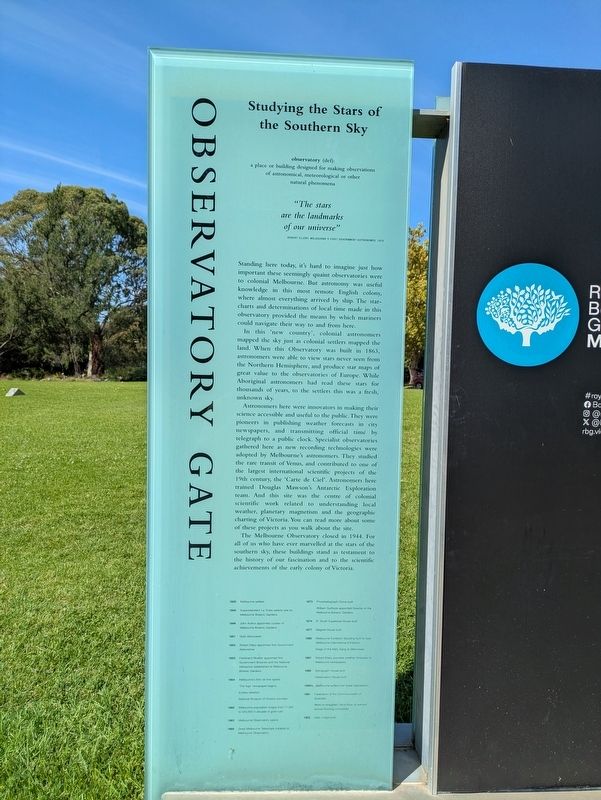
1. Observatory Gate Marker
observatory (Def): a place or building designed for making observations of astronomical, meteorological or other natural phenomena
"The stars are the landmarks of our universe"
Robert Ellery, Melbourne's First Government Astronomer, 1870
Standing here today, it's hand to imagine just how important these seemingly quaint observatories were to colonial Melbourne. But astronomy was useful knowledge in this most remote English colony, where almost everything arrived by ship. The star-charts and determinations of local time made in this observatory provided the means by which mariners could navigate their way to and from here.
In this new country, colonial astronomers mapped the sky just as colonial settlers mapped the land. When this Observatory was built in 1863, astronomers were able to view stars never seen from the Northern Hemisphere, and produce star maps of great value to the observatories of Europe. While Aboriginal astronomers had read these stars for thousands of years, in the settlers this was a fresh unknown sky.
Astronomers here were innovators in making their
this page online
The Melbourne Observatory closed in 1944. For all of who have ever marvelled at the stars of the southern sky, these buildings stand as testament to the history of our fascination and to the scientific achievements of the early colony of Victoria.
Topics. This historical marker is listed in these topic lists: Colonial Era • Science & Medicine. A significant historical year for this entry is 1863.
Location. 37° 49.803′ S, 144° 58.489′ E.
Photographed by Dean Barton-Ancliffe, March 30, 2026
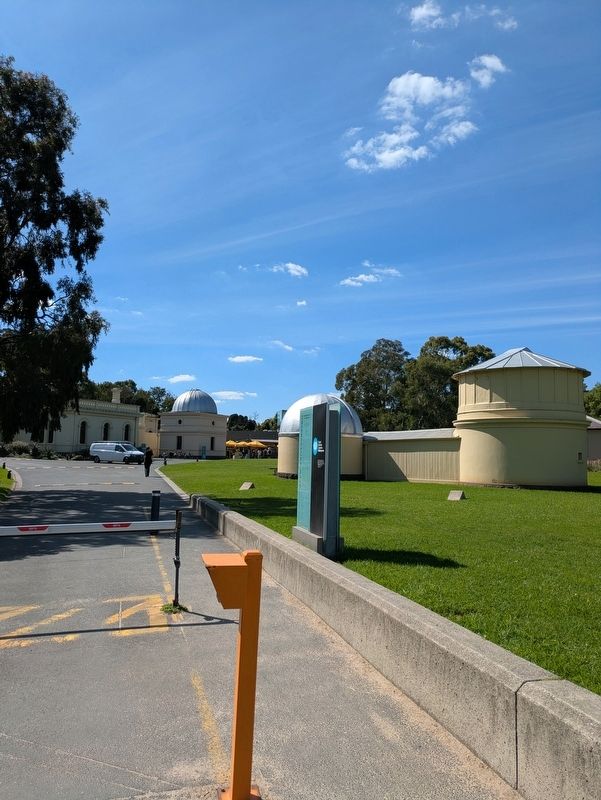
2. Observatory Gate Marker at the entrance to the Melbourne Observatory area

Regionally, it is in Oceania, in Australasia, in the Pacific Ocean, in South Pacific, on the Pacific Rim, in the Western World, and in the Anglosphere. Historically, it finds itself in what was once a British colony.
Other nearby markers. At least 8 other markers are within walking distance of this marker: Gate Lodge (here, next to this marker); Photoheliograph House 8" South Equatorial House (within shouting distance of this marker); Edward George Honey (within shouting distance of this marker); Observatory Building (within shouting distance of this marker); Magnet House (within shouting distance of this marker); Astrograph House (within shouting distance of this marker); A Tribute to our War Horses (about 90 meters away, measured in a direct line); King's Domain - La Trobe's Cottage (about 90 meters away). Touch for a list and map of all markers in Melbourne.
Also see . . . Melbourne Observatory.
Dating back to 1863, the Melbourne Observatory holds a significant place in Victoria's history. Throughout its operational years, it provided invaluable contributions to the state. Although decommissioned from official government work in 1945, the Melbourne Observatory continues to hold great importance. Since the mid-1990s, the site has been under the stewardship of the Royal Botanic Gardens Victoria. Recognising its immense cultural value, the Melbourne Observatory and its surroundings were included in the National Heritage list in early 2018, as part of the esteemed "Melbourne Domain and Memorial Precinct." A visit to this remarkable site is a journey through time and an opportunity to appreciate a national treasure.(Submitted on April 2, 2026, by Dean Barton-Ancliffe of Rowville, Victoria.)
Credits. This page was last revised on April 2, 2026. It was originally submitted on April 2, 2026, by Dean Barton-Ancliffe of Rowville, Victoria. This page has been viewed 14 times since then. Photos: 1, 2. submitted on April 2, 2026, by Dean Barton-Ancliffe of Rowville, Victoria. • Andrew Ruppenstein was the editor who published this page.
