Melbourne , Victoria, Australia — Oceania
Astrograph House
| — | Melbourne Observatory | — |
Photographed by Dean Barton-Ancliffe, March 30, 2026
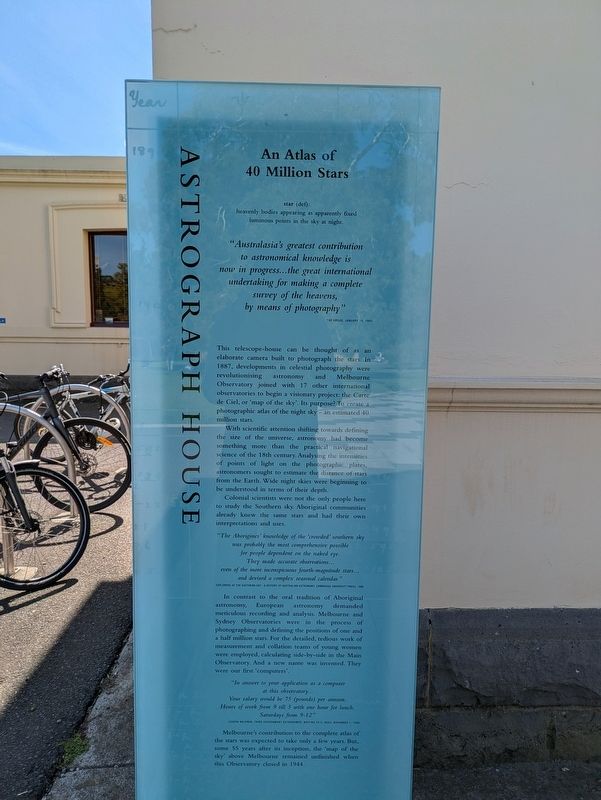
1. Astrograph House Marker
Star (def): heavenly bodies appearing as apparently fixed luminous points in the sky at night.
"Australasia's greatest contribution to astronomical knowledge is now in progress...the great international undertaking for making a complete survey of the heavens, by means of photography"
The Argus, January 10, 1900
This telescope-house can be thought of as elaborate camera built to photograph the stars. In 1887, developments in celestial photography were revolutionising astronomy and Melbourne Observatory joined with 17 other international observatories to begin a visionary project: the Carte de Ciel, or 'map of the sky'. Its purpose? To create a photographic atlas of the night sky - an estimated 40 million stars.
With scientific attention shifting towards defining the size of the universe, astronomy had become something more than the practical navigational science of the 18th century. Analysing the intensities of points of light on the photographic plates, astronomers sought to estimate the distance of stars from the Earth. Wide night skies were beginning to be understood in terms
this page online
Colonial scientists were not the only people here to study the Southern sky. Aboriginal communities already knew the same stars and had their own interpretations and uses.
"The the aborigines knowledge of the 'crowded' southern sky was probably the most comprehensive possible for people dependent on the naked eye. They made accurate observations... even more inconspicuous fourth-magnitude stars... and devised a complex season calendar.
Explorers of the Southern Sky : A history of Australian Astronomy, Cambridge University Press, 1996
In contrast to the oral tradition of Aboriginal astronomy, European astronomy demanded meticulous recording and analysis. Melbourne and Sydney Observatories were in the process of photographing and defining the position of one and a half million stars. For the detailed, tedious work of measurement and collation teams of young women were employed, calculating side-by-side in the Main Observatory. And a new name was invented. They were our first 'computers'.
"In answer to your application as a computer at this observatory... Your salary would be 75 (pounds) per annum. Hours of work from 9 to 5 with one hour for lunch. Saturdays from 9-12"
Joseph

Photographed by Dean Barton-Ancliffe, March 30, 2026
2. Astrograph House at the Marker
Melbourne's contribution to the complete atlas of the stars was expected to take only a few years. But, some 55 years after its inception, the 'map of the sky' above Melbourne remained unfinished when this Observatory closed in 1944.
Topics. This historical marker is listed in these topic lists: Colonial Era • Science & Medicine. A significant historical date for this entry is January 10, 1900.
Location. 37° 49.782′ S, 144° 58.527′ E. Marker is in Melbourne, Victoria. It can be reached from Birdwood Avenue 0.2 kilometers west of Dallas Brooks Drive, on the right when traveling north. Touch for map. Marker is in this post office area: Melbourne VIC 3004, Australia. Touch for directions.

Regionally, it is in Oceania, Australasia, the Pacific Ocean, South Pacific, the Pacific Rim, the Western World, and the Anglosphere. Historically, it finds itself in what was once a British colony.
Other nearby markers. At least 8 other markers are within walking distance of this marker: Observatory Building (a few steps from this marker); Photoheliograph House 8" South Equatorial House (within shouting distance of this marker); Magnet House (within shouting distance of this marker); Observatory House (within shouting distance of this marker); Observatory Gate (within shouting distance of this marker); Gate Lodge (within shouting distance of this marker); Edward George Honey (about 90 meters away, measured in a direct line); King's Domain - La Trobe's Cottage (about 90 meters away). Touch for a list and map of all markers in Melbourne.
Also see . . . Melbourne Observatory.
Dating back to 1863, the Melbourne Observatory holds a significant place in Victoria's history. Throughout its operational years, it provided invaluable contributions to the state. Although decommissioned from official government work in 1945, the Melbourne Observatory continues to hold great importance. Since the mid-1990s, the site has been under the stewardship of the Royal Botanic Gardens Victoria. Recognising its immense cultural value, the Melbourne Observatory and its surroundings were included in the National Heritage list in early 2018, as part of the esteemed "Melbourne Domain and Memorial Precinct." A visit to this remarkable site is a journey through time and an opportunity to appreciate a national treasure.(Submitted on April 2, 2026, by Dean Barton-Ancliffe of Rowville, Victoria.)
Credits. This page was last revised on April 4, 2026. It was originally submitted on April 2, 2026, by Dean Barton-Ancliffe of Rowville, Victoria. This page has been viewed 15 times since then. Photos: 1, 2. submitted on April 2, 2026, by Dean Barton-Ancliffe of Rowville, Victoria. • Andrew Ruppenstein was the editor who published this page.
