Melbourne , Victoria, Australia — Oceania
Observatory Building
| — | Melbourne Observatory | — |
Photographed by Dean Barton-Ancliffe, March 30, 2026
1. Observatory Building Marker
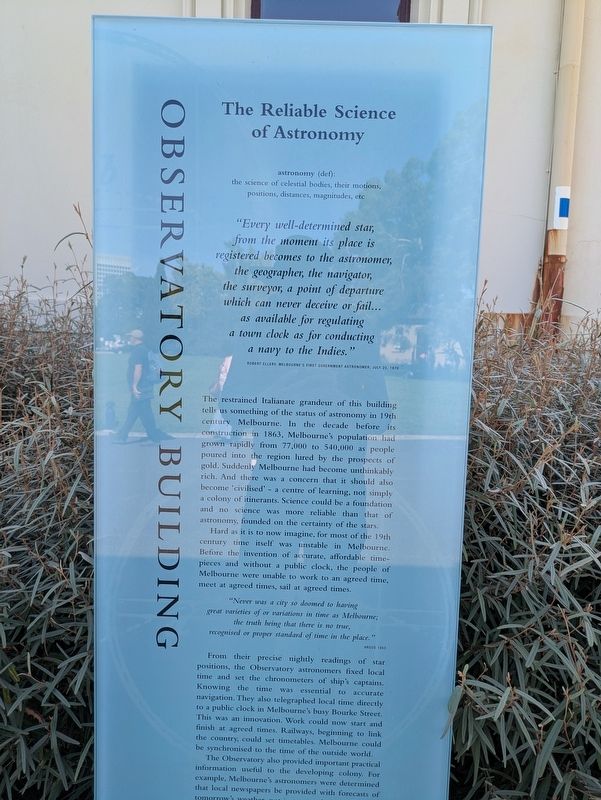
The Reliable Science of Astronomy
astronomy (def): the science of celestial bodies, their motions, positions, distances, magnitudes, etc.
"Every well-determined star, from the moment its place is registered becomes to the astronomer, the geographer, the navigator, the surveyor, a point of departure which can never deceive or fail... as available for regulating a town clock as for conducting a navy to the Indies."
Robert Ellery, Melbourne's First Government Astronomer, July 25, 1870
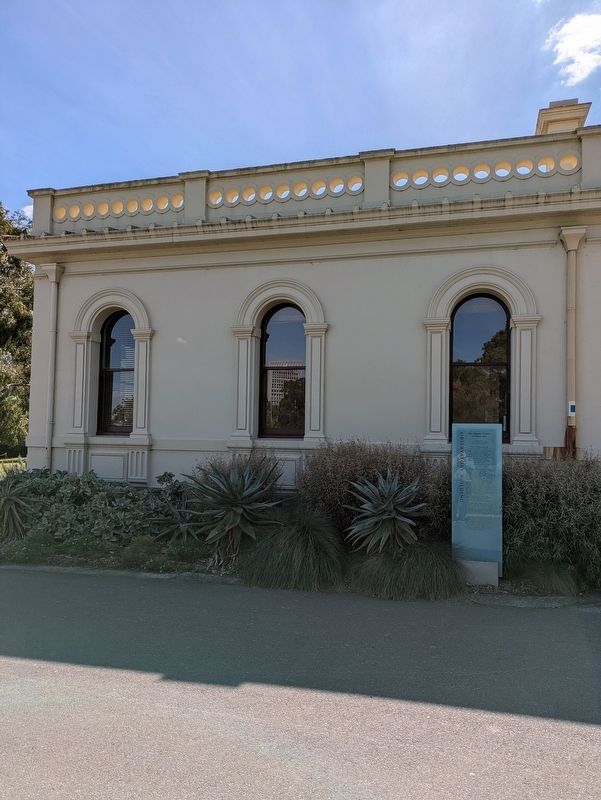
The restrained Italianate grandeur of this building tells us something of the status of astronomy in 19th century Melbourne. In the decade before its construction in 1863, Melbourne's population had grown rapidly from 77,000 to 540,000 as people poured into the region lured by the prospects of gold. Suddenly Melbourne had become unthinkably rich. And there was a concern that it should also become 'civilised' - a centre of learning, not simply a colony of itinerants. Science could be a foundation and no science was more reliable than that of astronomy, founded on the certainty of the stars.
Hard as it is to now imagine, for most of
this page online
"Never was a city so doomed to having great varieties of or variations in time as Melbourne; the truth being that there is no true, recognised or proper standard of time in the place."
The Argus 1853
From their precise nightly readings of star positions, the Observatory astronomers fixed local time and set the chronometers of ship's captains. Knowing the time was essential to accurate navigation. They also telegraphed local time directly to a public clock in Melbourne's busy Bourke Street. This was an innovation. Work could now start and finish at agreed times. Railways, beginning to link the country, could set timetables. Melbourne could be synchronised to the time of the outside world.
The Observatory also provided important practical information useful to the developing colony. For example, Melbourne's astronomers were determined that local newspapers be provided with forecasts
Photographed by Dean Barton-Ancliffe, March 30, 2026
2. Observatory Building at the Marker
Time and weather, the elements that were so influencing, yet strange and variable to Victoria's early colonists could become known as the result of the work of Melbourne Observatory.
Topics. This historical marker is listed in these topic lists: Colonial Era • Science & Medicine. A significant historical date for this entry is July 25, 1870.
Location. 37° 49.784′ S, 144° 58.518′ E. Marker is in Melbourne, Victoria. It can be reached from Birdwood Avenue 0.2 kilometers west of Dallas Brooks Drive, on the right when traveling north. Touch for map. Marker is in this post office area: Melbourne VIC 3004, Australia. Touch for directions.

Regionally, it is in Oceania, in Australasia, in the Pacific Ocean, in South Pacific, on the Pacific Rim, in the Western World, and in the Anglosphere. Historically, it finds itself in what was once a British colony.
Other nearby markers. At least 8 other markers are within walking distance of this marker: Astrograph House (a few steps from this marker); Photoheliograph House 8" South Equatorial House (within shouting distance of this marker); Magnet House (within shouting distance of this marker); Observatory Gate (within shouting distance of this marker); Gate Lodge (within shouting distance of this marker); Observatory House (within shouting distance of this marker); Edward George Honey (within shouting distance of this marker); King's Domain - La Trobe's Cottage (about 90 meters away, measured in a direct line). Touch for a list and map of all markers in Melbourne.
Also see . . . Melbourne Observatory.
Dating back to 1863, the Melbourne Observatory holds a significant place in Victoria's history. Throughout its operational years, it provided invaluable contributions to the state. Although decommissioned from official government work in 1945, the Melbourne Observatory continues to hold great importance. Since the mid-1990s, the site has been under the stewardship of the Royal Botanic Gardens Victoria. Recognising its immense cultural value, the Melbourne Observatory and its surroundings were included in the National Heritage list in early 2018, as part of the esteemed "Melbourne Domain and Memorial Precinct." A visit to this remarkable site is a journey through time and an opportunity to appreciate a national treasure.(Submitted on April 2, 2026, by Dean Barton-Ancliffe of Rowville, Victoria.)
Credits. This page was last revised on April 4, 2026. It was originally submitted on April 2, 2026, by Dean Barton-Ancliffe of Rowville, Victoria. This page has been viewed 19 times since then. Photos: 1, 2. submitted on April 2, 2026, by Dean Barton-Ancliffe of Rowville, Victoria. • Andrew Ruppenstein was the editor who published this page.
