La Laguna de los Adais in Robeline in Natchitoches Parish, Louisiana — The American South (West South Central)
Saint Tekakwitha Plaque and Statue

Photographed by Robert Brevelle, 2023
1. Saint Tekakwitha Plaque
Saint Kateri Tekakwitha known as Lily of the Mohawks by her people, she was the daughter of Kenneronkwa, a Mohawk Chief, and Tagaskouita, an Algonquin was the first Native American Saint in the Catholic Church. Under the Pontificate John Paul II in 1980 who called Kateri Tekakwitha God's "bountiful gift" to His Church was beatified and canonized by Pope Benedict XVI at Saint Peter's Basilica on 21 October 2012. This statue was blessed by Most Rev. Ronald P. Herzog, Bishop of Diocese of Alexandria, Louisiana on October 31, 2012 in the Thanksgiving Mass assisted by Rev. Antony, the Pastor of St. Anne Catholic Church.
The final ceremony and blessing of the Grotto were celebrated by Father John Purdue Pastor of St. Anne Church, Sunday, September 18, 2016, and very honored to have Sister kateria Milchell, SSA, Mohawk Kateri Turtle Clan, is the executive director of the Kateri Tekakwitha Conference attending this blessing ceremony and blood relative to the same Mohawk Tribe of Saint Kateri Tekakwitha.
Chief Rufus Joseph Davis, Jr. Chief and Tribal Historian, Adai Caddo Indian Nation, purchased the blessed Tekakwitha in
this page online
Saint Kateri Tekakwitha baptized as Catherine and known as Lily of the Mohawks by her people was born 1656 in the Mohawk village of Ossernehon, on the south side of the Mohawk River. WHen Tekakwitha was around four years old, her baby brother and both her parents died from the smallpox epidemic, she survived but was left with facial scars and impaired eyesight. She converted to Roman Catholicism at age nineteen, when she was renamed Kateri, baptized in honor of Stain Catherine of Siena. Refusing to marry, she left her village and moved for the remaining 5 years of her life to the Jesuit Mission Village, south of Montreal in New France, now Canada.
Upon her death, 1680 at the age of 24, witnesses said that minutes later her scars vanished and her face appeared radiant and beautiful.
These are various miracles and supernatural events attributed to her intercession. One of the supernatural events took place here at this grotto which
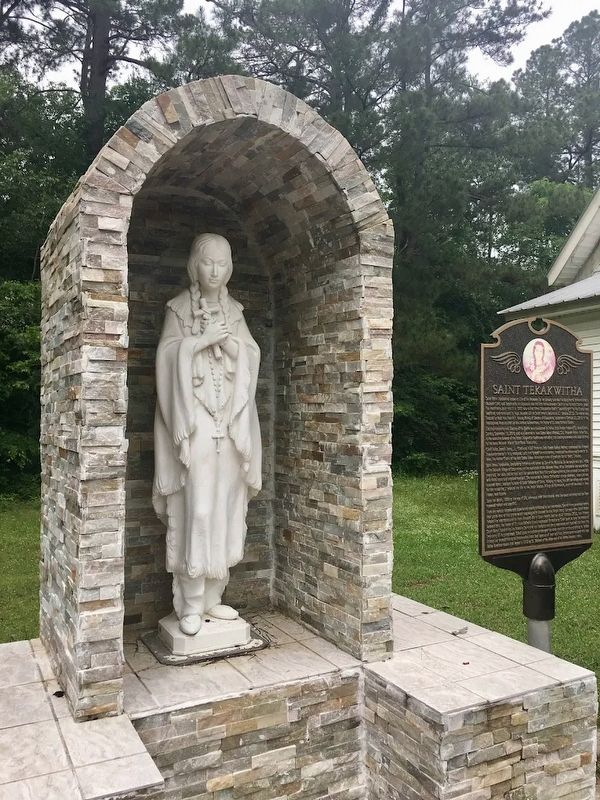
Photographed by Robert Brevelle
2. Saint Tekakwitha Plaque and Statue Marker
Erected 2016 by Adai Caddo Indian Nation.
Topics. This historical marker is listed in these topic lists: Indigenous Peoples and Communities • Religion & Religious Structures • Women. A significant historical date for this entry is September 18, 2016.
Location. 31° 47.183′ N, 93° 17.133′ W. Marker is in Robeline, Louisiana, in Natchitoches Parish. It is in La Laguna de los Adais. It is on Route 485 south of Blosmoore Road, on the left when traveling north. Touch for map.
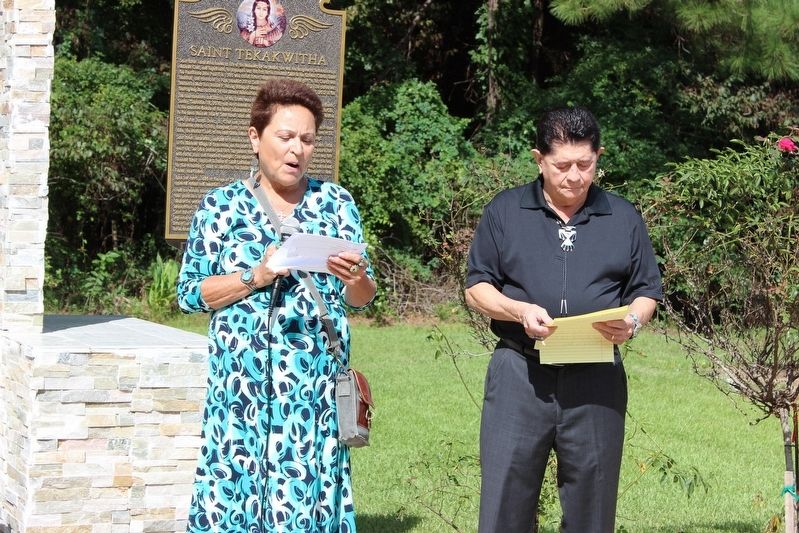
2016
3. Dedication of Saint Tekakwitha statue, grotto, and plaque by Chief Rufus Davis Jr.

Regionally, this marker is in Central Louisiana. It is also in the American South, specifically in the Deep South, and in the Piney Woods. Globally, it is in North America, a Gulf of Mexico state, the Western Hemisphere, the Western World, and the Anglosphere. Historically, it finds itself in what was once New Spain, the Viceroyalty of New France, the territory of the Mississippian Culture, the Louisiana Purchase, one of the Confederate States of America, and the Antebellum South.
Other nearby markers. At least 8 other markers are within 9 miles of this marker, measured as the crow flies: Church of St. Anne (here, next to this marker); El Camino Real de los Tejas (approx. 5.4 miles away); The Presidio Nuestra Senora del Pilar de los Adais (approx. 5.4 miles away); Los Adais (approx. 5.4 miles away); El Camino Real (approx. 5.9 miles away); Los Adaes (approx. 5.9 miles away); In Honor and Memory of our Veterans (approx. 8 miles away); William Hodge Barnhill (approx. 8½ miles away). Touch for a list and map of all markers in Robeline.
More about this marker. Designed and dedicated by Chief Rufus Davis Jr. of the Adai Caddo Indian Nation
Credits. This page was last revised on April 4, 2026. It was originally submitted on April 3, 2026, by Robert Brevelle of Anacoco, Louisiana. This page has been viewed 21 times since then. Photos: 1, 2, 3. submitted on April 3, 2026, by Robert Brevelle of Anacoco, Louisiana. • Devry Becker Jones was the editor who published this page.
