Jefferson City in Cole County, Missouri — The American Midwest (Upper Plains)
The Bolivar Street Bridge

Photographed by Wayne Johnson, April 9, 2026
1. The Bolivar Street Bridge Marker
To protect and ensure the city's prosperity, in 1893 a special committee of the local Commercial Club organized to raise money to build a bridge. Businessmen and property owners formed a corporation and raised the entire $225,000 to finance the venture. This site, the north end of Bolivar Street ⑬, was selected for the bridge.
Construction began in 1895 and the bridge opened February 17, 1896 ⑭, funneling travelers into the Bolivar Street neighborhood in unprecedented numbers. It was operated as a toll bridge through three successive owners: Jefferson City Bridge & Transfer Company (1910), McKinley Power & Light of Illinois (1916), and the Capital City Highway Bridge Company (1928). The latter retired the bond and turned the bridge over to the state in 1932. There was a huge dedication ceremony to celebrate the state's ownership and the newly "free" bridge ⑮.
In 1934, for $7000, the state installed the art deco pillars.
The rotating bridge served horse- and ox-drawn conveyances, horseback riders, foot traffic and motor vehicles until it was replaced in 1955 by the current (west) bridge ⑯.
this page online
The second bridge, which carries northbound traffic out of the city, was built and dedicated in 1991. Today the combined average of crossings on the bridges is over 50,000 vehicles per day ⑰.
A natural observation spot, Jefferson Citians and visitors have been watching traffic—boats, horseback riders, buggies, trains, cars and planes—from this spot for well over a century.
It is a fitting tribute for the Rotarians, today's business leaders, to pay tribute to their predecessors' vision on Rotary Club International's 100th Anniversary. This significant site is a reminder of the humble beginnings of the city and the progressive vision that has guided its growth.
Topics. This historical marker is listed in these topic lists: Bridges & Viaducts • Railroads & Streetcars • Roads & Vehicles • Waterways & Vessels. A significant historical date for this entry is February 17, 1896.
Location. 38° 35.083′ N, 92° 10.665′ W. Marker is in Jefferson City, Missouri, in Cole County. It is on Bolivar Street north
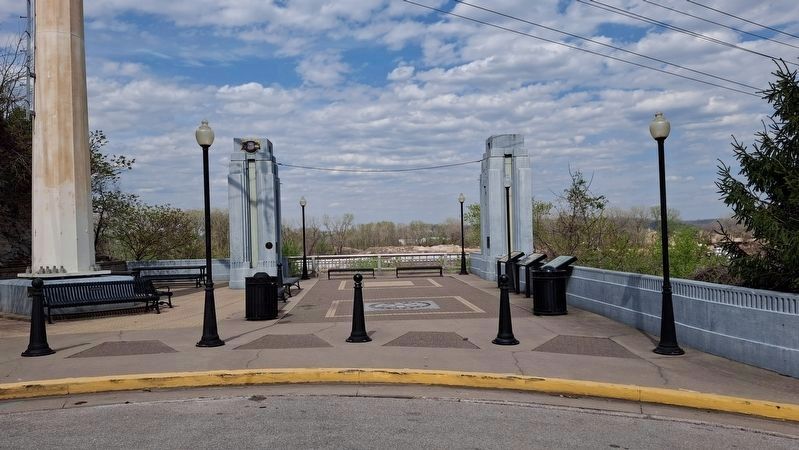
Photographed by Wayne Johnson, April 9, 2026
2. The Bolivar Street Bridge Remains

Regionally, this marker is in the Missouri River Corridor. It is also in the American Midwest, in the Lewis & Clark Corridor, and in the Corn Belt. Globally, it is in North America, the Western Hemisphere, the Western World, and the Anglosphere. Historically, it finds itself in what was once the territory of the Mississippian Culture, the Louisiana Purchase, and the Antebellum South.
Other nearby markers. At least 8 other markers are within walking distance of this marker: The Bolivar Street Neighborhood (here, next to this marker); Jefferson City (about 700 feet away, measured in a direct line); Gold Star Memorial (approx. 0.4 miles away); Dedicated to You, A Free Citizen in a Free Land (approx. 0.4 miles away); Thomas Jefferson (approx. half
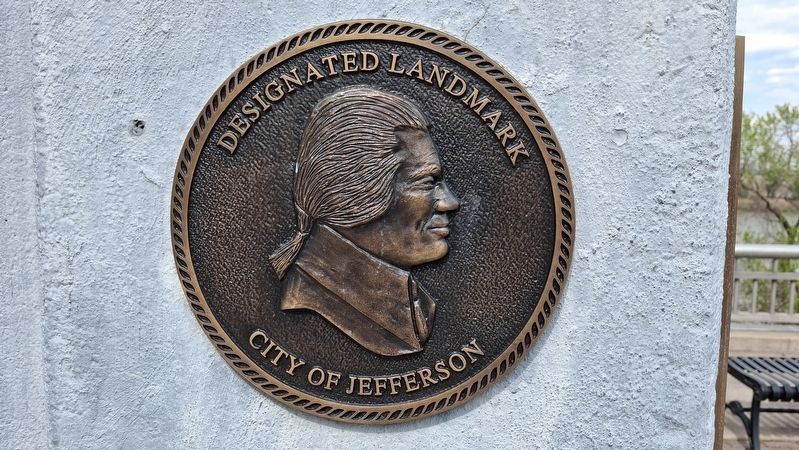
Photographed by Wayne Johnson, April 9, 2026
3. Jefferson City Landmark Plaque
Additional commentary.
1. First Bridge at Jefferson City Missouri
Supported by the book, Jefferson City's First Bridge, April 2025, Wayne Johnson author.
— Submitted April 9, 2026, by Wayne Johnson of Jefferson City, Missouri.
2. Comments about the bridge
The first bridge crossing the Missouri River at Jefferson City was contracted for by a private corporation, Jefferson City Bridge & Transit Company with design and construction by Missouri Valley Bridge & Iron Company. It was located at the north end of Bolivar Street. Groundbreaking for the project was held on May 22, 1895 and physical construction of the bridge began on July 31, 1895. The bridge was completed and open for traffic on Sunday, April 19, 1896 and was dedicated on May 22, 1896 with thousands of individuals attending from all over the state. The Missouri River Bridge at Jefferson City originally
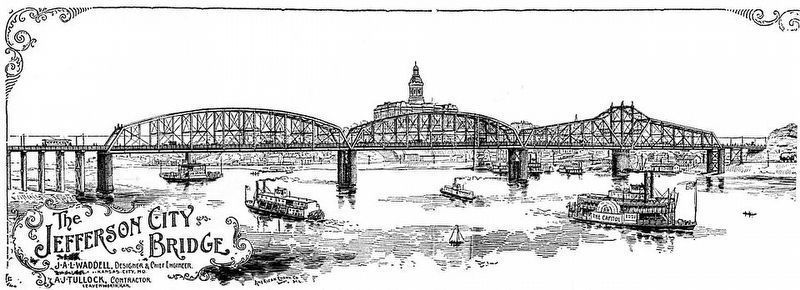
courtesy of the State Republican Newspaper, Jefferson City, Missouri, circa May 21, 1896
4. Architecht's Drawing of the Bolivar Street Bridge
— Submitted April 10, 2026, by Wayne Johnson of Jefferson City, Missouri.
3. Bridge description
A general description of the construction details of the bridge follows. In the retaining wall in the street to the high water's edge, the structure will be a trestle about 140 feet long, across the Missouri Pacific railway track, with a clearance of 21 feet above base rail. This trestle would consist of steel towers, cross girders with wooden floor and rod iron hand railing. The first span from the Jefferson City Shore will be a draw span of 440 feet between the centers of end pans, following which will be two clear spans of 350 feet each, then a pile trestle about 465 feet long, and finally a protective earth embankment about 1,300 feet long. The clear roadway of the bridge is to be 20 feet, making the distance between center spans of the trestle 22 feet. The clear headway will be something less than 15 feet. The hand rails are to be of wood, strong and high, and thoroughly braced is to prevent accidents. At the bottom of each hand rail there is to be a wheel guard of timber to prevent vehicles from striking the hand rail or superstructure. The floor is to be of long leaf, southern yellow pine. The bridge is constructed for carrying motor vehicles and street cars, wagons, etc.
— Submitted April 10, 2026, by Wayne Johnson of Jefferson City, Missouri.
Additional keywords. Jefferson City, Bridge, Missouri River, Transportation, Trolley, Callaway County
Credits. This page was last revised on April 10, 2026. It was originally submitted on April 9, 2026. This page has been viewed 50 times since then. Photos: 1, 2, 3, 4. submitted on April 9, 2026, by Wayne Johnson of Jefferson City, Missouri. • Devry Becker Jones was the editor who published this page.
Editor’s want-list for this marker. A photo of the entire marker. • Can you help?
