Central in Cleveland in Cuyahoga County, Ohio — The American Midwest (Great Lakes)
Freedom Seekers and their Supporters
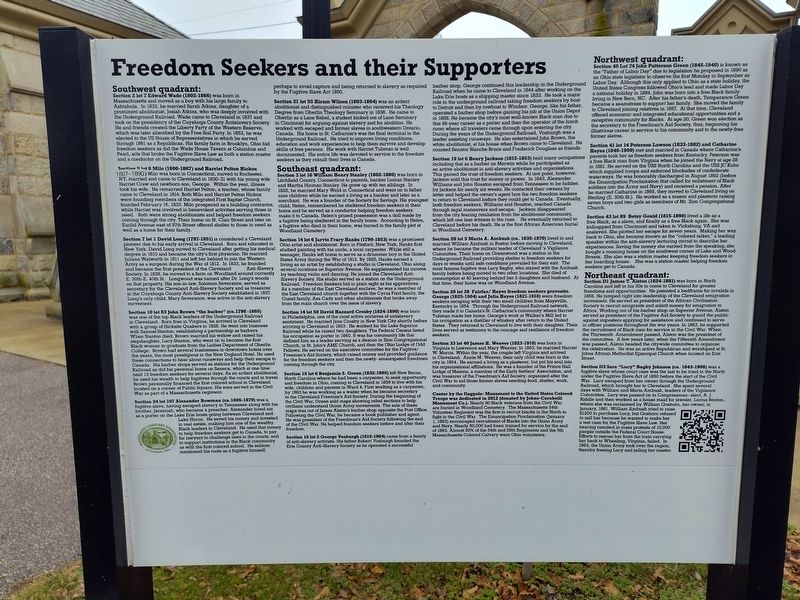
Photographed by Craig Doda, March 7, 2026
1. Freedom Seekers and their Supporters Marker
Southwest quadrant:
Section 2 lot 7 Edward Wade (1802-1866) was born in Massachusetts and moved as a boy with his large family to Ashtabula. In 1832, he married Sarah Atkins, daughter of a prominent abolitionist, Josiah Atkins, who was deeply involved with the Underground Railroad. Wade came to Cleveland in 1837 and took on the presidency of the Cuyahoga County Antislavery Society. He and friends created the Liberty Party of the Western Reserve, which was later absorbed by the Free Soil Party. In 1853, he was elected to the US House of Representatives in which he served through 1861 as a Republican. His family farm in Brooklyn, Ohio hid freedom seekers as did the Wade House Tavern at Columbus and Pearl, acts that broke the Fugitive Slave Law as both a station master and a conductor on the Underground Railroad.
Section 5 lot 6 Milo (1800-1867) and Harriet Pelton Hickox 1807-1890) Milo was born in Connecticut, moved to Rochester, NY, married and came to Cleveland in 1830-31 with his young wife Harriet Craw and newborn son, George. Within the year, illness took his wife. He remarried Harriet Pelton, a teacher, whose family
this page online
Section 7 lot 1 David Long (1787-1851) is considered a Cleveland pioneer due to his early arrival in Cleveland. Born and educated in New York, David Long moved to Cleveland after getting his medical degree in 1810 and became the city's first physician. He married Juliana Walworth in 1811 and left her behind to join the Western Army as a surgeon during the War of 1812. In 1833, he founded and became the first president of the Cleveland Anti-Slavery Society. In 1836, he moved to a farm on Woodland around currently E. 30th-E. 40th St. Longwood was named after Dr. Long's woods on that property. His son-in-law, Solomon Severance, served as secretary
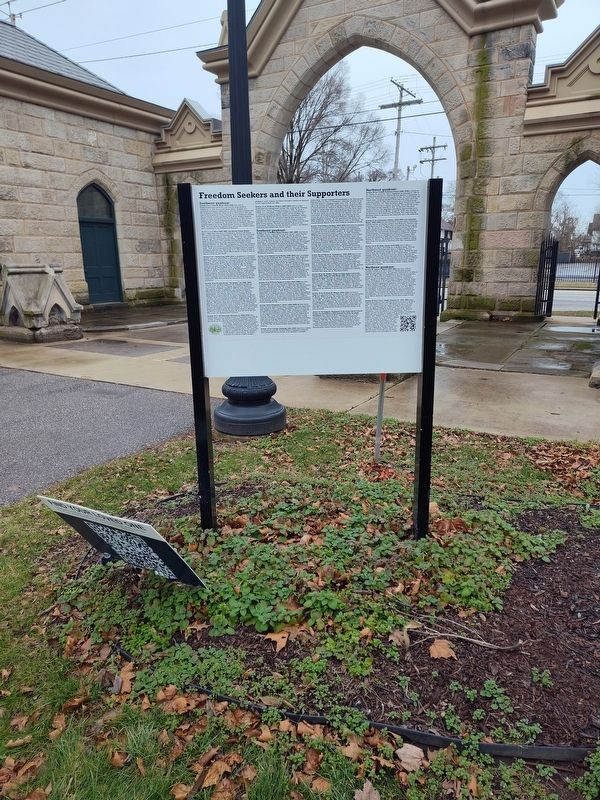
Photographed by Craig Doda, March 7, 2026
2. Freedom Seekers and their Supporters Marker
Section 10 lot 83 John Brown "the barber" (ca.1798-1865) was one of the top Black leaders of the Underground Railroad in Cleveland. Born free in Virginia, he arrived in Cleveland with a group of Hicksite Quakers in 1828. He went into business with Samuel Stanton, establishing a partnership as barbers. When Stanton died, Brown married his widow and raised his stepdaughter, Lucy Stanton, who went on to become the first Black woman to graduate from the Ladies Department of Oberlin College. Brown had several businesses in downtown hotels over the years, the most prestigious in the New England Hotel. He used these connections to hear about runaways and help their escape to Canada. His barber shops served as stations for the Underground Railroad as did his personal home on Seneca, which at one time held 13 freedom seekers for several days. As an ardent abolitionist, he used his wealth to help fugitives through the courts and in travel. Brown personally financed the first colored school in Cleveland located on a corner of Public Square. His sons served in the Civil War as part of a Massachusetts regiment.
Section 24 lot 107 Alexander Bowman (ca.1806-1879) was a fugitive slave, having escaped slavery in Tennessee along with his brother, Jeremiah, who became a preacher. Alexander hired out as a porter on the Lake Erie boats going between Cleveland and Lake Huron. He saved his money and invested in real estate, making him one of the wealthy Black leaders in Cleveland. He used that money to help freedom seekers get to Canada, to pay for lawyers to challenge laws in the courts, and to support institutions in the Black community as with the first colored school. He seldom mentioned his roots as a fugitive himself, perhaps to avoid capture and being returned to slavery as required by the Fugitive Slave Act 1850.
Section 21 lot 55 Hiram Wilson (1803-1864) was an ardent abolitionist and distinguished minister who received his Theology Degree from Oberlin Theology Seminary in 1836. He came to Oberlin as a Lane Rebel, a student kicked out of Lane Seminary in Cincinnati for arguing against slavery and for abolition. He worked with escaped and former slaves in southwestern Ontario, Canada. His home in St. Catharine's was the final terminal in the Underground Railroad. He tried to improve living conditions, education and work experiences to help them survive and develop skills of free persons. His work with Harriet Tubman is well documented. His entire life was devoted to service to the freedom seekers as they rebuilt their lives in Canada.
Southeast quadrant: Section 3 lot 16 William Henry Stanley (1802-1880) was born in Litchfield County, Connecticut to parents, banker Luman Stanley and Martha Hinman Stanley. He grew up with ten siblings. In 1825, he married Mary Weld in Connecticut and went on to father nine children while he earned a living as a banker and later as a merchant. He was a founder of the Society for Savings. His youngest child, Helen, remembered he sheltered freedom seekers in their home and he served as a conductor helping freedom seekers make it to Canada. Helen's prized possession was a doll made by a fugitive being sheltered in the family home. According to Helen, a fugitive who died in their home, was buried in the family plot at Woodland Cemetery.
Section 14 lot 6 Jarvis Frary Hanks (1799-1853) was a prominent Ohio artist and abolitionist. Born in Pitsford, New York, Hanks first studied painting with his uncle, a local carpenter. While still a teenager, Hanks left home to serve as a drummer boy in the United States Army during the War of 1812. By 1825, Hanks earned a living as an artist by establishing a studio in Cleveland, Ohio along several locations on Superior Avenue. He supplemented his income by teaching violin and dancing. He joined the Cleveland Anti- Slavery Society. His studio served as a station on the Underground Railroad. Freedom Seekers hid in plain sight as his apprentices. As a member of the East Cleveland enclave, he was a member of the East Cleveland church together with the Cyrus Ford family, the Cozad family, Asa Cady and other abolitionists that broke away from the main church over the issue of slavery.
Section 14 lot 50 David Hazzard Crosby (1824-1890) was born in Philadelphia, one of the most active enclaves of antislavery sentiment. He married Jane Crosby in New York City shortly before arriving in Cleveland in 1853. He worked for the Lake Superior Railroad while he raised two daughters. The Federal Census listed his occupation as porter in 1860. It was his community life that defined him as a leader serving as a deacon in Zion Congregational Church, in St. John's AME Church, and then the Ohio Lodge of Odd Fellows. He served on the executive committee for the Fugitive/ Freemen's Aid Society, which raised money and provided guidance for the freedom seekers and then the newly- emancipated freedmen coming through the city.
Section 15 lot 6 Benjamin S. Green (1832-1905) left New Berne, North Carolina where he had been a carpenter, to seek opportunity and freedom in Ohio, coming to Cleveland in 1859 to live with his wife, children and parents in Ward 4. First working as a carpenter, by 1863 he was working as a waiter when he became secretary to the Cleveland Freeman's Aid Society. During the beginning of the Civil War, Green sold maps showing rebel sections to help civilians understand Union Army movements. The sale of these maps was out of James Alston's barber shop opposite the Post Office. Following the Civil War, he became a book publisher and agent. He was president of the Freedman's Aid Society following the end of the Civil War. He helped freedom seekers before and after their freedom.
Section 16 lot 2 George Vosburgh (1819-1904) came from a family of anti-slavery activists. His father Robert Vosburgh founded the Erie County Anti-Slavery Society as he operated a successful barber shop. George continued this leadership in the Underground Railroad when he came to Cleveland in 1844 after working on the Lake Erie boats as a shipping master since 1833. He took a major role in the underground railroad taking freedom seekers by boat to Detroit and then by rowboat to Windsor. George, like his father, operated a barber shop before gaining his job at the Union Depot in 1858. He became the city's most well-known Black man due to this 46-year career as a porter and then the operator of the lunch room where all travelers came through upon entering the city. During the years of the Underground Railroad, Vosburgh was a leader assisting runaways. He also entertained John Brown, the white abolitionist, at his house when Brown came to Cleveland. He counted Senator Blanche Bruce and Frederick Douglass as friends.
Section 19 lot 6 Henry Jackson (1815-1853) held many occupations including that as a barber on Merwin while he participated as an active abolitionist in anti-slavery activities and organizations. This gained the trust of freedom seekers. At one point, however, Jackson sold this trust for money or power. In 1843, Alexander Williams and John Houston escaped from Tennessee to be hidden by Jackson for nearly six weeks. He contacted their owners by letter and helped the owner's agent lure the two freedom seekers to return to Cleveland before they could get to Canada. Eventually, both freedom seekers, Williams and Houston, reached Canada through legal maneuvers and escape. Jackson disappeared from the city fearing retaliation from the abolitionist community, which left one less witness to the ruse. He eventually returned to Cleveland before his death. He is the first African American burial in Woodland Cemetery.
Section 20 lot 5 Maria A. Ambush (ca. 1830-1870) lived in and married William Ambush in Boston before moving to Cleveland, where he became the militant leader of Cleveland 's Vigilance Committee. Their home on Greenwood was a station in the Underground Railroad providing shelter to freedom seekers for days or weeks until safe conditions prevailed for their exit. The most famous fugitive was Lucy Bagby, who stayed with the Ambush family before being moved to two other locations. She died of consumption at 40 leaving behind her 2 daughters and husband. At that time, their home was on Woodland Avenue.
Section 28 lot 38 Fairfax/ Hayes freedom seekers gravesite. George (1825-1904) and Julia Hayes (1821-1918) were freedom seekers escaping with their two small children from Maysville, Kentucky in 1854. Through the Underground Railroad network, they made it to Canada's St. Catharine's community where Harriet Tubman made her home. George's work at Walker's Mill led to his occupation as a distiller of whiskey after return to the United States. They returned to Cleveland to live with their daughter. Their lives served as testimony to the courage and resilience of freedom seekers.
Section 33 lot 40 James H. Weaver (1823-1910) was born in Virginia to Lawrence and Mary Weaver. In 1853, he married Harriet W. Morris. Within the year, the couple left Virginia and arrived in Cleveland. Annie M. Weaver, their only child was born in the city in 1854. He earned a living as a plasterer, but put his soul into his organizational affiliations. He was a founder of the Prince Hall Lodge of Masons, a member of the Early Settlers' Association, and was treasurer of the Freedman's Aid Society, organized after the Civil War to aid those former slaves needing food, shelter, work, and community.
Center by the flagpole: Monument to the United States Colored Troops was dedicated in 2012 (donated by Johns-Carabelli Monument Co.). Nearly 80 Black veterans from the Civil War are buried in Woodland Cemetery. The Massachusetts 54th Volunteer Regiment was the first to recruit blacks in the North to fight in the Civil War. The Emancipation Proclamation (January 1, 1863) encouraged recruitment of Blacks into the Union Army and Navy. Nearly 50,000 had been trained for service by the end of 1863. Almost 20% of the 54th and 55th Regiments and the 5th Massachusetts Colored Calvary were Ohio volunteers.
Northwest quadrant:
Section 49 Lot 74 John Patterson Green (1845-1940) is known as the "Father of Labor Day" due to legislation he proposed in 1890 as an Ohio state legislator to observe the first Monday in September as Labor Day. Although this only applied to Ohio as a state holiday, the United States Congress followed Ohio's lead and made Labor Day a national holiday in 1894. John was born into a free Black family living in New Bern, NC. After his father's death, Temperance Green became a seamstress to support her family. She moved the family to Cleveland joining relatives in 1857. At that time, Cleveland offered economic and integrated educational opportunities and a receptive community for Blacks. At age 20, Green won election as the secretary to the Freedman's Aid Society, thus, beginning his illustrious career in service to his community and to the newly-free former slaves.
Section 41 lot 14 Peterson Lawson (1833-1882) and Catharine Hayes (1846-1900) met and married in Canada where Catharine's parents took her as freedom seekers from Kentucky. Peterson was a free Black man from Virginia when he joined the Navy at age 28 in 1861. He served on the USS North Carolina and the USS JC Kuhn which supplied troops and enforced blockades of confederate waterways. He was honorably discharged in August 1862 (before the Emancipation Proclamation that called for enlistment of Black soldiers into the Army and Navy) and received a pension. After he married Catharine in 1865, they moved to Cleveland living on Sterling (E. 30th St.). He worked as a mason and plasterer raising seven boys and two girls as members of Mr. Zion Congregational Church.
Section 43 lot 89 Betsy Gould (1815-1890) lived a life as a free Black, as a slave, and finally as a free Black again. She was kidnapped from Cincinnati and taken to Vicksburg, VA and enslaved. She plotted her escape for seven years. Making her way back to Ohio, she became known as the "colored talker," a leading speaker within the anti-slavery lecturing circuit to describe her experiences. Saving the money she earned from the speaking, she bought a rooming house on the southwest corner of Lake and Wood Streets. She also was a station master keeping freedom seekers in her boarding house. She was a station master helping freedom seekers get to Canada.
Northeast quadrant:
Section D1 James T. Alston (1824-1881) was born in North Carolina and left in his 30s to come to Cleveland for greater freedoms and opportunities. He patented a bedframe for invalids in 1856. He jumped right into leadership of the Cleveland emigration movement. He served as president of the African Civilization Society to recruit emigrants and solicit money for emigration to Africa. Working out of his barber shop on Superior Avenue, Alston served as president of the Fugitive Aid Society to guard the public against imposters applying for assistance and continued to serve in officer positions throughout the war years. In 1863, he supported the recruitment of Black men for service in the Civil War. When the Thirteenth Amendment passed, Alston was the president of the committee. A few years later, when the Fifteenth Amendment was passed, Alston headed the citywide committee to organize the celebration. He was an active Republican and worshiped at St. Johns African Methodist Episcopal Church when located on Erie Street.
Section D3 Sara "Lucy" Bagby Johnson (ca. 1843-1906) was a fugitive slave whose court case was the last to be tried in the North under the Fugitive Slave Act of 1850 before the start of the Civil War. Lucy escaped from her owner through the Underground Railroad, which brought her to Cleveland. She spent several days with William and Maria Ambush, leaders of the Vigilance Committee. Lucy was passed on to Congressman-elect, A. J. Riddle and then worked as a house maid for jeweler, Lucius Benton, where she was reclaimed by William Goshorn, her owner, in January, 1861. William Ambush tried to raise $1200 to purchase Lucy, but Goshorn refused to sell her because he wanted to make her a test case for the Fugitive Slave Law. Her hearing resulted in mass protests of 10,000 people outside the Federal Court House. Efforts to rescue her from the train carrying her back to Wheeling, Virginia, failed. In 1863, the Union Army took over the region, thereby freeing Lucy and jailing her master.
Erected by Woodland Cemetery Foundation.
Topics and series. This historical marker is listed in these topic lists: Abolition & Underground RR • African Americans • Cemeteries & Burial Sites • Religion & Religious Structures. In addition, it is included in the Quakerism series list. A significant historical month for this entry is January 1861.
Location. 41° 29.299′ N, 81° 38.529′ W. Marker is in Cleveland, Ohio, in Cuyahoga County. It is in Central. It is at the intersection of Woodland Avenue and East 66th Street, on the right when traveling west on Woodland Avenue. Touch for map. Marker is at or near this postal address: 6830 Woodland Ave, Cleveland OH 44104, United States of America. Touch for directions.

Regionally, this marker is on the Lake Erie Shore and in the Western Reserve. It is also in the American Midwest. Globally, it is in North America, on the Great Lakes, in the Western Hemisphere, in the Western World, and in the Anglosphere. Historically, it finds itself in what was once the Haudenosaunee (Iroquois) Confederacy, the territory of the Mississippian Culture, and the Northwest Territory.
Other nearby markers. At least 8 other markers are within walking distance of this marker: Woodland Cemetery (a few steps from this marker); Woodland Cemetery Civil War Memorial (within shouting distance of this marker); 23rd Ohio Volunteer Infantry Monument (within shouting distance of this marker); a different marker also named 23rd Ohio Volunteer Infantry Monument (within shouting distance of this marker); Veterans Memorial (approx. 0.2 miles away); US Civil War (approx. 0.2 miles away); War of 1812 (approx. 0.2 miles away); John Patterson Green (approx. ¼ mile away). Touch for a list and map of all markers in Cleveland.
Credits. This page was last revised on April 15, 2026. It was originally submitted on April 10, 2026, by Craig Doda of Napoleon, Ohio. This page has been viewed 23 times since then. Photos: 1, 2. submitted on April 10, 2026, by Craig Doda of Napoleon, Ohio. • Devry Becker Jones was the editor who published this page.
