Northwestern Precinct in Saint Paul in Ramsey County, Minnesota — The American Midwest (Upper Plains)
Minnesota Memorial to Special Forces in Laos

Photographed by McGhiever, April 26, 2025
1. Minnesota Memorial to Special Forces in Laos Marker
Introduction
The creation of the Minnesota Memorial to The Special Forces in Laos was driven by the children who survived the "Secret War" in Laos from 1961 to 1975, and completed by the Hmong and Lao Veterans Statue Committee. It was supported by the Minnesota State Legislature and funded by the citizens of the State of Minnesota and private donations. The Memorial is built to commemorate the Hmong, Lao and other combat veterans and their American advisors, trainers, volunteers and forgotten heroes who served and fought to maintain peace and freedom in Southeast Asia.
Design Concept
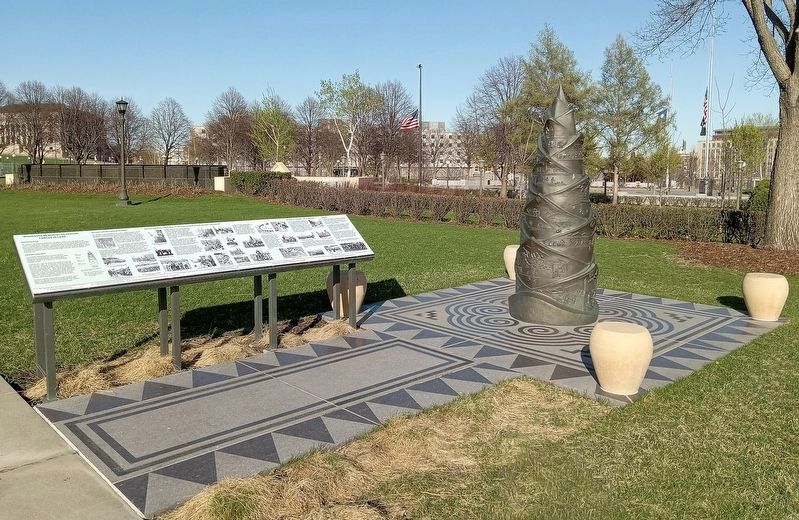
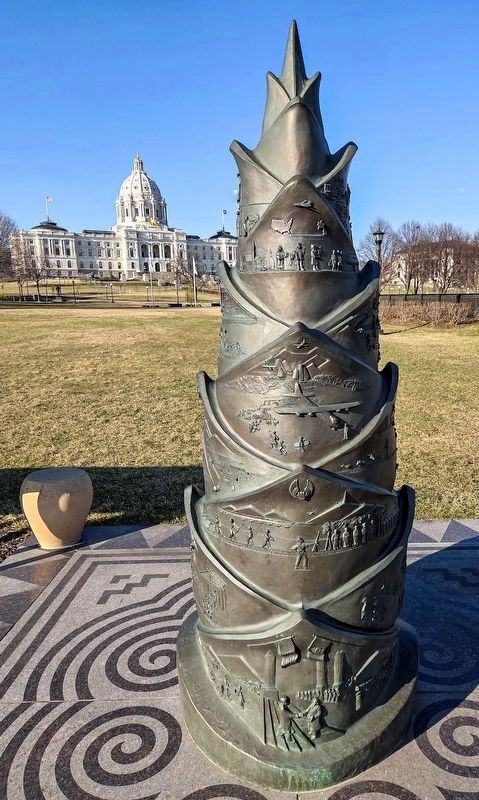
The memorial sculpture depicts a vigorous sprout to symbolize new life, tenacity and hope. Just as new plants emerge with impressive energy, this sculpted sprout represents renewal of the Hmong and Lao communities destroyed by war.
Organized into 4 tiers, the sprout has 4 leaves on each tier. Each leaf tells a story. In all there are 16 stories of life, war and relocation. Beginning at the bottom, the stories move up with time, just as a sprout grows. Carved in bas-relief, they honor the embroidered story cloths (paj ntaub) created
this page online
The plaza pavement pays tribute to Hmong paj ntaub. At the center is an elephant's footprint illustrating radiating water ripples, representative of Laos and Minnesota. The triangular motif symbolizes the beauty of land and mountains.
Sprout Sketch: Ntsuag Kub
Tier 4: Resettlement
Tier 3: Post-war
Tier 2: During the war
Tier 1: Before the war
Each side of the sprout tells stories from a different point of view;
South: the U.S. involvement in Laos
North: the impact on the country of Laos
East: the war's impact on civilians
West: Special Guerilla Units (SGU) CIA ally forces
Lao History of Foreign Invasion
The Kingdom of Laos was known as the "Land of a Million Elephants" with rich and abundant natural resources and a land area approximately the size of Minnesota. Laos gained independence
Photographed by McGhiever, April 26, 2025
2. Minnesota Memorial to Special Forces in Laos
Map of Southeast Asia
The U.S. government began sending financial aid and military assistance to Laos beginning in 1961. The Central Intelligence Agency (CIA) sent Specialist Colonel James W. (Bill) Lair to Padong, an area south of the Plain of Jars, to meet with Lieutenant Vang Pao, the commander of the 10th Infantry Battalion of the 2nd Military Region of Laos. A mutual commitment between the CIA and the Royal Lao Army began a long relationship and military alliance. The Hmong, Lao and Khmu became the Special Guerrilla Units (SGU) in the defense of freedom and independence of the Kingdom of Laos.
Arrival of CIA personnel who begin to train and provide financial assistance
Specialist Colonel Lair (CIA) and General Vang Pao tour highland villages
Thai soldiers and CIA meet with General Vang Pao
Long Cheng Air Base and key 2nd Military Region leaders
Special Guerrilla Units (SGU): Stories of Courage, Honor, Bravery and Tenacity
Strategic
Photographed by McGhiever, April 11, 2026
3. Memorial sculpture south of the Minnesota State Capitol
By April of 1961, President John F. Kennedy had authorized the dispatch of 300 U.S. military advisors to Laos. The country was divided into five military regions. Early in 1963 President Kennedy and King Savang Vatthana of Laos met at the White House regarding the conflict.
During the fifteen years of warfare, the CIA supplied and trained the SGU to fight against communist expansion into the Southeast Asia region. From 1961 to 1975, approximately 46,000 Hmong, Lao, Khmu and Mien were armed as part of the SGU in the first, second, third and fourth military regions. By the end of the war, 35,000 were killed or missing in action.
President Kennedy points to a map of enemy movements in Laos and Vietnam
President Kennedy welcomes King Savang Vatthana of Laos to the U.S.
CIA meets with other Laotian ethnic groups
CIA training Guerilla Special Forces trainees
General Vang Pao overseeing front line battle
SGU troops recapture battle site
CIA personnel with Hmong Soldiers
Artillery fire
Hmong fighter pilot
Young soldiers ship out to the front line
Troops prepare to ship out aboard an American C-123 transport plane
As many as 100 SGU personnel were engaged on a typical rescue mission for a downed American pilot. Wounded soldiers, however, had little medical support. Only a few were able to be transported for medical treatment where it was primarily provided by young Hmong and Lao women nurses trained and supplied by the United States Agency for International Development (U.S.A.I.D.).
The Ravens (CIA Air Unit)
Air American training Lao, Hmong, and Khmu T-28 pilots
King of Laos presents medals to the nurses of the 2nd Military Region
Treating wounded soldiers
After the war ended in 1975, Laos became known as one of the most heavily bombed countries in the world. It was also heavily poisoned by chemicals. Victims of the bombings and chemical herbicides included civilian peasants who lived in small villages – cattle raisers, rice farmers, men, women and children, young and old. Thousands died, livestock and wild animals perished. Today many areas are still unsafe to cultivate or live on.
Guerrilla Special Forces rescue a downed U.S. helicopter pilot
Soldiers wounded from combat
Journey to Thailand / Life as Refugee
In 1973, the Paris Peace Accords were signed and the United States began to pull military forces out of Southeast Asia. In the spring of 1975, the Pathet Lao took control of Laos. About 45,000 political and military leaders, government employees, and technicians were sent to political "re-education camps" organized by the new leadership. The King, members of the royal family, many royal Lao government officials, and others perished in these labor camps. Those who were able to escape to neighboring Thailand became political refugees.
Life in a refugee camp in Thailand
Evacuation of war-torn families out of Laos to refugee camps in Thailand
Refugees waiting for humanitarian aid
The decision to leave their homeland behind was difficult for the Hmong, Lao and Laotian ethnic groups. Thousands of people died en route or drowned trying to cross the Mekong River on their way to Thailand. The refugee camps offered an uncertain future, providing a last hope for some and proving fatal for many. The camps were crowded, unsanitary places where starvation, disease and violence prevailed.
Transport plane leaving the CIA air base of Long Cheng
Remnants of U.S. allies asking for help in Laos
New Life
Countries providing sanctuary and the chance to resettle and begin new lives included the United States, Canada, France, French Guiana, Germany, Argentina, Netherlands, and Australia. The families of many of the SGU soldiers and Lao government officials who assisted the U.S. during the war were allowed to resettle in this country.
Faith organizations sponsored the resettlement of refugees in the United States providing financial and emotional support to the families. Later, many of those same refugees have been able to sponsor their extended family members to immigrate to this country. Minnesota, California and Wisconsin are home to the majority of Hmong and Lao survivors of the war.
The Hmong and Lao people have integrated quickly into the communities where they have settled. They have become educated and serve in many different professions. Some have joined the U.S. military. Others have started businesses and become civic leaders and elected officials. In the short time they have been in the United States, the Hmong and Lao people have woven themselves into the fabric of their new home.
Older Hmong and Lao still remember the war, but like their children, they call the United States of America home.
Memorial Groundbreaking Ceremony
1950's: United States supports mutual defense agreement with Laos, Vietnam, and Cambodia
1954: Laos gained full independence from France
1957: First Royal Lao Government of Coalition formed
1961: CIA provides military and financial aid to Lao, Hmong, and Khmu; SGU formed
1961: U.S. Special Forces assist with Lao Army training SGU Forces
1962: Declaration of the Neutrality of Laos signed by 14 nations prohibiting foreign military activities from entering Laos
1964-1973: U.S. warplanes carried out 580,000 bombing missions over Laos, dropping an estimated 2.3 million tons of bombs
1973: Cease Fire ends U.S. combat operations in Laos
1975: Last U.S. military personnel left Laos
1975-1980: One-third of the Lao, Hmong, and Khmu were killed during this period
1976: First Hmong refugees resettled in Minnesota
1975-1990: Congress granted thousands of refugees entrance to the U.S.
1980: The U.S. Refugee Act of 1980 standardized resettlement services for all refugees. 272,242 Hmong arrived in the U.S.
1973-1997: Some 11,000 Lao civilians were killed or wounded by unexploded ordnance from the war
1990: First Hmong entered into U.S. political arena. They were elected and appointed to serve in public offices
1992: The U.S. restored diplomatic relations with Laos
2000: Hmong Veterans' Naturalization Act allowed Hmong and other ethnic Laotian veterans, who were legal refugees, to become U.S. citizens
2004-2006: Wat Tham Krabok refugee camp closed, approximately 15,000 Hmong refugees resettled to the U.S.
2006: Twin Cities Metro Area is home to the largest concentrated population of Hmong in the U.S.
2011: General Vang Pao passed
2015: 40th Anniversary of Hmong in the U.S.
2016: Minnesota Memorial to Special Forces in Laos is dedicated
Erected 2016.
Topics. This memorial is listed in these topic lists: Asian Americans • Immigration • War, Cold • War, Vietnam. A significant historical year for this entry is 1961.
Location. 44° 57.134′ N, 93° 6.209′ W. Memorial is in Saint Paul, Minnesota, in Ramsey County. It is in Northwestern Precinct. It can be reached from John Ireland Boulevard near W. 12th Street, on the right when traveling north. The marker is near the southwest corner of the Minnesota Capitol Mall. Touch for map. Memorial is at or near this postal address: 101 W 12th Street, Saint Paul MN 55155, United States of America. Touch for directions.

Regionally, this memorial is in the Twin Cities Metropolitan Area. It is also in the American Midwest, in the Corn Belt, and in the Great River Road Region. Globally, it is in North America, the Western Hemisphere, the Western World, and the Anglosphere. Historically, it finds itself in what was once Rupert’s Land, the territory of the Mississippian Culture, and the Louisiana Purchase.
Other nearby markers. At least 8 other markers are within walking distance of this marker: "Spiral for Justice" Roy Wilkins Memorial (within shouting distance of this marker); Major William A. Curtis (within shouting distance of this marker); POW/MIA All Conflicts (within shouting distance of this marker); Order of the Purple Heart (within shouting distance of this marker); 194th Light Tank Battalion (within shouting distance of this marker); Charles A. Lindbergh (about 300 feet away, measured in a direct line); Governor, Warrior, Peacemaker (about 300 feet away); Service & Sacrifice (about 300 feet away). Touch for a list and map of all markers in Saint Paul.
Credits. This page was last revised on April 13, 2026. It was originally submitted on April 13, 2026, by McGhiever of Minneapolis, Minnesota. This page has been viewed 30 times since then. Photos: 1, 2, 3. submitted on April 13, 2026, by McGhiever of Minneapolis, Minnesota.
