Portsmouth, Virginia — The American South (Mid-Atlantic)
Captain William Tee
1758 - 1849
Photographed by C. Ryan Dodson, April 10, 2026
1. Captain William Tee Marker
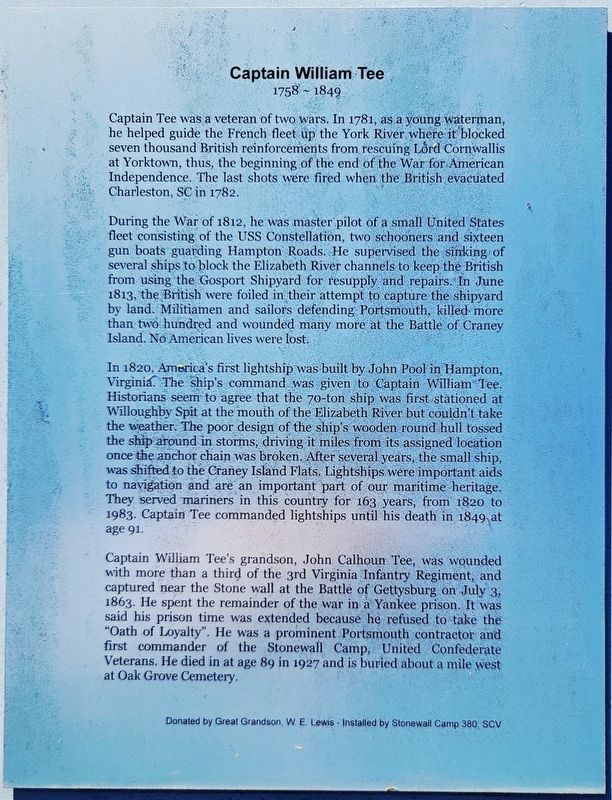
Captain Tee was a veteran of two wars. In 1781, as a young waterman, he helped guide the French fleet up the York River where it blocked seven thousand British reinforcements from rescuing Lord Cornwallis at Yorktown, thus, the beginning of the end of the War for American Independence. The last shots were fired when the British evacuated Charleston, SC in 1782.
During the War of 1812, he was master pilot of a small United States fleet consisting of the USS Constellation, two schooners and sixteen gun boats guarding Hampton Roads. He supervised the sinking of several ships to block the Elizabeth River channels to keep the British from using the Gosport Shipyard for resupply and repairs. In June 1813, the British were foiled in their attempt to capture the shipyard by land. Militiamen and sailors defending Portsmouth, killed more than two hundred and wounded many more at the Battle of Craney Island. No American lives were lost.
In 1820, America's first lightship was built by John Pool in Hampton, Virginia. The ship's command was given to Captain William Tee. Historians seem to agree that the 70-ton ship was first
this page online
Captain William Tee's grandson, John Calhoun Tee, was wounded with more than a third of the 3rd Virginia Infantry Regiment, and captured near the Stone wall at the Battle of Gettysburg on July 3, 1863. He spent the remainder of the war in a Yankee prison. It was said his prison time was extended because he refused to take the "Oath of Loyalty". He was a prominent Portsmouth contractor and first commander of the Stonewall Camp, United Confederate Veterans. He died in at age 89 in 1927 and is buried about a mile west at Oak Grove Cemetery.
Erected 2008 by Stonewall Camp
Photographed by C. Ryan Dodson, April 10, 2026
2. Captain William Tee Marker
Topics and series. This historical marker is listed in these topic lists: Cemeteries & Burial Sites • War of 1812 • War, US Civil • War, US Revolutionary. In addition, it is included in the Sons of Confederate Veterans/United Confederate Veterans series list. A significant historical year for this entry is 1781.
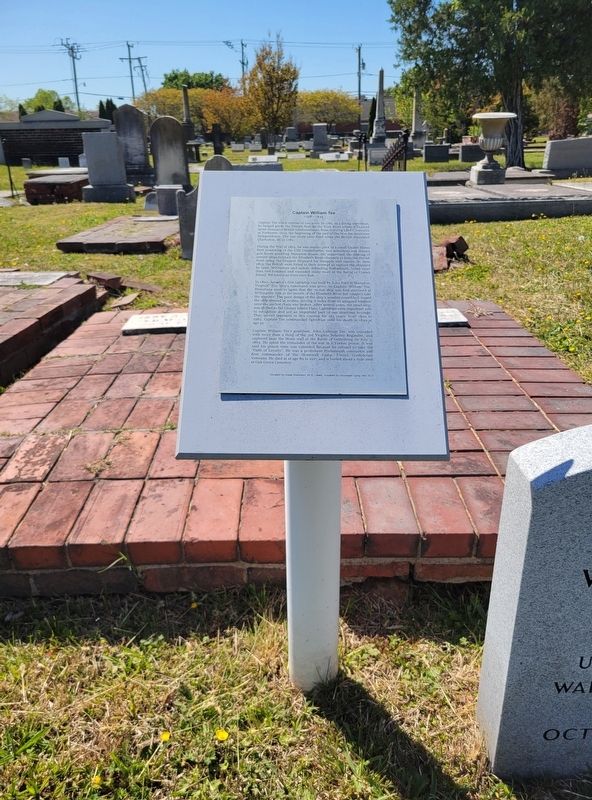
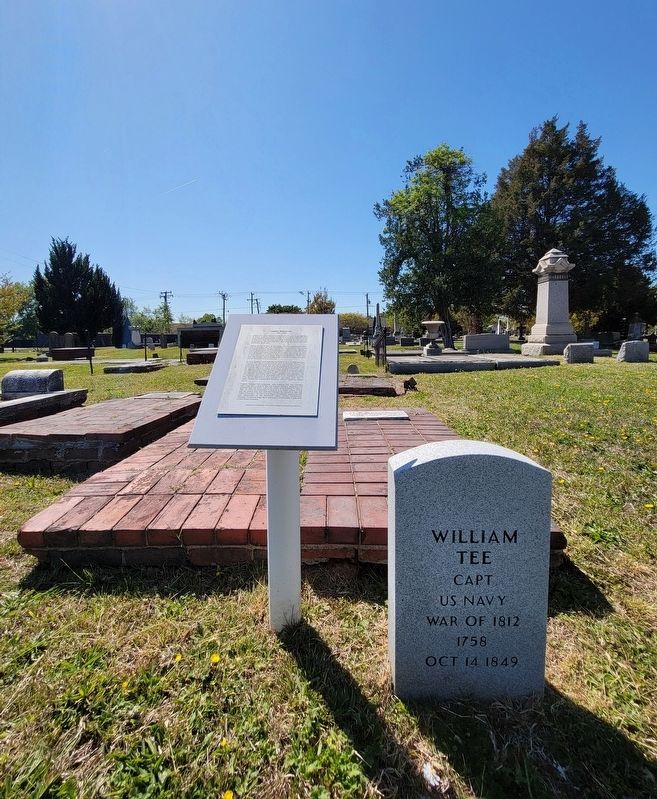
Location. 36° 50.291′ N, 76° 18.439′ W. Marker is in Portsmouth, Virginia. It can be reached from the intersection of Fort Lane and Holladay Street, on the right when traveling north. The Marker is located in Cedar Grove Cemetery. Touch for map. Marker is at or near this postal address: 301 Fort Lane, Portsmouth VA 23704, United States of America. Touch for directions.

Regionally, this marker is in Virginia’s Hampton Roads, specifically in Coastal Virginia, and in the Hampton Roads Metropolitan Area. It is also in the American South, specifically in the Upper South, in the Tidewater, and on the Eastern Seaboard. Globally, it is in the North Atlantic Region, North America, the Western Hemisphere, the Western World,
Photographed by C. Ryan Dodson, April 10, 2026
3. Captain William Tee Marker
Other nearby markers. At least 8 other markers are within walking distance of this marker: Captain John Julius Guthrie (within shouting distance of this marker); Lieutenant William H. Cocke (within shouting distance of this marker); Ellsberry V. White (within shouting distance of this marker); Captain Hugh Nelson Page (within shouting distance of this marker); Commodore James Wallace Cooke (within shouting distance of this marker); Arthur Emmerson (within shouting distance of this marker); War of 1812 Veterans buried in this Cemetery (within shouting distance of this marker); Captain Arthur Emmerson (within shouting distance of this marker). Touch for a list and map of all markers in Portsmouth.

Photographed by C. Ryan Dodson, April 10, 2026
4. Captain William Tee grave
Credits. This page was last revised on April 30, 2026. It was originally submitted on April 13, 2026, by C. Ryan Dodson of Danville, Virginia. This page has been viewed 13 times since then. Photos: 1, 2, 3, 4. submitted on April 13, 2026, by C. Ryan Dodson of Danville, Virginia. • Devry Becker Jones was the editor who published this page.
