Hollywood in St. Mary's County, Maryland — The American Northeast (Mid-Atlantic)
Sotterley's Early Days
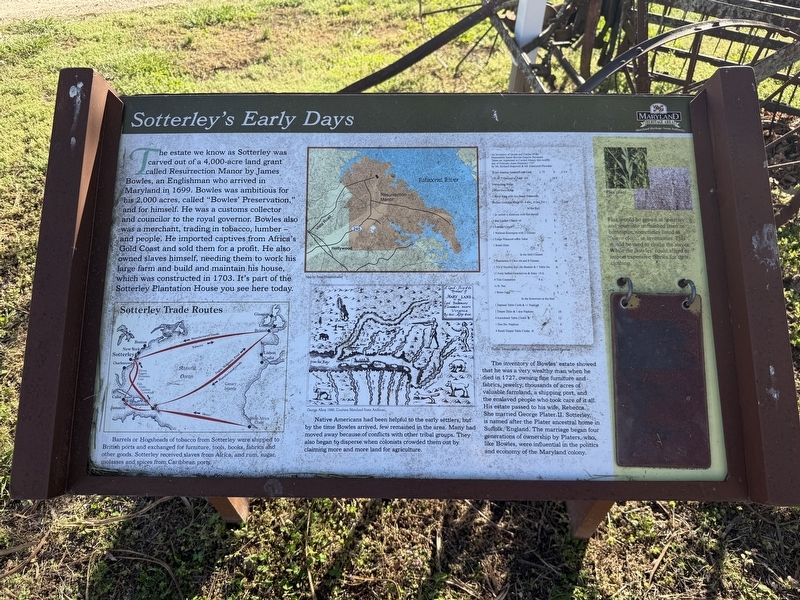
The estate we know as Sotterley was carved out of a 4,000-acre land grant called Resurrection Manor by James Bowles, an Englishman who arrived in Maryland in 1699. Bowles was ambitious for his 2,000 acres, called "Bowles' Preservation," and for himself. He was a customs collector and councilor to the royal governor. Bowles also was a merchant, trading in tobacco, lumber — and people. He imported captives from Africa's Gold Coast and sold them for a profit. He also owned slaves himself, needing them to work his large farm and builds and maintain his house, which was constructed in 1703. It's part of the Sotterley Plantation House you see here today.
[Captions:]
Barrels or Hogsheads of tobacco from Sotterley were shipped to British ports and exchanged for furniture, tools, books, fabrics and other goods. Sotterley received slaves from Africa, and rum, sugar, molasses and spices from Caribbean ports.
Native Americans had been helpful to early settlers, but by the time Bowles arrived, few remained in the area. Many had moved away because of conflicts with other tribal groups. They also began to disperse when colonists crowded them out by claiming more and more land for agriculture.
The inventory of Bowles' estate showed that he was a very wealthy man when he died in 1727, owning fine furniture and fabrics, jewelry, thousands of acres of valuable farmland, a shipping port, and the enslaved people who took care of it all. His estate passed to his wife, Rebecca. She married George Plater, II. Sotterley, is named after the Plater ancestral home in Suffolk, England. The marriage began four generations of ownership by Platers, who, like Bowles, were influential in the politics and economy of the Maryland colony.
Flax would be grown at Sotterley and spun into unfinished linen or homespun, sometimes listed as "slave cloth" in inventories. This would be used to clothe the slaves. While the Bowles' could afford to import expensive fabrics for their clothing.
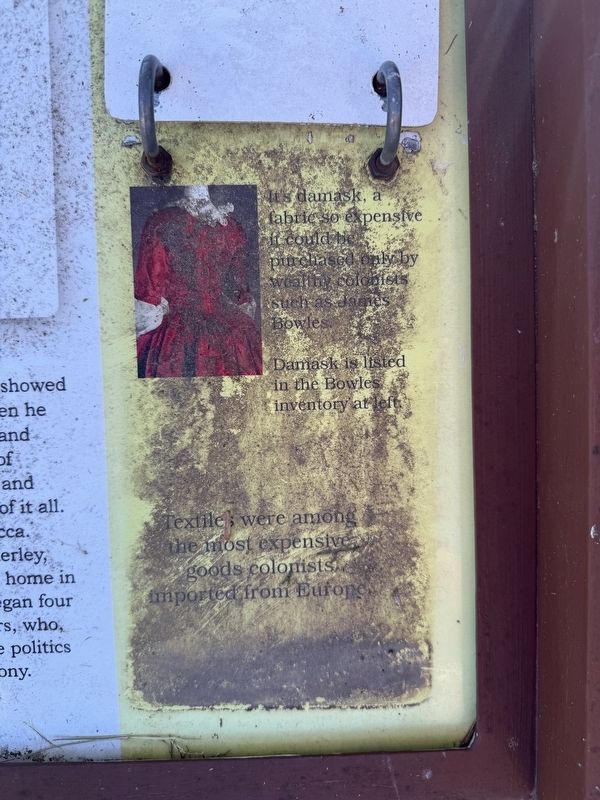
It's damask, a fabric so expensive it could be purchased only by wealthy colonists such as James Bowles.
Erected by Maryland
this page online
Topics. This historical marker is listed in these topic lists: African Americans • Agriculture • Colonial Era • Industry & Commerce. A significant historical year for this entry is 1699.
Location. 38° 22.526′ N, 76° 32.554′ W. Marker is in Hollywood, Maryland, in St. Mary's County. It is on Sotterley Lane north of Sotterley Wharf Road, on the right when traveling west. Touch for map. Marker is at or near this postal address: 44296 Sotterley Ln, Hollywood MD 20636, United States of America. Touch for directions.

Regionally, this marker is in Southern Maryland. It is also in the American South, specifically in the Upper South, in the Mid-Atlantic, in the Tidewater, in the Chesapeake Bay Region, and on the Eastern Seaboard. Globally, it is in the North Atlantic Region, North America, the Western Hemisphere, the Western World, and the Anglosphere. Historically, it finds itself in what was once one of the original Thirteen Colonies and also the Antebellum South.
Other nearby markers. At least 8 other markers are within walking distance of this marker: The Cooper (a few steps from this
Additional keywords. Transatlantic trade; human trafficking
Credits. This page was last revised on April 18, 2026. It was originally submitted on April 18, 2026, by Devry Becker Jones of Washington, District of Columbia. This page has been viewed 12 times since then. Photos: 1, 2, 3. submitted on April 18, 2026, by Devry Becker Jones of Washington, District of Columbia.
