
Hollywood in St. Mary's County, Maryland — The American Northeast (Mid-Atlantic)
Slavery at Sotterley
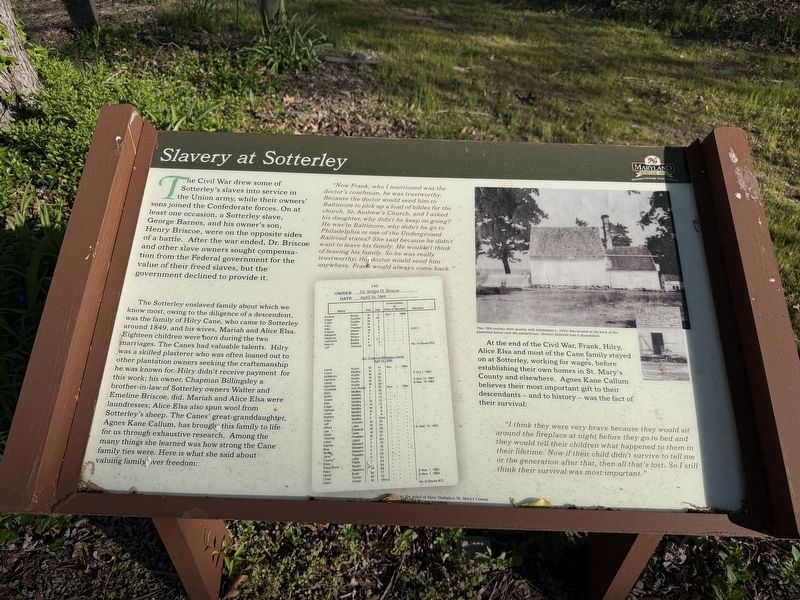
The Civil War drew some of Sotterley's slaves into service in the Union army, while their owners' sons joined the Confederate forces. On at least one occasion, a Sotterley slave, George Barnes, and his owner's son, Henry Briscoe, were on the opposite sides of a battle. After the war ended, Dr. Briscoe and other slave owners sought compensation from the Federal government for the value of their freed slaves, but the government declined to provide it.
The Sotterley enslaved family about which we know most, owning to the diligence of a descendent, was the family of Hilry Cane, who came to Sotterley around 1849, and his wives, Mariah and Alice Elsa. Eighteen children were born during the two marriages. The Canes had valuable talents. Hilry was a skilled plasterer who was often loaned out to other plantation owners seeking the craftsmanship he was known for. Hilry didn't receive payment for this work; his owner, Chapman Billingsley, a brother-in-law of Sotterley owners Walter and Emeline Briscoe, did. Mariah and Alice Elsa were laundresses; Alice Elsa also spun wool from Sotterley's sheep. The Canes' great-granddaughter, Agnes Kane Callum, has brought this family to life for us through exhaustive research. Among the many things she learned was how strong the Cane family ties were. Here is what she said about valuing family over freedom:
"Now Frank, who I mentioned was the doctor's coachman, he was trustworthy. Because the doctor would send him to Baltimore to pick up a load of bibles for the church, St. Andrew's Church, and I asked his daughter, why didn't he keep on going? He was in Baltimore, why didn't he go to Philadelphia or one of the Underground Railroad states? She said because he didn't want to leave his family. He wouldn't think of leaving his family. So he was really trustworthy; the doctor would send him anywhere. Frank would always come back.
At the end of the Civil War, Frank, Hilry, Alice Elsa and most of the Cane family stayed on at Sotterley, working for wages, before establishing their own homes in St. Mary's County and elsewhere. Agnes Kane Callum believes their most important gift to their descendants – and to history – was the fact of their survival:
"I think they were very brave because they would sit around the fireplace at night before they go to bed and they would tell their children what happened to them in their lifetime. Now if their child didn't survive to tell me or the generation after that, then all that's lost. So I still think their survival was most important."
Erected by Maryland
this page online
Topics. This historical marker is listed in these topic lists: African Americans • Agriculture • Anthropology & Archaeology • Industry & Commerce. A significant historical year for this entry is 1849.
Location. 38° 22.545′ N, 76° 32.528′ W. Marker is in Hollywood, Maryland, in St. Mary's County. It is on Sotterley Lane. Touch for map. Marker is in this post office area: Hollywood MD 20636, United States of America. Touch for directions.

Regionally, this marker is in Southern Maryland. It is also in the American South, specifically in the Upper South, in the Mid-Atlantic, in the Tidewater, in the Chesapeake Bay Region, and on the Eastern Seaboard. Globally, it is in the North Atlantic Region, North America, the Western Hemisphere, the Western World, and the Anglosphere. Historically, it finds itself in what was once one of the original Thirteen Colonies and also the Antebellum South.
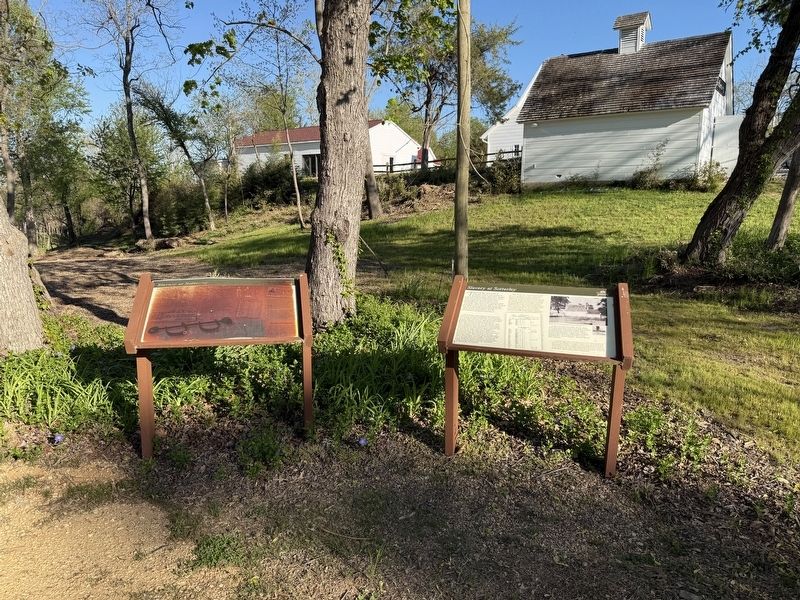
Other nearby markers. At least 8 other markers are within walking distance of this marker: A different marker also named Slavery at Sotterley (here, next to this marker); Sotterley Plantation (within
Additional commentary.
1. Language on the marker
If this marker were erected more recently, it would most likely refer to Briscoe as Barnes' enslaver rather than owner.
— Submitted April 19, 2026, by Devry Becker Jones of Washington, District of Columbia.
Credits. This page was last revised on April 19, 2026. It was originally submitted on April 19, 2026, by Devry Becker Jones of Washington, District of Columbia. This page has been viewed 15 times since then. Photos: 1, 2. submitted on April 19, 2026, by Devry Becker Jones of Washington, District of Columbia.
