Biloxi in Harrison County, Mississippi — The American South (East South Central)
Middle Passage to Biloxi
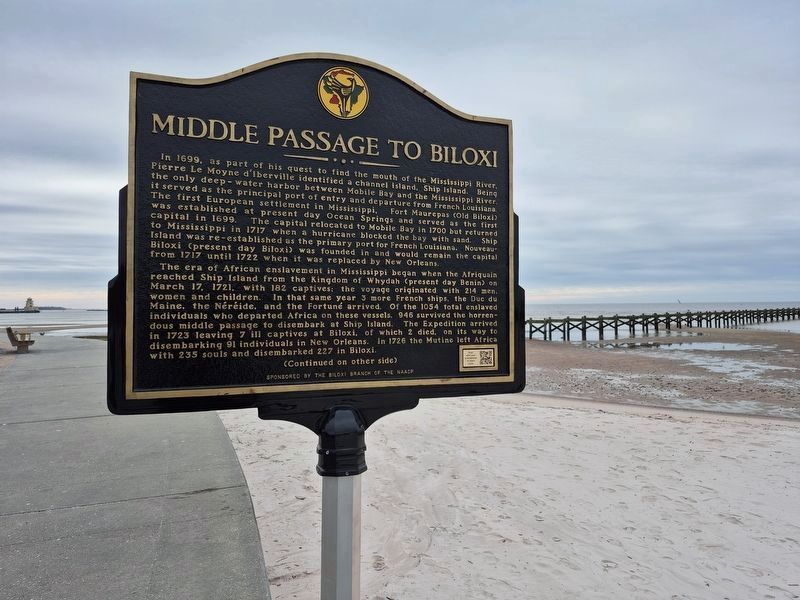
Photographed by Mpcpmp, January 12, 2025
1. Middle Passage to Biloxi Marker
In 1699, as part of his quest to find the mouth of the Mississippi River, Pierre Le Moyne d'Iberville identified a channel island, Ship Island. Being the only deep-water harbor between Mobile Bay and the Mississippi River, it served as the principal port of entry and departure from French Louisiana. The first European settlement in Mississippi, Fort Maurepas (Old Biloxi) was established at present day Ocean Springs and served as the first capital in 1699. The capital relocated to Mobile Bay in 1700 but returned to Mississippi in 1717 when a hurricane blocked the bay with sand. Ship Island (present day Biloxi) was founded in and would remain the capital from 1717 until 1722 when it was replaced by New Orleans.
The era of African enslavement in Mississippi began when the Afriquain reached Ship Island from the Kingdom of Whydah (present day Benin) on March 17, 1721, with 182 captives: the voyage originated with 214 men, women, and children. In that same year 3 more French ships, the Duc du Maine, the Néréide, and the Fortuné arrived. Of the 1054 total enslaved individuals who departed Africa on these vessels, 946 survived
this page online
The 1763 Treaty of Paris ending the Seven Year's War between France and Britain transferred the Louisiana territory east of Mississippi to Britain. In 1776 the British ships Beggar's Bennison, Lord North, Philip, Nancy and Swallow departed with 927 captives from West Africa but only 797 survived to disembark in Mississippi. Following the American Revolution 348 captives were transported from Jamaica to Mississippi between 1784 and 1786.
The Africans were not a monolithic group. Abducted from "nations" in Senegambia, Congo, Angola and Whydah (Benin) regions, they included the Wolof, Fulo, Mandinka and Bambara who spoke Sereer, Malinke, and Pulaar. Their agricultural skills cultivating rice, corn, tobacco, cotton and indigo were essential to the survival of the colony. They were also highly skilled metalworkers in gold, silver, and copper.
Despite diverse

Photographed by Mpcpmp, January 12, 2025
2. Middle Passage to Biloxi Marker
Biloxi MS was declared a UNESCO Site of Memory in 2019.
Erected 2025 by The Biloxi Chapter of the NAACP and Middle Passage Ceremonies and Port Markers Project (MPCPMP).
Topics. This historical marker is listed in these topic lists: African Americans • Colonial Era • Industry & Commerce • Waterways & Vessels. A significant historical date for this entry is March 17, 1721.
Location. 30° 23.632′ N, 88° 54.087′ W. Marker is in Biloxi, Mississippi, in Harrison County. It is at the intersection of Beach Boulevard (U.S. 90) and Porter Avenue, on the right when traveling east on Beach Boulevard. Touch for map. Marker is at or near this postal address: 1061 Beach Blvd, Biloxi MS 39530, United States of America. Touch for directions.

Regionally, this marker is in the American South, specifically in the Deep South, and on the Gulf Coast. Globally, it is in North America, a Gulf of Mexico state, the Western Hemisphere, the Western World, and the Anglosphere. Historically, it finds itself in what was once New Spain, the Viceroyalty of New France, the territory of the Mississippian Culture, one of the Confederate States of America, and the Antebellum South.
Other nearby markers. At least 8 other markers are within walking distance of this marker: Sea Turtles of the Mississippi Sound (here, next to this marker); Civil Rights Wade-Ins (a few steps from this marker); Design for Future Beach Wade-In Memorial (a few steps from this marker); A love letter to Biloxi (within shouting distance of this marker); a different marker also named Biloxi Lighthouse (within shouting distance of this marker); Astronaut Fred Haise (within shouting distance of this marker); The Story of Apollo 13 (within shouting distance of this marker); a different marker also named The Biloxi Lighthouse (within shouting distance of this marker). Touch for a list and map of all markers in Biloxi.
Other markers no longer nearby. The Landing of Pierre LeMoyne D'Iberville (was within shouting distance of this marker but has been permanently removed); Biloxi Beach Wade-In (was within shouting distance of this marker but has been permanently removed); Biloxi Lighthouse (was within shouting distance of this marker but has been permanently removed); a different marker also named Biloxi Lighthouse (was within shouting distance of this marker but has been confirmed missing).
Also see . . . Mississippi: Trans-Atlantic Voyages of Captive Africans to Biloxi. Middle Passage Ceremonies and Port Markers Project (Submitted on February 25, 2026, by James Hulse of Medina, Texas.)
Additional keywords. Middle Passage Ceremonies and Port Markers Project; UNESCO Routes of Enslaved Peoples (Slave Route Project); Human trafficking; Middle Passage; Trans-Atlantic Trade; UNESCO Site of Memory; International Coalition Site of Conscience
Credits. This page was last revised on April 24, 2026. It was originally submitted on February 19, 2026, by Kaycee Hailey of Charlotte, North Carolina. This page has been viewed 91 times since then. Last updated on April 24, 2026, by Kaycee Hailey of Charlotte, North Carolina. Photos: 1. submitted on February 19, 2026, by Kaycee Hailey of Charlotte, North Carolina. 2. submitted on February 23, 2026, by Kaycee Hailey of Charlotte, North Carolina. • Devry Becker Jones was the editor who published this page.
