Tower Hamlets in Greater London, England, United Kingdom — Northwestern Europe (the British Isles)
Jack the Ripper

Photographed by Andrew Ruppenstein, April 25, 2026
1. Jack the Ripper Marker
Who was Jack the Ripper?
There have been numerous attempts to uncover the identity of the man who brutally murdered five East End women between 31 August - 30 November 1888.
Amongst those suspected were Queen Victoria's heir, the Duke of Clarence.
A less prominent suspect was George Chapman, a barber/surgeon, who at the time lived in the cellar of this pub. He was later found guilty of poisoning his three wives for which he was hung. Was he also Jack the Ripper?
Topics. This historical marker is listed in these topic lists: Notable Events • Women. A significant historical date for this entry is August 31, 1888.
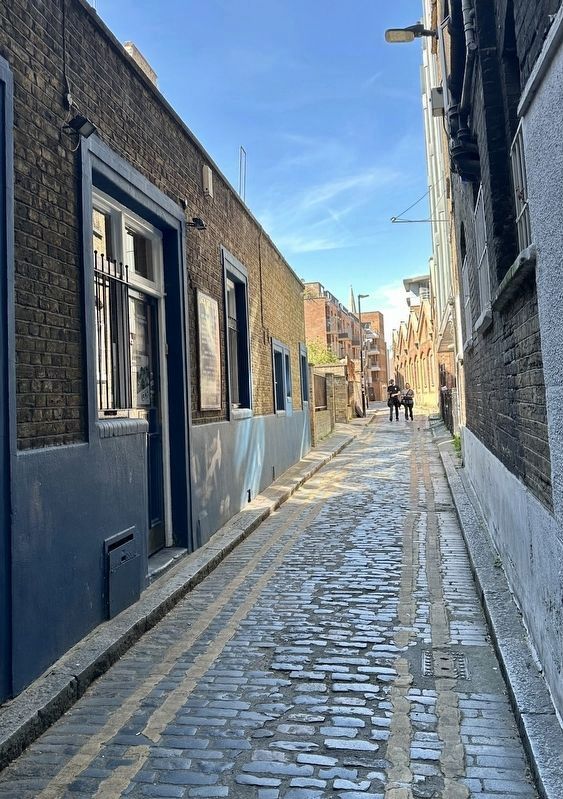
Location. 51° 30.96′ N, 0° 4.255′ W. Marker is in Tower Hamlets, England, in Greater London. It is on Gunthorpe Steet just north of Whitechapel High Street, on the left when traveling north. From Whitechapel High Street, enter Gunthorpe Street through a passageway (where the street name is visible) and walk about 25 meters north to the marker site. Touch for map. Marker is in this post office area: Tower Hamlets, England E1 7QX, United Kingdom. Touch for directions.

Regionally, this marker is in
this page online
Other nearby markers. At least 8 other markers are within walking distance of this marker: Gunthorpe Street (a few steps from this marker); Isaac Rosenberg (within shouting distance of this marker); Dr. Jimmy Mallon (about 120 meters away, measured in a direct line); Dietrich Bonhoeffer (about 240 meters away); Whitechapel (approx. 0.3 kilometers away); Phillis Wheatley (approx. 0.4 kilometers away); Aldgate (approx. half a kilometer away); The Great Synagogue Dukes Place (approx. half a kilometer away). Touch for a list and map of all markers in Tower Hamlets.
Also see . . . Jack the Ripper (Wikipedia). Excerpt:
Jack the Ripper was an unidentified serial killer active in and around the impoverished Whitechapel district of London, England, in 1888. In both criminal case files and the contemporaneous journalistic accounts, the killer was also called the(Submitted on April 25, 2026.)Whitechapel Murderer and Leather Apron.Photographed by Andrew Ruppenstein, April 25, 20262. Jack the Ripper Marker - wide view, looking north on Gunthorpe StreetThe marker is visible here on the left.
Attacks ascribed to Jack the Ripper typically involved women working as prostitutes who lived in the slums of the East End of London. Their throats were cut prior to abdominal mutilations. The removal of internal organs from at least three of the victims led to speculation that the killer had some anatomical or surgical knowledge. Rumours that the murders were connected intensified in September and October 1888, and numerous letters were received by media outlets and Scotland Yard from people purporting to be the murderer.
Extensive newspaper coverage bestowed enduring international notoriety on the Ripper, and the legend solidified. A police investigation into a series of eleven brutal murders committed in Whitechapel and Spitalfields between 1888 and 1891 was unable to connect all the killings conclusively to the 1888 murders. Five victims—Mary Ann Nichols, Annie Chapman, Elizabeth Stride, Catherine Eddowes and Mary Jane Kelly—are known as the "canonical five", and their murders between 31 August and 9 November 1888 are often considered the most likely to be linked. The murders were never solved, and the legends surrounding these crimes became a combination of historical research, folklore and pseudohistory, capturing public imagination to the present day.
Credits. This page was last revised on April 25, 2026. It was originally submitted on April 25, 2026, by Andrew Ruppenstein of Lamorinda, California. This page has been viewed 17 times since then. Photos: 1, 2. submitted on April 25, 2026, by Andrew Ruppenstein of Lamorinda, California.
