Morro Bay in San Luis Obispo County, California — The American West (Pacific Coastal)
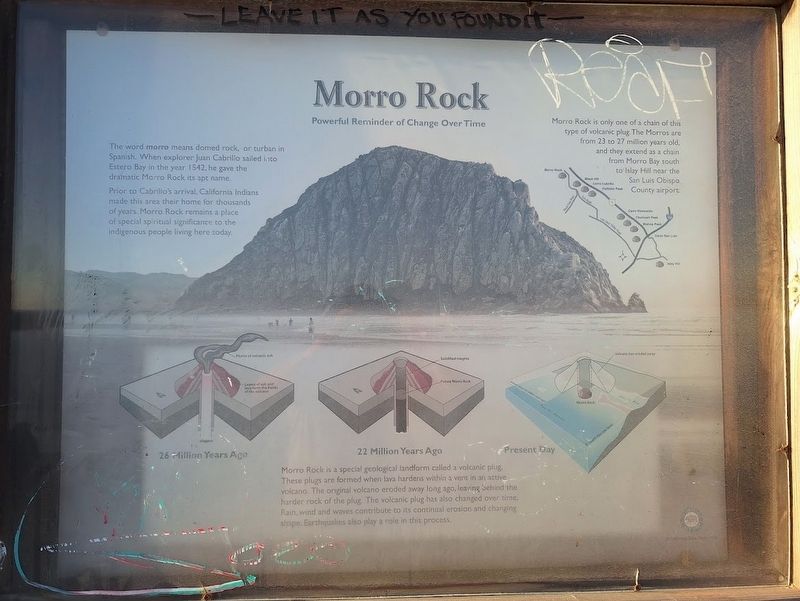
Morro Rock
Powerful Reminder of Change Over Time
Photographed by Jason Voigt, March 25, 2026
1. Morro Rock Marker
The word morro means domed rock, or turban in Spanish. When explorer Juan Cabrillo sailed into Estero Bay in the year 1542, he gave the dramatic Morro Rock its apt name.
Prior to Cabrillo's arrival, California Indians made this area their home for thousands of years. Morro Rock remains a place of special spiritual significance to the indigenous people living here today.
Morro Rock is only one of a chain of this type of volcanic plug. The Morros are from 23 to 27 million years old, and they extend as a chain from Morro Bay south to Islay Hill near the San Luis Obispo County Airport.
Morro Rock is a special geological landform called a volcanic plug. These plugs are formed when lava hardens within a vent in an active volcano. The original volcano eroded away long ago, leaving behind the harder rock of the plug. The volcanic plug has also changed over time. Rain, wind and waves contribute to its continual erosion and changing shape. Earthquakes also play a role in this process.
Erected by California State Parks.
Topics. This historical marker is listed in these topic lists: Exploration • Indigenous Peoples and Communities
this page online
Location. 35° 22.046′ N, 120° 52.057′ W. Marker is in Morro Bay, California, in San Luis Obispo County. It can be reached from Coleman Drive. Marker can be viewed at the Morro Rock Natural Preserve. No vehicular access is allowed on Coleman after the parking lot, as it is a pedestrian trail that leads behind the Morro Rock. Touch for map. Marker is at or near this postal address: Coleman Dr, Morro Bay CA 93442, United States of America. Touch for directions.

Regionally, this marker is on the Central Coast and specifically on the Coast Ranges. It is also on the American Pacific Coast. Globally, it is in North America, on the Ring of Fire, on the Pacific Rim, in the Western Hemisphere, in the Western World, and in the Anglosphere. Historically, it finds itself in what was once New Spain and also Mexico’s Alta California.
Other nearby markers. At least 8 other markers are within walking distance of this marker: A different marker also named Morro Rock (approx. ¼ mile away); Endearing & Endangered (approx. 0.3 miles away); The First Landing of Filipinos in the Continental United States
Photographed by Jason Voigt, March 25, 2026
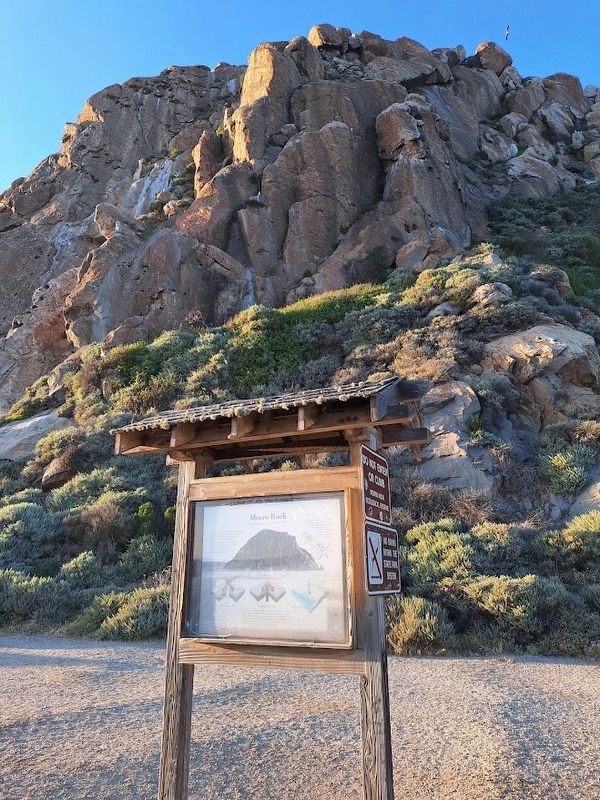
2. Morro Rock Marker
Also see . . . Morro Rock on Wikipedia. (Submitted on April 27, 2026, by Jason Voigt of Glen Carbon, Illinois.)
Credits. This page was last revised on April 27, 2026. It was originally submitted on April 26, 2026, by Jason Voigt of Glen Carbon, Illinois. This page has been viewed 32 times since then. Photos: 1. submitted on April 26, 2026, by Jason Voigt of Glen Carbon, Illinois. 2. submitted on April 27, 2026, by Jason Voigt of Glen Carbon, Illinois.
