Fort Monroe in Hampton, Virginia — The American South (Mid-Atlantic)
First Africans in Virginia
Photographed by Brandon D Cross
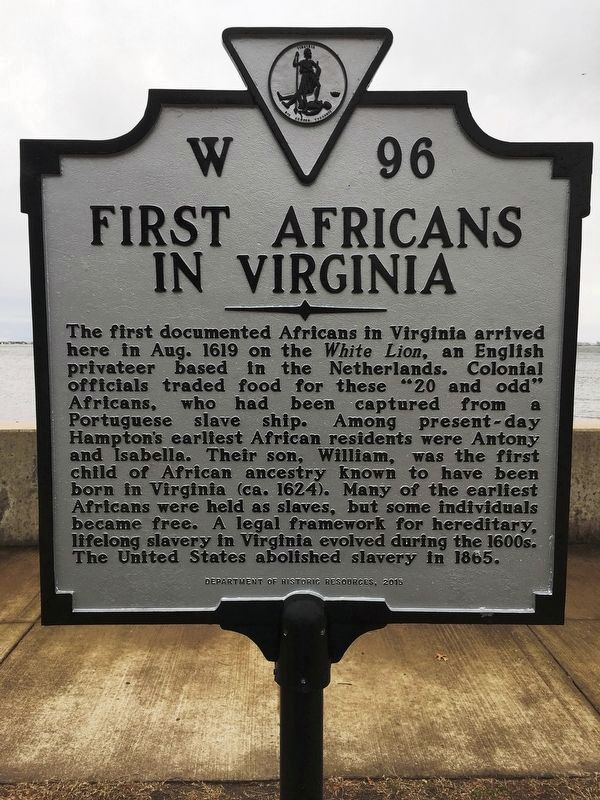
1. First Africans in Virginia Marker
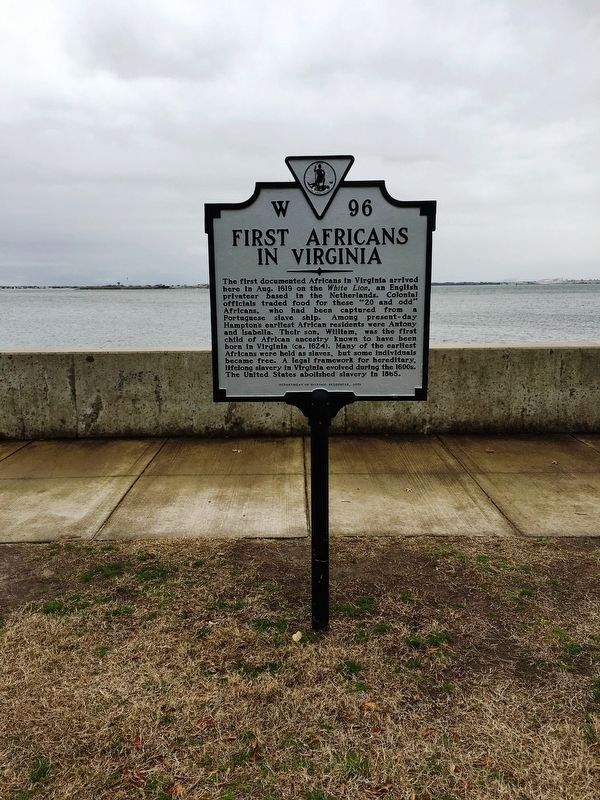
The first documented Africans in Virginia arrived here in Aug. 1619 on the White Lion, an English privateer based in the Netherlands. Colonial officials traded food for these “20 and odd” Africans, who had been captured from a Portuguese slave ship. Among present-day Hampton’s earliest African residents were Antony and Isabella. Their son, William, was the first child of African ancestry known to have been born in Virginia (ca. 1624). Many of the earliest Africans were held as slaves, but some individuals became free. A legal framework for hereditary, lifelong slavery in Virginia evolved during the 1600s. The United States abolished slavery in 1865.
Erected 2015 by Department of Historic Resources. (Marker Number W-96.)
Topics and series. This historical marker is listed in these topic lists: African Americans • Colonial Era • Industry & Commerce • Waterways & Vessels. In addition, it is included in the Virginia Department of Historic Resources (DHR) series list. A significant historical year for this entry is 1619.
Location. 37° 0.062′ N, 76° 18.492′ W. Marker is in Hampton, Virginia. It is in Fort
this page online

Regionally, this marker is on Virginia’s Peninsula and in Coastal Virginia. It is also in the American South, specifically in the Upper South, in the Tidewater, and on the Eastern Seaboard. Globally, it is in the North Atlantic Region, North America, the Western Hemisphere, the Western World, and the Anglosphere. Historically, it finds itself in what was once the territory of the Mississippian Culture, one of the original Thirteen Colonies, one of the Confederate States of America, and the Antebellum South.
Other nearby markers. At least 8 other markers are within walking distance of this marker: Fort Monroe History (within shouting distance of this marker); Notable Locations in the Hampton Roads (within shouting distance of this marker); The Movement of a Legacy (about 300 feet away, measured in a direct line); Retreat / Courtesies (about 300 feet away); The Cultural Connections
Photographed by Brandon D Cross
2. First Africans in Virginia Marker
Other markers no longer nearby. First Africans in Virginia (has been replaced with this marker); Fort Monroe Seawall History (was within shouting distance of this marker but has been confirmed missing); Engineer Wharf (was about 300 feet away but has been confirmed missing); a different marker also named Fort Monroe Seawall History (was about 300 feet away but has been confirmed missing); Lantaka (was about 400 feet away but has been permanently removed); Spanish 1-½-Pounder (was about 400 feet away but has been permanently removed); 12-Pounder Howitzer (was about 400 feet away but has been permanently removed); 3 – Inch Ordnance Rifle (was about 400 feet away but has been permanently removed).
Related marker. Click here for another marker that is related to this marker. This marker has replaced the linked marker.
Also see . . .
1. Old Marker at this Location. This marker replaced an older one at this location also titled
National Park Service, Thomas Stone National Historic Site, August 15, 2018
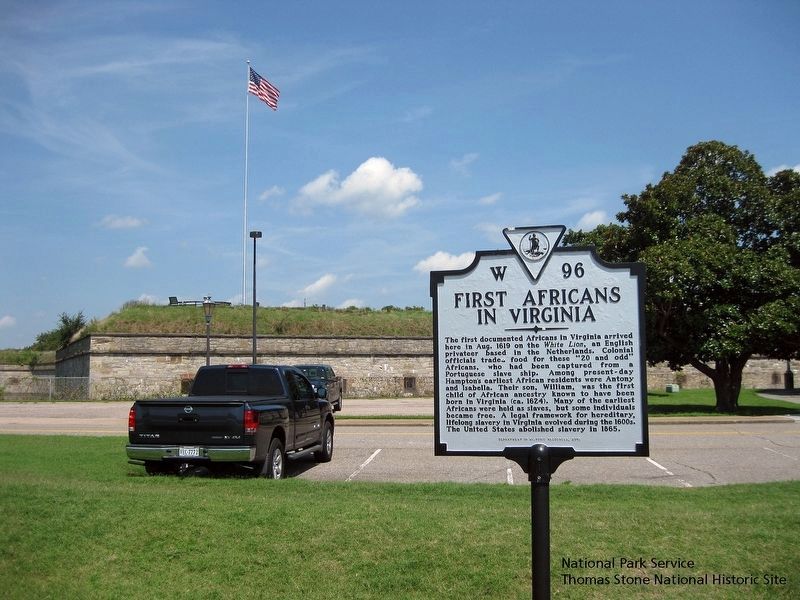
3. First Africans in Virginia Marker
Viewing north towards marker and Fenwick Road.
2. Fort Monroe (Stone Fort) National Register of Historic Places Registration Form (pdf file). (Submitted on August 19, 2019.)
3. Fort Monroe National Monument, National Park Service. (Submitted on August 19, 2019.)
Additional keywords. Human trafficking; Middle Passage; Middle Passage Ceremonies and Port Markers Project; Trans-Atlantic Trade; UNESCO Routes of Enslaved Peoples (Slave Route Project); UNESCO Site of Memory; International Coalition Site of Conscience
Photographed by Devry Becker Jones (CC0), February 6, 2021
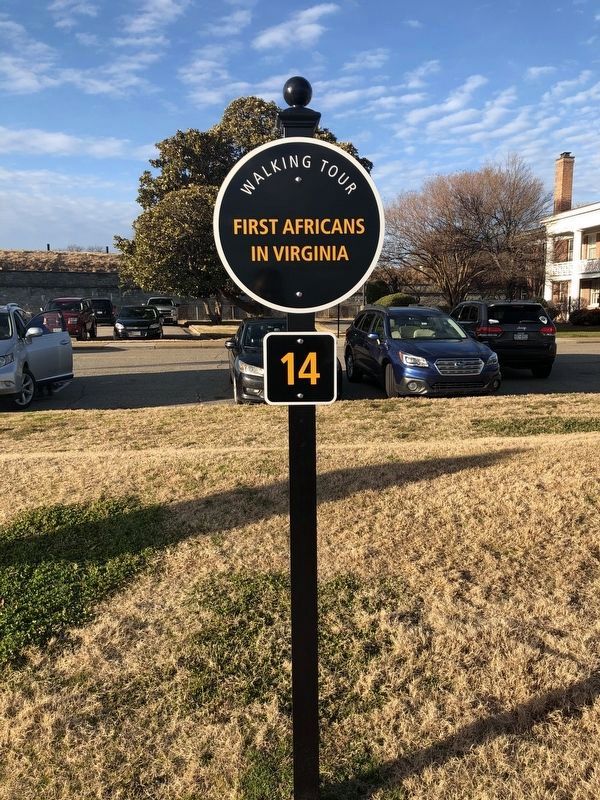
4. Nearby walking tour sign for the marker
Credits. This page was last revised on April 27, 2026. It was originally submitted on February 12, 2019, by Brandon D Cross of Flagler Beach, Florida. This page has been viewed 1,970 times since then and 114 times this year. Last updated on April 27, 2026, by Kaycee Hailey of Charlotte, North Carolina. Photos: 1, 2. submitted on February 11, 2019, by Brandon D Cross of Flagler Beach, Florida. 3. submitted on August 19, 2019. 4. submitted on February 9, 2021, by Devry Becker Jones of Washington, District of Columbia. • Devry Becker Jones was the editor who published this page.
