
St. John's Coalition in Pensacola in Escambia County, Florida — The American South (South Atlantic)
William F. Miller
| — | St. John's Cemetery | — |

Photographed by Cosmos Mariner, June 19, 2025
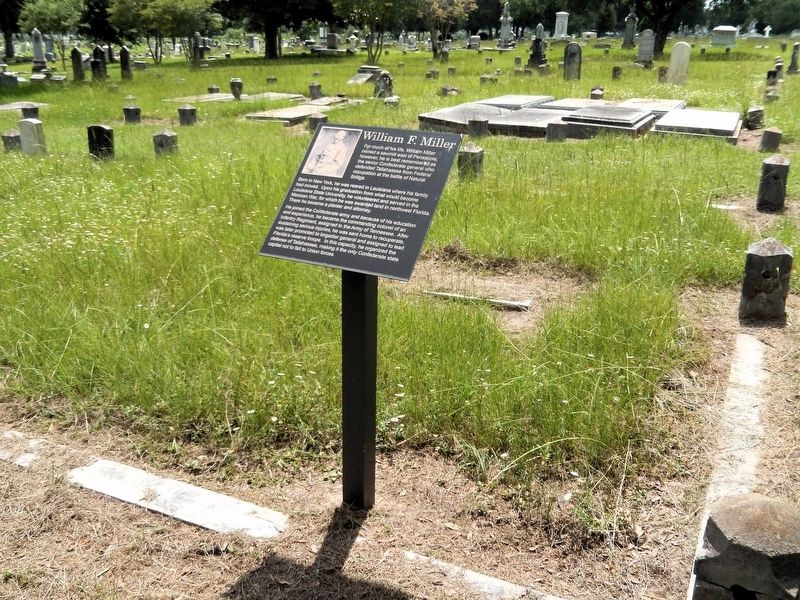
1. William F. Miller Marker
For much of his life, William Miller owned a sawmill east of Pensacola; however, he is best remembered as the senior Confederate general who defended Tallahassee from Federal occupation at the battle of Natural Bridge.
Born in New York, he was reared in Louisiana where his family had moved. Upon his graduation from what would become Louisiana State University, he volunteered and served in the Mexican War, for which he was awarded land in northwest Florida. There he became a planter and attorney.
He joined the Confederate army and because of his education and experience, he became the commanding colonel of an Infantry Regiment, assigned to the Army of Tennessee. Atter sustaining serious injuries, he was sent home to recuperate, was later promoted to brigadier general and assigned to lead Florida's reserve troops. In this capacity, he organized the defense of Tallahassee, making it the only Confederate state capital not to fall to Union forces.
Erected 2018 by Pensacola Bay Area Impact 100 and St. John's Cemetery Foundation.
Topics. This historical marker is listed in these topic lists: Cemeteries & Burial Sites
this page online
Location. 30° 25.019′ N, 87° 13.997′ W. Marker is in Pensacola, Florida, in Escambia County. It is in St. John's Coalition. It can be reached from the intersection of North G Street and West Belmont Street, on the left when traveling north. The marker is on the St. John's Cemetery grounds, at the William F. Miller gravesite in Section 9 Lot 19. Touch for map. Marker is at or near this postal address: 301 North G Street, Pensacola FL 32501, United States of America. Touch for directions.

Regionally, this marker is on the Florida Panhandle. It is also in the American South, specifically in the Deep South, and on the Gulf Coast. Globally, it is in the North Atlantic Region, North America, a Gulf of Mexico state, the Western Hemisphere, the Western World, and the Anglosphere. Historically, it finds itself in what was once New Spain, the territory of the Mississippian Culture, one of the Confederate States of America, and the Antebellum South.
Other nearby markers. At least 8 other markers are within walking distance of this marker:

2. Marker detail: William F. Miller
Related markers. Click here for a list of markers that are related to this marker. St. John's Cemetery
Also see . . .
1. William Miller (Wikipedia).
Excerpt: Attorney, timberman, and politician. He served as a general in the Confederate States Army during the American Civil War. One of the few Northern-born Confederate generals, he led the reserve troops of the state of Florida and helped win one of the South's last victories of the war at the Battle of Natural Bridge.(Submitted on April 30, 2026, by Cosmos Mariner of Cape Canaveral, Florida.)He was engaged in the timber and lumber business in northwest Florida prior to the Civil War. After the war, Miller returned
to his timber business and also established a farm. He eventually settled in Port Washington in Walton County, where he became the justice of the peace. Miller served two terms in the Florida House of Representatives and the Florida Senate.Photographed by Cosmos Mariner, June 19, 20253. William F. Miller MarkerLooking west across St. John's Cemetery from Section 9 Lot 19.
2. William Miller (1820-1909) (Find A Grave).
(Saint John's Cemetery, Pensacola, Escambia County, Florida, USA, Section 9, Lot 19) Excerpt: Civil War Confederate Brigadier General. Born in Ithaca, New York, he graduated from West Point, served in the Mexican War and was engaged in the and lumber business in northwest Florida prior to the Civil War. With the start of the war, he formed a Militia unit and was appointed Colonel of the 1st Florida Infantry in August 1862. At the Battle of Stones River he was severely wounded, sent home to Florida to recuperate and was placed in charge of the Confederate Conscript Bureau for South Florida. In August 1864, he was promoted Brigadier General commander of the Florida District, raised and commanded the 1st Florida Reserves, remaining in position until he surrendered to Union forces at Tallahassee in May 1865. After the war, he returned to his timber business and also established a farm.(Submitted on April 30, 2026, by Cosmos Mariner of Cape Canaveral, Florida.)
Credits. This page was last revised on May 1, 2026. It was originally submitted on April 28, 2026, by Cosmos Mariner of Cape Canaveral, Florida. This page has been viewed 17 times since then. Photos: 1, 2, 3. submitted on April 30, 2026, by Cosmos Mariner of Cape Canaveral, Florida.
