Boerne in Kendall County, Texas — The American South (West South Central)
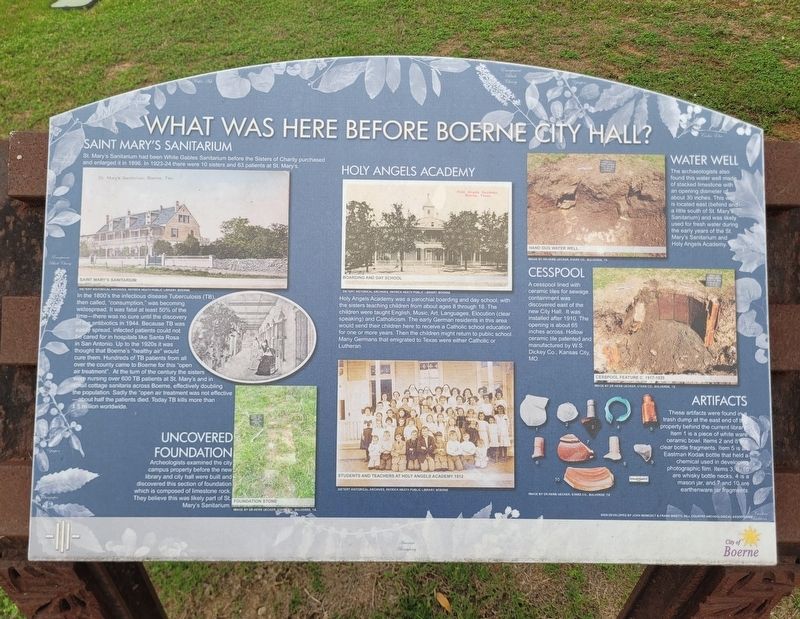
What Was Here Before Boerne City Hall?
Photographed by James Hulse, April 26, 2026
1. What Was Here Before Boerne City Hall? Marker
Saint Mary’s Sanitarium
St. Mary’s Sanitarium had been White Gables Sanitarium before the Sisters of Charity purchased and enlarged it in 1896. In 1923–24 there were 10 sisters and 63 patients at St. Mary’s.
In the 1800s, the infectious disease tuberculosis (TB), then called “consumption,” was becoming widespread. It was fatal at least 50% of the time, and there was no cure until the discovery of the antibiotic in 1944. Because TB was easily spread, infected patients could not be cared for in hospitals like Santa Rosa in San Antonio. Up to the 1920s it was thought that Boerne’s “healthy air” would cure them. Hundreds of TB patients from all over the country came to Boerne for this “open air treatment.” At the turn of the century, the sisters were nursing over 600 TB patients at St. Mary’s and in cottage sanitaria across Boerne, effectively doubling the population. Sadly, the “open air treatment” was not effective; about half the patients died. Today, TB kills more than 1.5 million worldwide.
Uncovered Foundation
Archaeologists examined the city campus property before the new library and city hall were built and
this page online
Holy Angels Academy
Holy Angels Academy was a parochial boarding and day school, with the sisters teaching children from about ages 6 through 18. The children were taught English, music, art, languages, elocution (clear speaking), and Catholicism. Early German residents in this area would send their children here to receive a Catholic school education for one or more years. Then the children might return to public school. Many Germans who immigrated to Texas were either Catholic or Lutheran.
Water Well
The archaeologists also found this water well made of stacked limestone with an opening diameter of about 30 inches. This well is located east (behind and a little south of St. Mary’s Sanitarium) and was likely used for fresh water during the early years of St. Mary’s Sanitarium and Holy Angels Academy.
Cesspool
A cesspool lined with ceramic tiles for sewage containment was discovered east of the new City Hall. It was installed after 1910. The opening is about 65 inches across. Hollow ceramic

Photographed by James Hulse, April 26, 2026
2. What Was Here Before Boerne City Hall? Marker
The marker is located in front of the Boerne City Hall.
Artifacts
These artifacts were found in a trash dump at the east end of the property behind the current library. Item 1 is a piece of whiteware ceramic bowl. Items 2 and 8 are clear bottle fragments. Item 5 is an Eastman Kodak bottle that held a chemical used in developing photographic film. Items 3, 6, and 10 are whisky bottle necks; 4 is a Mason jar; and 7 and 10 are earthenware jar fragments.
Captions:
Saint Mary’s Sanitarium - Dietert Historical Archives, Patrick Heath Public Library, Boerne
Foundation Stone - Image by Dr. Herb Uecker, Stars Co., Bulverde
Boarding and Day School - Dietert Historical Archives, Patrick Heath Public Library, Boerne
Students and Teachers at Holy Angels Academy, 1912 - Dietert Historical Archives, Patrick Heath Public Library, Boerne
Hand-Dug Water Well - Image by Dr. Herb Uecker, Stars Co., Bulverde, TX
Cesspool Feature, c. 1917–1925 - Image by Dr. Herb Uecker, Stars Co., Bulverde, TX
Image by Dr. Herb Uecker, Stars Co., Bulverde, TX
Erected by City of Boerne and John Benedict & Frank Binetti,

Photographed by James Hulse, April 26, 2026
3. What Was Here Before Boerne City Hall? Marker
The view of the marker with Main Street in the background.
Topics. This historical marker is listed in these topic lists: Anthropology & Archaeology • Education • Religion & Religious Structures • Science & Medicine. A significant historical year for this entry is 1896.
Location. 29° 47.862′ N, 98° 44.009′ W. Marker is in Boerne, Texas, in Kendall County. It is at the intersection of North Main Street and Johns Road, on the left when traveling south on North Main Street. Touch for map. Marker is at or near this postal address: 515 N Main St, Boerne TX 78006, United States of America. Touch for directions.

Regionally, this marker is in the Hill Country and in the San Antonio Metropolitan Area. Globally, it is in North America, a Gulf of Mexico state, the Western Hemisphere, the Western World, and the Anglosphere. Historically, it finds itself in what was once New Spain, the Republic of Texas, and one of the Confederate States of America.
Other nearby markers. At least 8 other markers are within walking distance of this marker: Beseler House (within shouting distance of this marker); St. Helena's Episcopal Church (about 300 feet away, measured in a direct line); One-Time Hill Country Health Capital (about 300 feet away); Did Indians Ever Live Here? (about 400 feet away); History of Kendall County (about 700 feet away); Local Groundwater (about 700 feet away); Native Plants (about 700 feet away); Early Kendall County Farming and Ranching (about 700 feet away). Touch for a list and map of all markers in Boerne.
Credits. This page was last revised on April 29, 2026. It was originally submitted on April 28, 2026, by James Hulse of Medina, Texas. This page has been viewed 20 times since then. Photos: 1, 2, 3. submitted on April 29, 2026, by James Hulse of Medina, Texas.
