Washington Park in Roanoke, Virginia — The American South (Mid-Atlantic)
Washington Park
landfill to brownfield
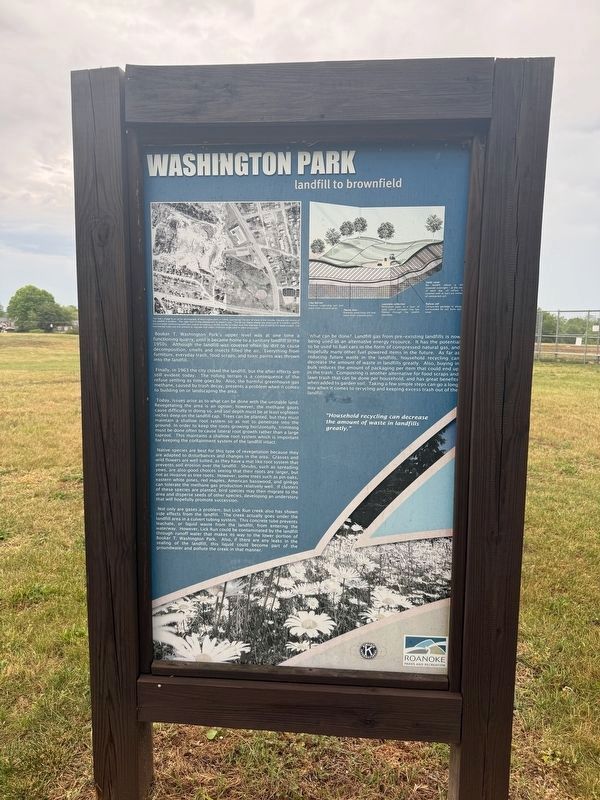
Booker T. Washington Park's upper level was at one time a functioning quarry, until it became home to a sanitary landfill in the 1950s. Although the landfill was covered often by dirt to cause decomposition, smells and insects filled the air. Everything from furniture, everyday trash, food scraps, and toxic paints was thrown into the landfill.
Finally, in 1963 the city closed the landfill, but the after effects are still evident today. The rolling terrain is a consequence of the refuse settling as time goes by. Also, the harmful greenhouse gas methane, caused by trash decay, presents a problem when it comes to building on or landscaping the area.
Today, issues arise as to what can be done with the unstable land. Revegetating the area is an option; however, the methane gases cause difficulty in doing so, and soil depth must be at least eighteen inches deep on the landfill cap. Trees can be planted, but they must maintain a shallow root system so as to not penetrate into the ground. In order to keep the roots growing horizontally, trimming must be done often to cause lateral root growth rather than a large taproot.
this page online
Native species are best for this type of revegetation because they are adapted to disturbances and changes in the area. Grasses and wildflowers are well suited, as they have a mat like root system that prevents soil erosion over the landfill. Shrubs, such as spreading yews, are also good choices seeing that their roots are larger, but not as invasive as tree roots. However, some trees such as pin oaks, eastern white pines, red maples, American basswood, and ginkgo can tolerate the methane gas production relatively well. If clusters of these species are planted, bird species may then migrate to the area and disperse seeds of other species, developing an understory that will hopefully promote succession.
Not only are gases a problem, but Lick Run creek also has shown side effects from the landfill. The creek actually goes under the landfill area in a culvert tubing system. This concrete tube prevents leachate, or liquid waste from the landfill, from entering the waterway. However, Lick Run could be contaminated by the
What can be done? Landfill gas from pre-existing landfills is now being used as an alternative energy resource. It has the potential to be used to fuel cars in the form of compressed natural gas, and hopefully many other fuel powered items in the future. As far as reducing future waste in the landfills, household recycling can decrease the amount of waste in landfills greatly. Also, buying in bulk reduces the amount of packaging per item that could end up in the trash. Composting is another alternative for food scraps and lawn trash that can be done per household, and has great benefits when added to garden soil. Taking a few simple steps can go a long way when it comes to recycling and keeping excess trash out of the landfill.
"Household recycling can decrease the amount of waste in landfills greatly."
[Captions:]
The main image is an aerial photograph of Washington Park in 1959. Just below the line of trees in the middle, the scarred terrain of the landfill is evident. The right half of the photograph is present day. The photo below shows the structure of a modern landfill. Ground water monitoring wells are usually located around the landfill to make sure that leachate is not invading the water supply. Gas monitoring tubes are also present to regulate and collect methane to be used in other processes.
Clay barrier
Prevents underlying soil and water from contamination.
Plastic liner
Prevents underlying soil and water from contamination.
Leachate collection
Perforated pipes in a layer of sand collect rainwater that has filtered through the landfill (leachate).
Refuse cell
Compacted garbage is always surrounded by soil from daily cover.
Daily cover
No land refuse is left exposed overnight - at the end of each day, all refuse is covered with at least six inches of compacted soil.
Erected by Kiwanis International; Roanoke Parks and Recreation.
Topics. This historical marker is listed in these topic lists: Environment • Horticulture & Forestry • Industry & Commerce • Parks & Recreational Areas. A significant historical year for this entry is 1963.
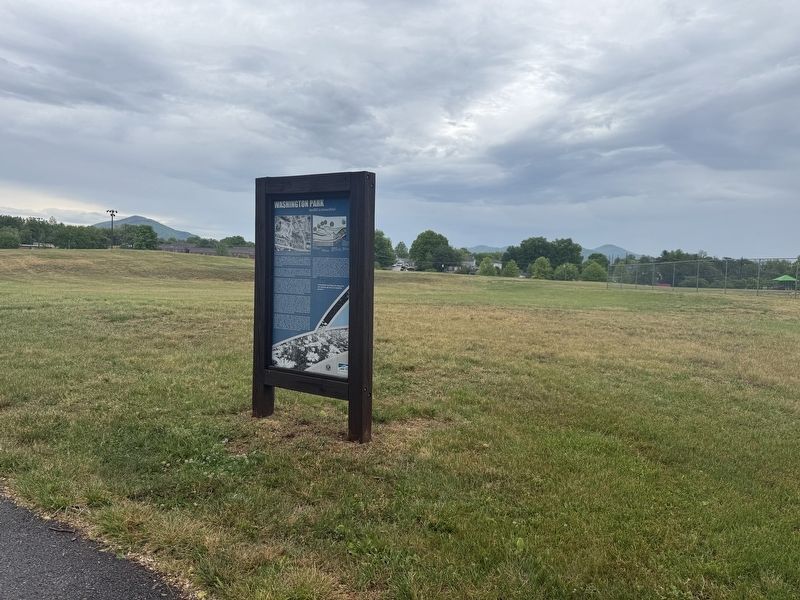
Location. 37° 17.129′ N, 79° 56.768′ W. Marker is in Roanoke, Virginia. It is in Washington Park. It is on Lick Run Greenway north of Carver Avenue Northwest, on the right when traveling north. Touch for map. Marker is in this post office area: Roanoke VA 24016, United States of America. Touch for directions.

Regionally, this marker is in the Mountain Region and in Southwest Virginia. It is also in the American South and specifically in the Upper South. Globally, it is in North America, the Western Hemisphere, the Western World, and the Anglosphere. Historically, it finds itself in what was once the territory of the Mississippian Culture, one of the original Thirteen Colonies, one of the Confederate States of America, and the Antebellum South.
Other nearby markers. At least 8 other markers are within walking distance of this marker: Burrell Memorial Hospital (approx. 0.3 miles away); Lucy Addison (approx. 0.3 miles away); Brown-Robertson Park and the Flood of 1985 (approx. 0.3 miles away); Childhood Home of Oliver White Hill, Sr. (approx. 0.6 miles away); Oliver White Hill Sr. (approx. 0.6 miles away); Gainsboro Branch of the Roanoke City Public Library (approx. 0.6 miles away); Gainsboro Branch Library (approx. 0.6 miles away); Claytor Memorial Clinic (approx. 0.7 miles away). Touch for a list and map of all markers in Roanoke.
Credits. This page was last revised on April 29, 2026. It was originally submitted on April 29, 2026, by Devry Becker Jones of Washington, District of Columbia. This page has been viewed 16 times since then. Photos: 1, 2. submitted on April 29, 2026, by Devry Becker Jones of Washington, District of Columbia.
