Melbourne , Victoria, Australia — Oceania
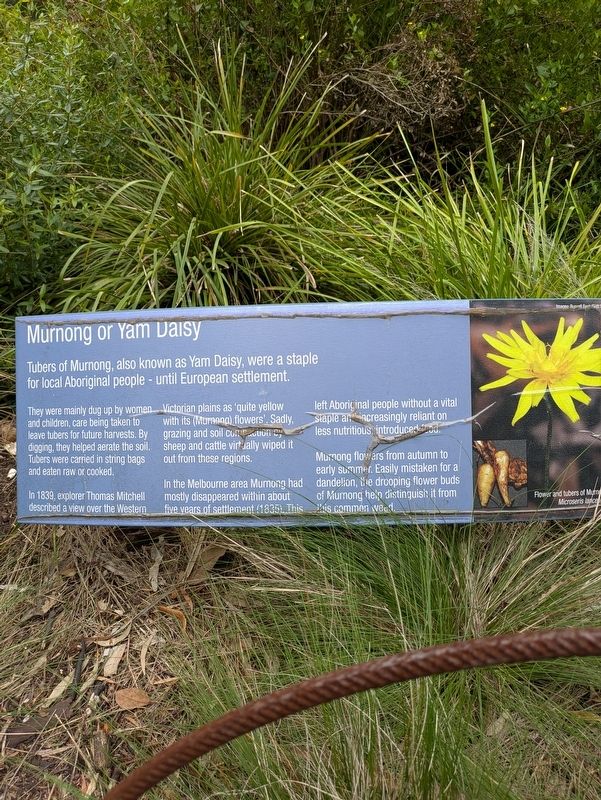
Murong or Yam Daisy
| — | Royal Botanic Gardens - Melbourne | — |
Photographed by Dean Barton-Ancliffe, April 14, 2026
1. Murong or Yam Daisy Marker
Tubers of Murnong, also known as Yam Daisy, were a staple for local Aboriginal people - until European settlement.
They were mainly dug up by women and children, care being taken to leave tubers for future harvests. By digging, they helped aerate the soil. Tubers were carried in string bags and eaten raw or cooked.
In 1839, explorer Thomas Mitchell described a view over the Western Victorian plains as 'quite yellow' with its (Murnong) flowers'. Sadly, grazing and soil compaction by sheep and cattle virtually wiped it out from these regions.
In the Melbourne area Murong had mostly disappeared within about five years of settlement (1835). This left Aboriginal people without a vital staple and increasingly reliant on less nutritious, introduced food.
Murnong flowers from autumn to early summer. Easily mistaken for a dandelion, the drooping flower buds of Murong help distinguish it from this common weed.
Topics. This historical marker is listed in these topic lists: Colonial Era • Horticulture & Forestry • Indigenous Peoples and Communities • Settlements & Settlers. A significant historical year for this entry is 1839.
Location. 37° 49.688′ S,
this page online

Regionally, it is in Oceania, in Australasia, in the Pacific Ocean, in South Pacific, on the Pacific Rim, in the Western World, and in the Anglosphere. Historically, it finds itself in what was once a British colony.
Other nearby markers. At least 8 other markers are within walking distance of this marker: Earth, mother (a few steps from this marker); Victoria's Grassy Woodland (within shouting distance of this marker); Taming the river (within shouting distance of this marker); Victoria's Native Orchids (within shouting distance of this marker); Botanic Gardens Curators or Directors (about 150 meters away, measured in a direct line); Director's Residence Royal Botanic Gardens (approx. 0.3 kilometers away); Morell (Anderson Street) Monier Arch Bridge (approx. 0.4 kilometers away); Carlo Catani (approx. 0.4 kilometers

Photographed by Dean Barton-Ancliffe, April 14, 2026
2. Murong or Yam Daisy Marker in the gardens
Also see . . .
1. Yam daisy, murnong - City of Melbourne.
Floral Emblem for the City of Melbourne(Submitted on April 30, 2026, by Dean Barton-Ancliffe of Rowville, Victoria.)
The yam daisy, also known by its Woi-wurrung name murnong, has roots in Melbourne’s history – literally!
Known for its yellow, star-shaped flowers, beneath the soil, its edible tubers were once an important food source for Kulin peoples. Before colonisation, you could guarantee a bountiful murnong harvest in the fertile plains of the areas we now call Batman’s Hill, Royal Park, Fawkner Park and North Melbourne. The woodlands once in Parkville, Carlton and East Melbourne were also known murnong territory. Today, the murnong is found in the temperate lowlands of Victoria, Tasmania and Australia’s south and east coasts, with the shape and size of its tasty tubers varying depending on location. A resourceful beauty, its leaves are also great for salads.
The murnong is part of the daisy family (Asteraceae). Like the billy-button and swamp everlasting, the murnong’s vibrant bloom is actually a tight cluster of tiny flowers that collectively appear as one. From July to November, it’ll shine in golden glory for a day or two, close and later reopen as a fluffy head of seeds – like a dandelion.
2. Thomas Mitchell - The Australian Museum.
With a reputation as a meticulous worker, he laid out towns, road routes and reserves, filled in vital gaps in inland maps, and discovered much of the best farming land in western Victoria and central Queensland.(Submitted on April 30, 2026, by Dean Barton-Ancliffe of Rowville, Victoria.)
Born in Scotland on 15 June 1792, Mitchell joined the army in 1811. In the Napoleonic Wars his surveying skill was noted and he produced plans of the major battlefields on the Iberian Peninsula.
In 1827 he came to Australia and became Surveyor-General. Surveying instruments were scarce and the department was in disarray, but Mitchell set about conducting the first proper baseline survey of New South Wales.
Credits. This page was last revised on May 1, 2026. It was originally submitted on April 30, 2026, by Dean Barton-Ancliffe of Rowville, Victoria. This page has been viewed 19 times since then. Photos: 1, 2. submitted on April 30, 2026, by Dean Barton-Ancliffe of Rowville, Victoria. • Devry Becker Jones was the editor who published this page.
