Staunton, Virginia — The American South (Mid-Atlantic)
England, 1650s
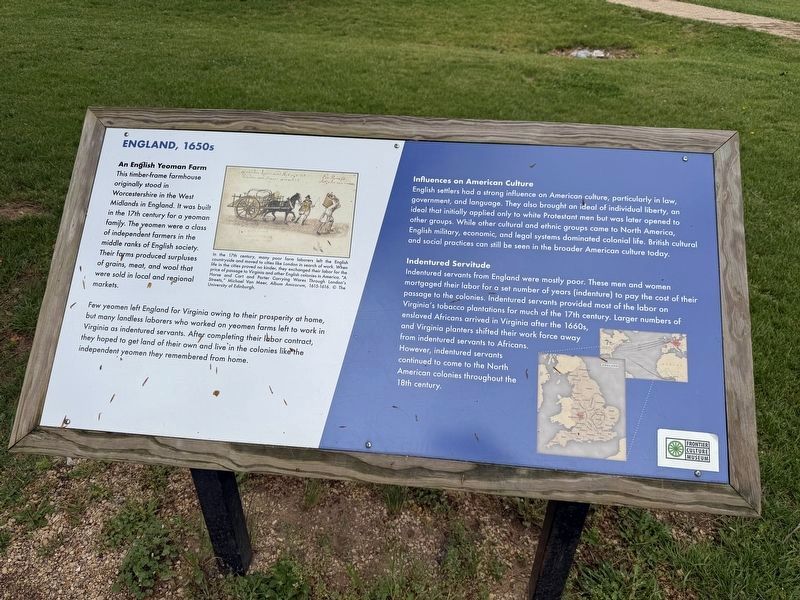
An English Yeoman Farm
This timber-frame farmhouse originally stood in Worcestershire in the West Midlands in England. It was built in the 17th century for a yeoman family. The yeomen were a class of independent farmers in the middle ranks of English society. Their farms produced surpluses of grains, meat, and wool that were sold in local and regional markets.
Few yeomen left England for Virginia owing to their prosperity at home, but many landless laborers who worked on yeoman farms left to work in Virginia as indentured servants. After completing their labor contract, they hoped to get land of their own and live in the colonies like the independent yeomen they remembered from home.
Influences on American Culture
English settlers had a strong influence on American culture, particularly in law, government, and language. They also brought an ideal of individual liberty, an ideal that initially applied only to white Protestant men but was later opened to other groups. While other cultural and ethnic groups came to North America, English military, economic, and legal systems dominated colonial life. British cultural
this page online
Indentured Servitude
Indentured servants from England were mostly poor. These men and women mortgaged their labor for a set number of years (indenture) to pay the cost of their passage to the colonies. Indentured servants provided most of the labor on Virginia's tobacco plantations for much of the 17th century. Larger numbers of enslaved Africans arrived in Virginia after the 1660s, and Virginia planters shifted their work force away from indentured servants to Africans. However, indentured servants continued to come to the North American colonies throughout the 18th century.
[Caption:]
In the 17th century, many poor farm laborers left the English countryside and moved to cities like London in search of work. When life in the cities proved no kinder, they exchanged their labor for the price of passage to Virginia and other English colonies in America. "A Horse and Cart and Porter Carrying Wares Through London's Streets," Michael Van Meer, Album Amicorum, 1615-1616. © The University of Edinburgh.
Erected by Frontier Culture Museum.
Topics.
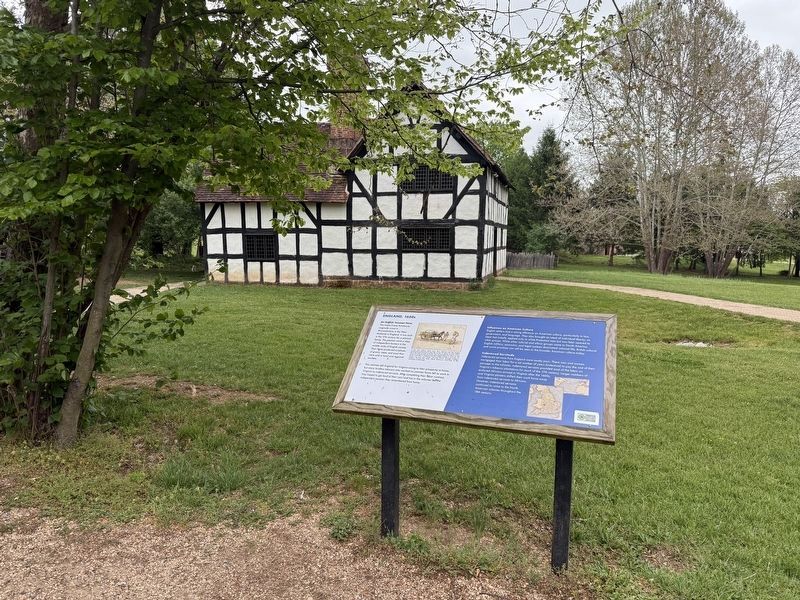
Location. 38° 7.415′ N, 79° 3.109′ W. Marker is in Staunton, Virginia. It can be reached from Frontier Drive north of Barterbrook Road, on the right when traveling north. Touch for map. Marker is at or near this postal address: 250 Moffett Br Dr, Staunton VA 24401, United States of America. Touch for directions.

Regionally, this marker is in the Shenandoah Valley. It is also in the American South and specifically in the Upper South. Globally, it is in North America, the Western Hemisphere, the Western World, and the Anglosphere. Historically, it finds itself in what was once the territory of the Mississippian Culture, one of the original Thirteen Colonies, one of the Confederate States of America, and the Antebellum South.
Other nearby markers. At least 8 other markers are within walking distance of this marker: West Africa, 1700s (about 300 feet away, measured in a direct line); a different marker also named West Africa, 1700s (about 300 feet away); Ireland, 1750s (about 400 feet away); a different marker also named Ireland, 1750s (about 600 feet away); The Great Road (about 600 feet away); Frontier Culture Museum (about 700 feet away); Welcome to the Frontier Culture Museum (about 800 feet away); Great Indian Warrior Trading Path (approx. 0.2 miles away). Touch for a list and map of all markers in Staunton.
Credits. This page was last revised on May 4, 2026. It was originally submitted on May 1, 2026, by Devry Becker Jones of Washington, District of Columbia. This page has been viewed 18 times since then. Photos: 1, 2. submitted on May 1, 2026, by Devry Becker Jones of Washington, District of Columbia.
