Staunton, Virginia — The American South (Mid-Atlantic)
Ireland, 1750s
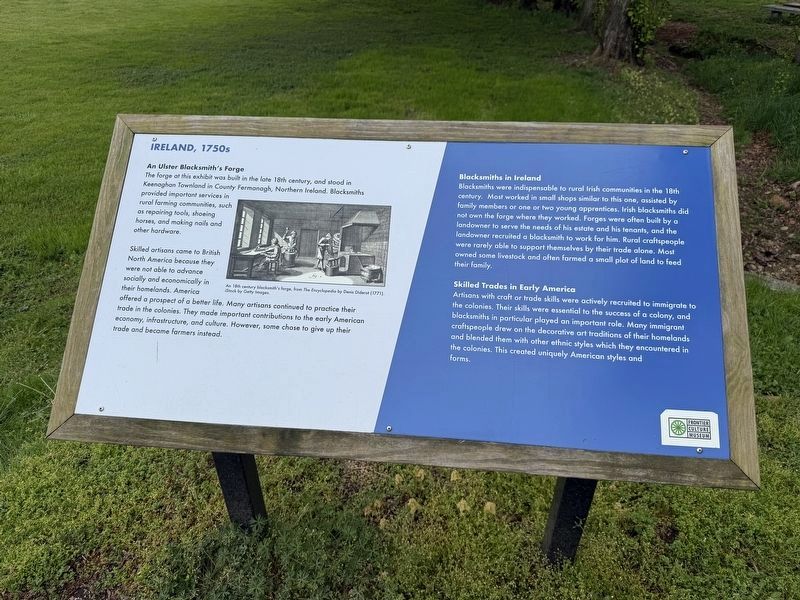
An Ulster Blacksmith's Forge
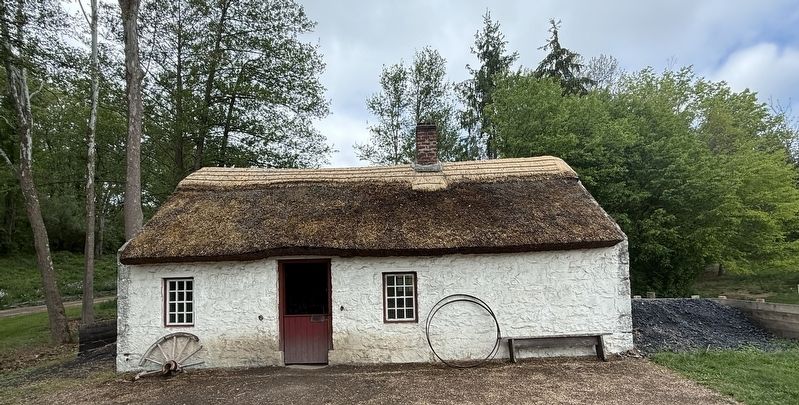
The forge at this exhibit was built in the late 18th century, and stood in Keenaghan Townland in County Fermanagh, Northern Ireland. Blacksmiths provided important services in rural farming communities, such as repairing tools, shoeing horses, and making nails and other hardware.
Skilled artisans came to British North America because they were not able to advance socially and economically in their homelands. America offered a prospect of a better life. Many artisans continued to practice their trade in the colonies. They made important contributions to the early American economy, infrastructure, and culture. However, some chose to give up their trade and became farmers instead.
Blacksmiths in Ireland,br> Blacksmiths were indispensable to rural Irish communities in the 18th century. Most worked in small shops similar to this one, assisted by family members or one or two young apprentices. Irish blacksmiths did not own the forge where they worked. Forges were often built by a landowner to serve the needs of his estate and his tenants, and the landowner recruited a blacksmith to work
this page online
Skilled Trades in Early America
Artisans with craft or trade skills were actively recruited to immigrate to the colonies. Their skills were essential to the success of a colony, and blacksmiths in particular played an important role. Many immigrant craftspeople drew on the decorative art traditions of their homelands and blended them with other ethnic styles which they encountered in the colonies. This created uniquely American styles and forms.
Erected by Frontier Culture Museum.
Topics. This historical marker is listed in these topic lists: Colonial Era • Immigration • Industry & Commerce • Settlements & Settlers.
Location. 38° 7.384′ N, 79° 3.045′ W. Marker is in Staunton, Virginia. It can be reached from Frontier Drive north of Barterbrook Road, on the right when traveling north. Touch for map. Marker is at or near this postal address: 1290 Richmond Rd, Staunton VA 24401, United States


Regionally, this marker is in the Shenandoah Valley. It is also in the American South and specifically in the Upper South. Globally, it is in North America, the Western Hemisphere, the Western World, and the Anglosphere. Historically, it finds itself in what was once the territory of the Mississippian Culture, one of the original Thirteen Colonies, one of the Confederate States of America, and the Antebellum South.
Other nearby markers. At least 8 other markers are within walking distance of this marker: A different marker also named Ireland, 1750s (within shouting distance of this marker); England, 1650s (about 400 feet away, measured in a direct line); West Africa, 1700s (about 600 feet away); a different marker also named West Africa, 1700s (about 600 feet away); The Great Road (about 600 feet away); Germany, 1750s (about 700 feet away); Frontier Culture Museum (about 800 feet away); The Virginia Frontier (approx. 0.2 miles away). Touch for a list and map of all markers in Staunton.
Credits. This page was last revised on May 1, 2026. It was originally submitted on May 1, 2026, by Devry Becker Jones of Washington, District of Columbia. This page has been viewed 17 times since then. Photos: 1, 2, 3. submitted on May 1, 2026, by Devry Becker Jones of Washington, District of Columbia.
