Staunton, Virginia — The American South (Mid-Atlantic)
Ireland, 1750s
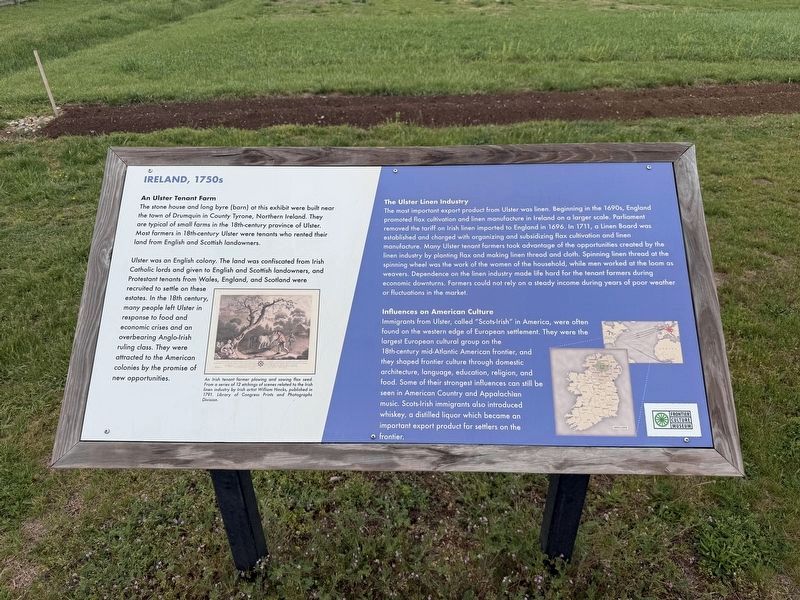
An Ulster Tenant Farm
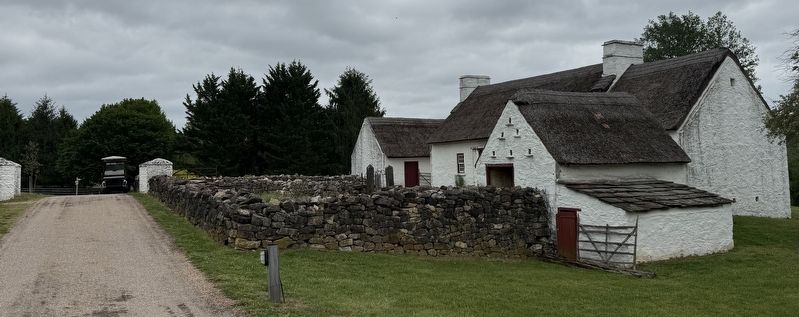
The stone house and long byre (barn) at this exhibit were built near the town of Drumquin in County Tyrone, Northern Ireland. They are typical of small farms in the 18th-century province of Ulster. Most farmers in the 18th-century Ulster were tenants who rented their land from English and Scottish landowners.
Ulster was an English colony. The land was confiscated from Irish Catholic lords and given to English and Scottish landowners, and Protestant tenants from Wales, England, and Scotland were recruited to settle on these estates. In the 18th century, many people left Ulster in response to food and economic crises and an overbearing Anglo-Irish ruling class. They were attracted to the American colonies by the promise of new opportunities.
The Ulster Linen Industry
The most important export product from Ulster was linen. Beginning in the 1690s, England promoted flax cultivation and linen manufacture in Ireland on a larger scale. Parliament removed the tariff on Irish linen imported to England in 1696. In 1711, a Linen Board was established and charged with organizing and subsidizing flax
this page online
Influences on American Culture
Immigrants from Ulster, called "Scots-Irish" in America, were often found on the western edge of European settlement. They were the largest European cultural group on the 18th-century mid-Atlantic American frontier, and they shaped frontier culture through domestic architecture, language, education, religion, and food. Some of their strongest influences can still be seen in American Country and Appalachian music. Scots-Irish immigrants also introduced whiskey, a distilled liquor which became an important export product for settlers on the frontier.
Erected by Frontier Culture Museum.
Topics.
Location. 38° 7.396′ N, 79° 2.995′ W. Marker is in Staunton, Virginia. It can be reached from Frontier Drive north of Barterbrook Road, on the right when traveling north. Touch for map. Marker is at or near this postal address: 1290 Richmond Rd, Staunton VA 24401, United States of America. Touch for directions.

Regionally, this marker is in Virginia’s Shenandoah Valley. It is also in the American South and specifically in the Upper South. Globally, it is in North America, the Western Hemisphere, the Western World, and the Anglosphere. Historically, it finds itself in what was once the territory of the Mississippian Culture, one of the original Thirteen Colonies, one of the Confederate States of America, and the Antebellum South.
Other nearby markers. At least 8 other markers are within walking distance of this marker: A different marker also named Ireland, 1750s (within shouting distance of this marker); Germany, 1750s (about 400 feet away, measured in a direct line); England, 1650s (about 600 feet away); The Great Road (about 600 feet away); The Virginia Frontier (about 600 feet away); West Africa, 1700s (about 700 feet away); a different marker also named West Africa, 1700s (about 700 feet away); Frontier Culture Museum (about 700 feet away). Touch for a list and map of all markers in Staunton.
Credits. This page was last revised on May 4, 2026. It was originally submitted on May 1, 2026, by Devry Becker Jones of Washington, District of Columbia. This page has been viewed 10 times since then. Photos: 1, 2. submitted on May 1, 2026, by Devry Becker Jones of Washington, District of Columbia.
