Morris Slater
| — | St. John's Cemetery | — |

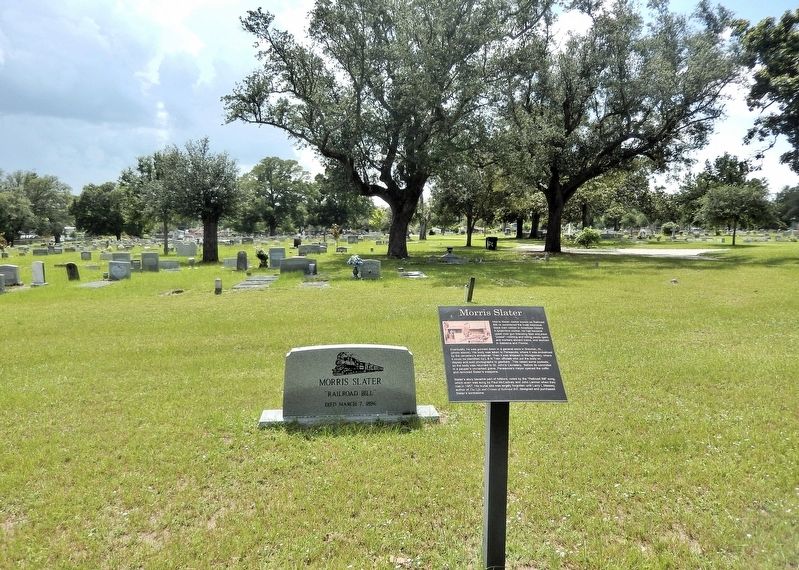
Morris Slater — better known as Railroad Bill — is considered the most infamous black train robber in American history. A turpentine worker, he had become upset over gun licensing fees and went “postal” — robbing and killing passengers and workers aboard trains, and lawmen in Alabama and Florida.
Eventually, he was gunned down in a general store in Brewton, AL, (photo above). His body was taken to Pensacola, where it was embalmed by the cemetery's embalmer. Then it was shipped to Montgomery, where it could be identified by L & N Train officials who put the body on display and sold photographs to gawkers. This raised some protests; so the body was returned to St. John's Cemetery. Before its committal in a pauper's unmarked grave, Pensacola's mayor opened the coffin and removed Slater's weapons.
Slater's story became part of folklore, noted by the “Railroad Bill” song, which even was sung by Paul McCartney and John Lennon when they met in 1957. His burial site was largely forgotten until Larry L. Massey, author of The Life and Crimes of Railroad Bill, designed and purchased Slater's tombstone.
Erected 2018 by Pensacola
this page online
Topics. This historical marker is listed in these topic lists: African Americans • Cemeteries & Burial Sites • Law Enforcement • Railroads & Streetcars. A significant historical date for this entry is March 7, 1896.
Location. 30° 24.978′ N, 87° 14.132′ W. Marker is in Pensacola, Florida, in Escambia County. It is in St. John's Coalition. It can be reached from the intersection of North G Street and West Belmont Street, on the left when traveling north. The marker is near the center of the St. John's Cemetery grounds, in Section 42, Lot 4. Touch for map. Marker is at or near this postal address: 301 North G Street, Pensacola FL 32501, United States of America. Touch for directions.

Regionally, this marker is on the Florida Panhandle. It is also in the American South, specifically in the Deep South, and on the Gulf Coast. Globally, it is in the North Atlantic Region, North America, a Gulf of Mexico state, the Western Hemisphere, the Western World, and the Anglosphere. Historically, it finds itself in what was once New Spain, the territory of the Mississippian Culture,
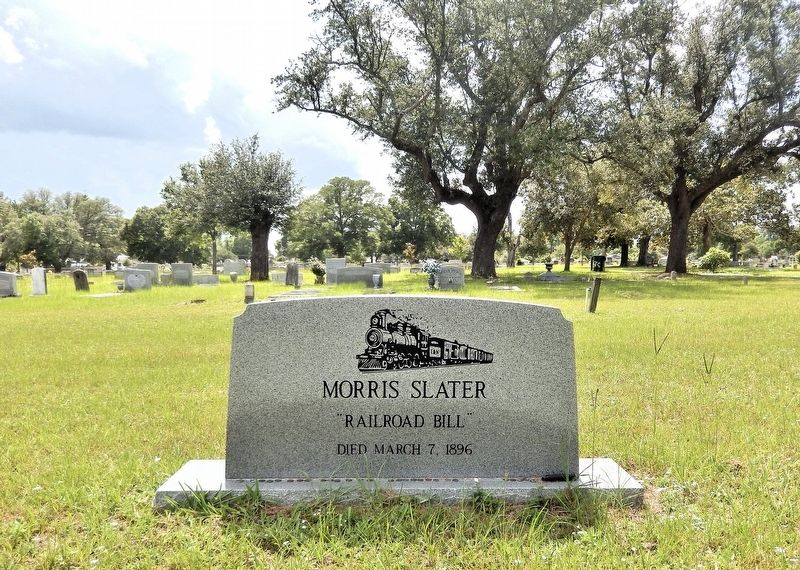
“Railroad Bill”
Died March 7, 1896
Other nearby markers. At least 8 other markers are within walking distance of this marker: Burials (within shouting distance of this marker); Historic Colored Section (within shouting distance of this marker); Historic Greek Section (within shouting distance of this marker); Monument Sculpting (about 400 feet away, measured in a direct line); Mollie McCoy (about 400 feet away); Former Goldfish Pond (about 500 feet away); Samuel G. French (about 500 feet away); Mary W. Willis (about 500 feet away). Touch for a list and map of all markers in Pensacola.
Related markers. Click here for a list of markers that are related to this marker. St. John's Cemetery
Also see . . .
1. Morris “Railroad Bill” Slater (Find A Grave).
(Saint John's Cemetery, Pensacola, Escambia County, Florida, USA, Section 42, Lot 4, Space 8) Excerpt: Railroad Bill — Morris Slater — was an African American robber of freight cars on the L&N, primarily between Hurricane Bayou and Bay Minette. He was a turpentine worker at Bluff Springs until he exchanged gunshots with a deputy(Submitted on May 2, 2026, by Cosmos Mariner of Cape Canaveral, Florida.)from Pensacola one day in 1894. He thereafter conducted robberies on L&N trains, wounded two brakemen, became engaged in a gunfight with about a dozen railroad employees at Hurricane Bayou, killed a deputy named James Stewart at Bay Minette, killed Sheriff McMillan at Bluff Springs and was killed at Atmore in March 1896. In the 1920s he became an item of folklore, and a Negro ballad emerged titled “Railroad Bill.”Photographed by Cosmos Mariner, June 19, 20253. Morris Slater Marker & TombstoneLooking west through St. John's Cemetery from Section 42.Railroad Bill's body was strapped to a board. His guns were placed on his person and he was placed on public display. In every “colored waiting room”, in every major depot, from Atmore and Brewton to Montgomery, citizens were given the chance to pay 25 or 50 cents to view the remains or have their pictures taken with the notorious outlaw.
2. Railroad Bill (song) (YouTube).
Excerpt: Private detectives, rail detectives, lawmen, and citizens were after Bill, or at least the $1250 reward on his head. A posse was taking a break in the store of Tidmore and Eard in Atmore when a lone, black man with a slight limp walked through to the counter. Nobody paid him much attention except the storekeeper who recognized him as Railroad Bill. After Bill's last visit, the storekeeper placed a double barrel shotgun within reach so that he might win that reward. He was so afraid of Bill that he didn't go for the gun.(Submitted on May 2, 2026, by Cosmos Mariner of Cape Canaveral, Florida.)Leonard McGowin had recognized Bill going into the store. Again, Bill's reputation, the legend that he could only be killed by a silver bullet, his known ability with a gun, caused McGowin to hesitate. McGowin went around to a side door and fired his rifle from outside, issuing a fatal wound. On the way down, Bill went for his gun but was hit again by a shotgun blast from the storekeeper. It took the startled posse a moment to figure out what was going on and then they opened fire on the corpse.
3. Railroad Bill (Wikipedia).
Excerpt: Although there was a price on his head for some years, he evaded capture through ingenuity and exceptional athletic abilities. His true name, location of his birth, and details of his family have been debated since his criminal career ended in 1896. What is known is that he once traveled with a circus and learned showmanship and the skills of a performer. He joined a turpentine company in South Carolina and continued with the firm when it moved to Baldwin County, Alabama, and Bluff Springs, Florida. In the turpentine camps he was known as Morris Slater — a profoundly athletic, “top notch” laborer and affable individual.(Submitted on May 2, 2026, by Cosmos Mariner of Cape Canaveral, Florida.)Slater became an antagonist of the Louisville and Nashville Railroad after a brakeman found him stealing a ride to Mobile, Alabama, and threw him off the moving train. That altercation led Slater into a personal vendetta against the company, in which he would wound several trainmen, commandeer a train and force it out of the station, and threaten the life of James I. McKinnie, Superintendent of L&N's Mobile and Montgomery Division. The company responded by dispatching detectives to investigate the offender and offering a reward for his capture. Not knowing Slater's name, detectives simply called him Railroad Bill. Slater embraced the moniker, and it became the name reporters typically used in writing hundreds of newspaper articles about his criminal activities.
On March 7, 1896, Railroad Bill was cornered and killed inside a general store in Atmore, Alabama. The body was embalmed and transported by officers to Montgomery, Alabama, for official identification that would qualify the payment of reward money. It was transported back to Pensacola on March 30, 1896, and given a Christian interment in the African American section of St. John's Cemetery. The ceremony was attended by the mayor and various dignitaries of the city. The location of the grave, however, was unmarked and became lost until rediscovered in 2012 using original interment records. A headstone was then placed on the grave to mark the last resting place of this American desperado.
Credits. This page was last revised on May 2, 2026. It was originally submitted on May 1, 2026, by Cosmos Mariner of Cape Canaveral, Florida. This page has been viewed 21 times since then. Photos: 1, 2, 3. submitted on May 2, 2026, by Cosmos Mariner of Cape Canaveral, Florida.
