The HeLa Legacy Garden
| — | Dixon Amity Peace Trail | — |
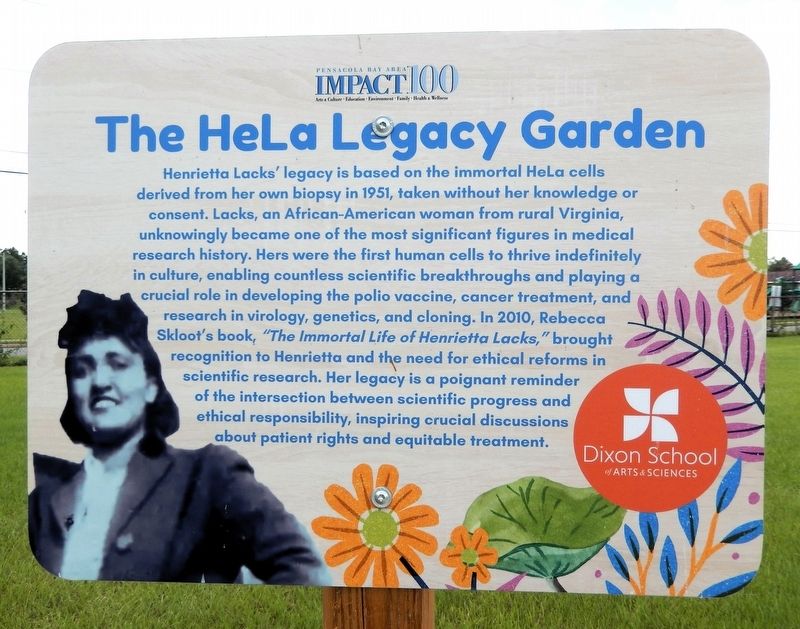
Henrietta Lacks' legacy is based on the immortal HeLa cells derived from her own biopsy in 1951, taken without her knowledge or consent. Lacks, an African-American woman from rural Virginia, unknowingly became one of the most significant figures in medical research history. Hers were the first human cells to thrive indefinitely in culture, enabling countless scientific breakthroughs and playing a crucial role in developing the polio vaccine, cancer treatment, and research in virology, genetics, and cloning. In 2010, Rebecca Skloot's book, “The Immortal Life of Henrietta Lacks,” brought recognition to Henrietta and the need for ethical reforms in scientific research. Her legacy is a poignant reminder of the intersection between scientific progress and ethical responsibility, inspiring crucial discussions about patient rights and equitable treatment.
Erected by Pensacola Bay Area Impact 100.
Topics. This historical marker is listed in these topic lists: African Americans • Science & Medicine • Women. A significant historical year for this entry is 1951.
Location. 30° 25.481′ N, 87° 14.11′ W. Marker is in Pensacola,
this page online

Regionally, this marker is on the Florida Panhandle. It is also in the American South, specifically in the Deep South, and on the Gulf Coast. Globally, it is in the North Atlantic Region, North America, a Gulf of Mexico state, the Western Hemisphere, the Western World, and the Anglosphere. Historically, it finds itself in what was once New Spain, the territory of the Mississippian Culture, one of the Confederate States of America, and the Antebellum South.
Other nearby markers. At least 8 other markers are within walking distance of this marker: Stevie's Trail of Wonder (a few steps from this marker); The Tabei Summit Wall (a few steps from this marker); A. A. Dixon Discovery Pavilion (a few
Also see . . . Henrietta Lacks (1920-1951) (Wikipedia).
Excerpt: African-American woman whose cancer cells are the source of the HeLa cell line, the first immortalized human cell line and one of the most important cell lines in medical research. An immortalized cell line reproduces indefinitely under specific conditions, and the HeLa cell line continues to be a source of invaluable medical data and research to the present day. Lacks was the unwitting source of these cells from a tumor biopsied during her treatment for cervical cancer at the Johns Hopkins Hospital in Baltimore, Maryland, in 1951. These cells were then cultured by George Otto Gey, who created the cell line known as HeLa, which is still used for medical research. As was then the practice, no consent was required to culture the cells obtained from Lacks's treatment. Neither she nor her family were compensated for the extraction or use of the HeLa cells.(Submitted on May 4, 2026, by Cosmos Mariner of Cape Canaveral, Florida.)George Otto Gey, the first researcher to study Lacks's cancerous cells, observed that these cells were unusual in that they reproduced at a very high rate and could be kept alive long enough in culture to allow more in-depth examination. Until then, cells cultured for laboratory studies survived for only a few days at most, which was not long enough to perform a variety of different tests on the same sample. Lacks's cells were the first to be observed that could be divided multiple times without dying, which is why they became known as "immortal". After Lacks's death, Gey had Mary Kubicek, his lab assistant, take further HeLa samples while Henrietta's body was at Johns Hopkins' autopsy facility. Gey was able to start a cell line from Lacks's sample by isolating one specific cell and repeatedly dividing it, meaning that the same cell could then be used for conducting many experiments. They became known as HeLa cells, because Gey's standard method for labeling samples was to use the first two letters of the patient's first and last names. The ability to rapidly reproduce HeLa cells in a laboratory setting has led to many important breakthroughs in biomedical research. HeLa cells were the first human cells successfully cloned, in 1955, and have since been used to test human sensitivity to tape, glue, cosmetics, and many other products. There are almost 11,000 patents involving HeLa cells.
Credits. This page was last revised on May 4, 2026. It was originally submitted on May 1, 2026, by Cosmos Mariner of Cape Canaveral, Florida. This page has been viewed 14 times since then. Photos: 1, 2. submitted on May 4, 2026, by Cosmos Mariner of Cape Canaveral, Florida.
