Staunton, Virginia — The American South (Mid-Atlantic)
Shenandoah Valley, 1820s
Early United States
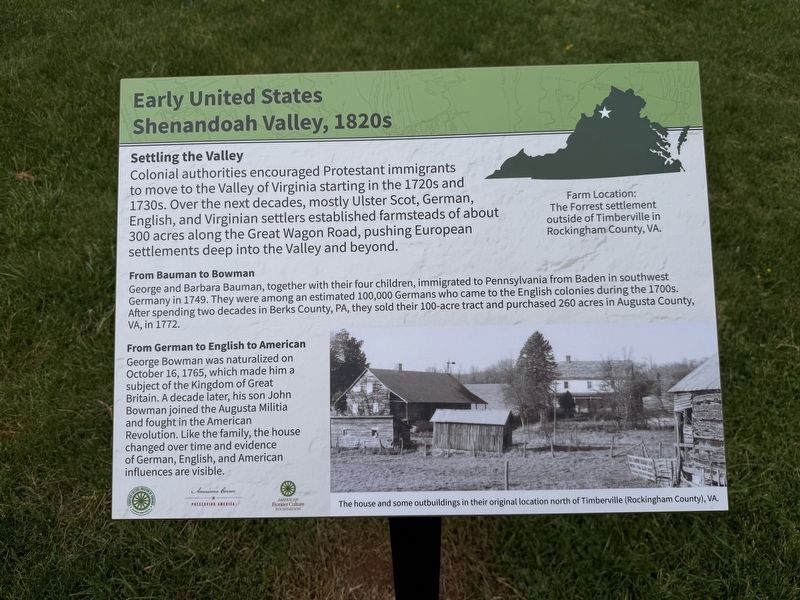
Settling the Valley
Colonial authorities encouraged Protestant immigrants to move to the Valley of Virginia starting in the 1720s and 1730s. Over the next decades, mostly Ulster Scot, German, English, and Virginian settlers established farmsteads of about 300 acres along the Great Wagon Road, pushing European settlements deep into the Valley and beyond.
From Bauman to Bowman
George and Barbara Bauman, together with their four children, immigrated to Pennsylvania from Baden in southwest Germany in 1749. They were among an estimated 100,000 Germans who came to the English colonies during the 1700s. After spending two decades in Berks County, PA, they sold their 100-acre tract and purchased 260 acres in Augusta County, VA, in 1772.
From German to English to American
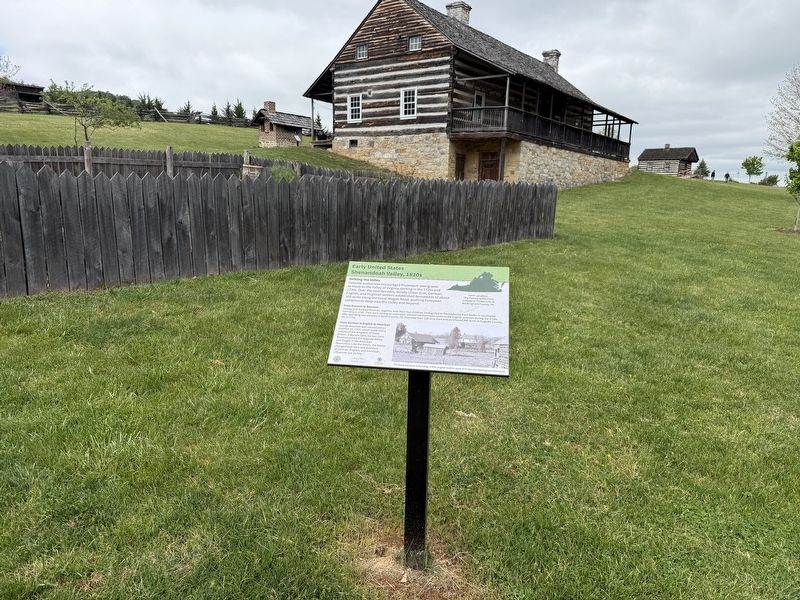
George Bowman was naturalized on October 16, 1765, which made him a subject of the Kingdom of Great Britain. A decade later, his son John Bowman joined the Augusta Militia and fought in the American Revolution. Like the family, the house changed over time and evidence of German, English, and American influences are visible.
[Captions:]
Farm Location: The Forrest settlement outside of Timberville in Rockingham County, VA.
Erected by Frontier
this page online
Topics. This historical marker is listed in these topic lists: Colonial Era • Immigration • Settlements & Settlers • War, US Revolutionary. A significant historical date for this entry is October 16, 1765.
Location. 38° 7.603′ N, 79° 2.7′ W. Marker is in Staunton, Virginia. It can be reached from Frontier Drive north of Barterbrook Road, on the right when traveling north. Touch for map. Marker is at or near this postal address: 1274 Richmond Rd, Staunton VA 24401, United States of America. Touch for directions.

Regionally, this marker is in the Shenandoah Valley. It is also in the American South and specifically in the Upper South. Globally, it is in North America, the Western Hemisphere, the Western World, and the Anglosphere. Historically, it finds itself in what was once the territory of the Mississippian Culture, one of the original Thirteen Colonies, one of the Confederate States of America, and the Antebellum South.
Other nearby markers. At least 8 other markers are within walking distance of this marker: A different marker also
Credits. This page was last revised on May 1, 2026. It was originally submitted on May 1, 2026, by Devry Becker Jones of Washington, District of Columbia. This page has been viewed 17 times since then. Photos: 1, 2. submitted on May 1, 2026, by Devry Becker Jones of Washington, District of Columbia.
