Staunton, Virginia — The American South (Mid-Atlantic)
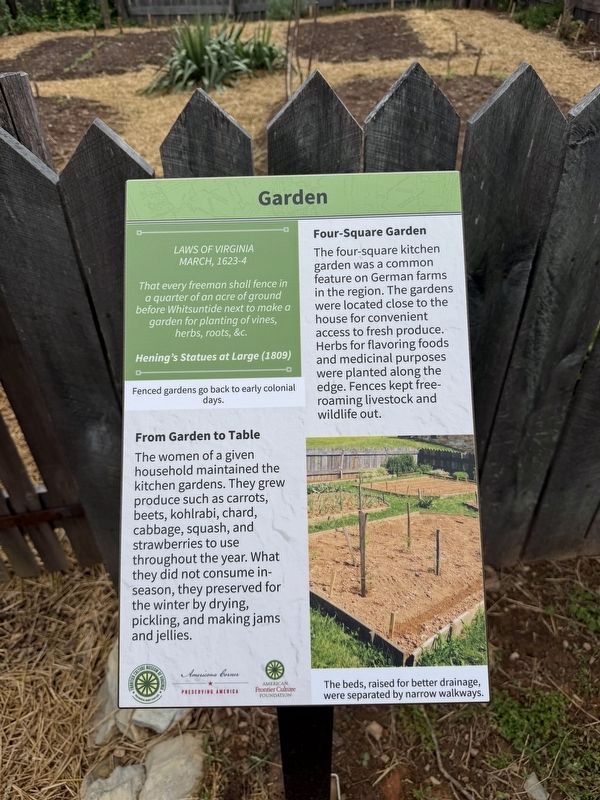
Garden
Four-Square Garden
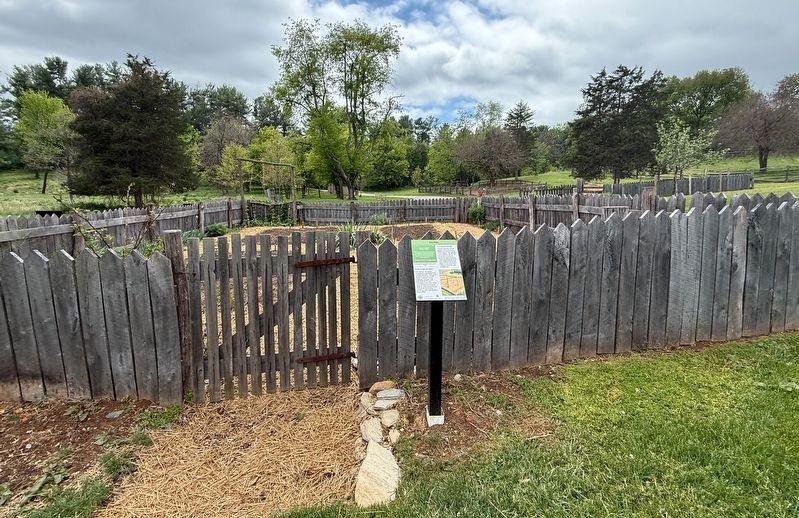
The four-square kitchen garden was a common feature on German farms in the region. The gardens were located close to the house for convenient access to fresh produce. Herbs for flavoring foods and medicinal purposes were planted along the edge. Fences kept free-roaming livestock and wildlife out.
From Garden to Table
The women of a given household maintained the kitchen gardens. They grew produce such as carrots, beets, kohlrabi, chard, cabbage, squash, and strawberries to use throughout the year. What they did not consume in-season, they preserved for winter by drying, pickling, and making jams and jellies.
[Sidebar:]
Laws of Virginia That every freeman shall fence in a quarter of an acre of ground before Whitsuntide next to make a garden for planting of vines, herbs, roots, &c.
March, 1623-4
Hening's Statues at Large (1809)
[Captions:]
Fenced gardens go back to early colonial days.
The beds, raised for better drainage, were separated by narrow walkways.
Erected by Frontier Culture Museum of Virginia; Americana Corner; American Frontier Culture Foundation.
Topics. This
this page online
Location. 38° 7.612′ N, 79° 2.703′ W. Marker is in Staunton, Virginia. It can be reached from Frontier Drive north of Barterbrook Road, on the right when traveling north. Touch for map. Marker is at or near this postal address: 1274 Richmond Rd, Staunton VA 24401, United States of America. Touch for directions.

Regionally, this marker is in the Shenandoah Valley. It is also in the American South and specifically in the Upper South. Globally, it is in North America, the Western Hemisphere, the Western World, and the Anglosphere. Historically, it finds itself in what was once the territory of the Mississippian Culture, one of the original Thirteen Colonies, one of the Confederate States of America, and the Antebellum South.
Other nearby markers. At least 8 other markers are within walking distance of this marker: Shenandoah Valley, 1820s (a few steps from this marker); Valley of Virginia, 1820s (a few steps from this marker); a different
Credits. This page was last revised on May 1, 2026. It was originally submitted on May 1, 2026, by Devry Becker Jones of Washington, District of Columbia. This page has been viewed 15 times since then. Photos: 1, 2. submitted on May 1, 2026, by Devry Becker Jones of Washington, District of Columbia.
