Boerne in Kendall County, Texas — The American South (West South Central)
Herff Ranch

Photographed by James Hulse, April 26, 2026
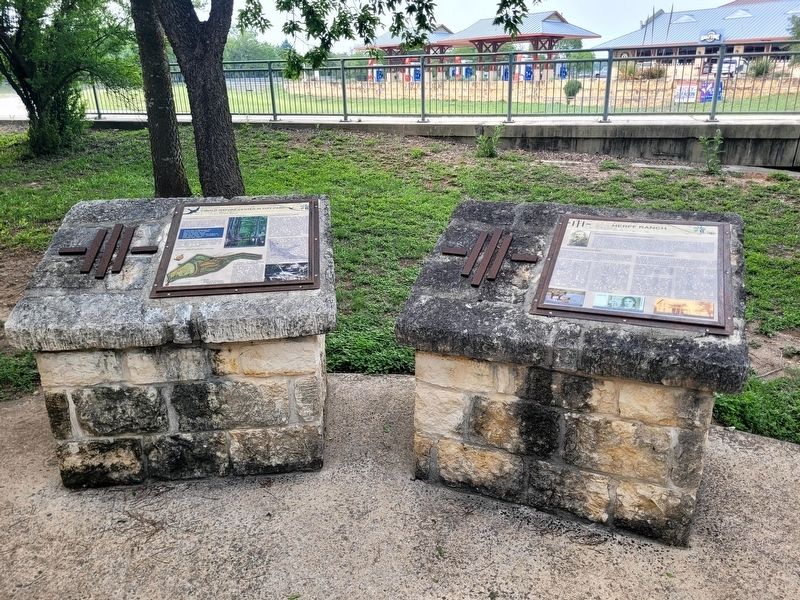
1. Herff Ranch Marker
Early Champion of the Boerne Community
Dr. Ferdinand Herff was an important pillar of the community in Boerne. He arrived in Texas in 1847 with an intellectual community seeking freedom, and soon established himself as a highly skilled doctor when there were few physicians in Texas. He completed many early successful operations in Texas, particularly with cataracts. The Bettina community, which was named after the German writer and novelist, Bettina von Arnim, failed. Dr. Herff returned to Germany to marry and bring his new wife to Texas, where he became a legend in the medical field. In time, he acquired over 10,000 acres of land through purchase and as “in-kind” medical payments for his services to patients without money. You are now standing on land that once belonged to the Herff Ranch. Across the river is the original homestead, and below are two stories from his grandson’s book The Doctors Herff: A Three-Generation Memoir.
A Blind Comanche Brave Sees
Dr. Herff began to learn Apache and Comanche as soon as he arrived and was friendly with the Native Americans. Within his first few weeks at Bettina, a Comanche
this page online
Dr. Herff wrote, “I knew that I was taking a risk, but I was also sure that without surgery this unfortunate Indian would be doomed to permanent blindness... Proverbially, one of the outstanding essentials in a cataract extraction is adequate light. In those primitive days, the only forms of artificial illumination were candlelight and kerosene lamps, whose rays were intensified by magnifying lenses. But the quandary lay in the fact that the only type of anesthesia available was ether by inhalation. The flammable nature of ether definitely contraindicated its use anywhere near a naked flame, so the only solution was to perform the surgery out of doors, aided by the sunlight. I decided to do the work out on a gravel-floored patio adjoining the bunkhouse. Requisites were a clear, entirely cloud-free, dustless, windless, insectless day. Surrounding the operating group stood a dozen 40-ers [the Bettina community] with palm leaf fans to keep the flies away. The patient was put to sleep by my associate physician while the subject’s head was steadied by Julie Herff [no relation to Dr. Herff], and I was ready to go to work.”
–
Photographed by James Hulse, April 26, 2026
2. Herff Ranch Marker
The marker is the right side marker of the two markers and the left marker is the Cibolo Nature Center in City Park marker.
The White Feather Story
Dr. Herff’s benevolent work among the Native Americans bore a great blessing in 1888 during the last serious Lipan uprising in the Boerne area. The family had found a group of Lipans near the Cibolo Falls earlier and fled back to the ranch, barricading themselves in the house. Dr. Ferdinand Peter Herff, Dr. Herff’s grandson, writes of the experience.
“The long night was sleepless but undisturbed until shortly before daylight. Piercing screams coming from the direction of Menger Creek bottom abruptly shattered the ominous silence.
By morning, the roads were alive with large, well-armed posses in angry search of the marauders. The attackers had been busy during the night, killing seven shepherds, stealing entire herds of cattle, and burning property. It became quickly apparent that the Herff ranch had been left unmolested, despite its precarious location in the track of an otherwise merciless rampage. A lone arrow protruding from the main gatepost supplied a frightening affirmation of the closeness of the family’s brush with peril. Tied to the missile was a white feather, the answer to the enigma of their survival. Long associated with Dr. Herff because of his medical services to their tribe, the Lipans had graciously extended the tribal sign of immunity... The Lipan tribute was possibly the most eloquent honor ever bestowed upon the doctor, spelling as it did the difference between life and death for the one honored and for his family.”
–
Photographed by James Hulse, April 26, 2026
3. Herff Ranch Marker
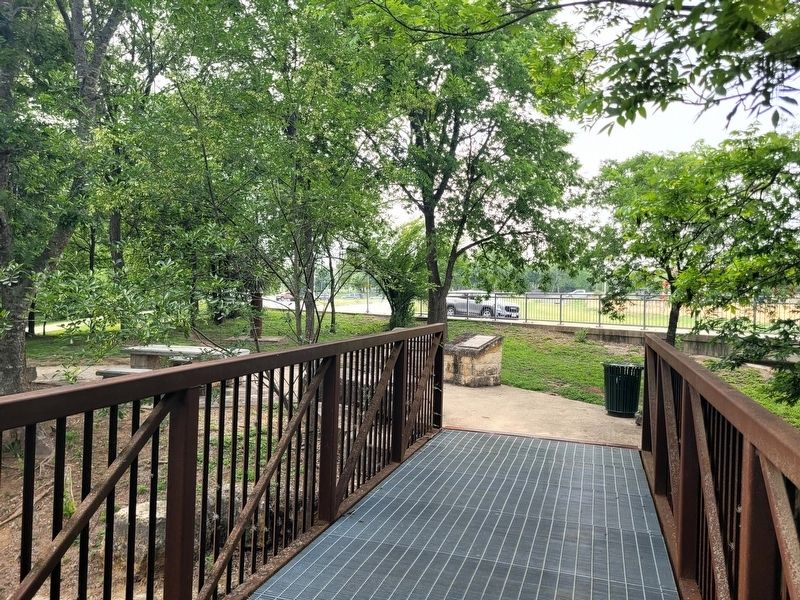
The view of the marker from the bridge.
Captions:
Dr. Herff
Dr. Herff’s Eye Operation Succeeded
Portrait of Bettina, the Community’s Namesake
Herff Ranch, circa 1880s
Erected by City of Boerne.
Topics. This historical marker is listed in these topic lists: Indigenous Peoples and Communities • Science & Medicine. A significant historical year for this entry is 1847.
Location. 29° 47.246′ N, 98° 42.913′ W. Marker is in Boerne, Texas, in Kendall County. It is on City Park Rd 0.1 miles east of State Highway 46. The marker is about 250 meters west of the city pool along the Cibolo Creek Trail. Touch for map. Marker is at or near this postal address: 106 City Park Rd, Boerne TX 78006, United States of America. Touch for directions.

Regionally, this marker is in the Hill Country and in the San Antonio Metropolitan Area. Globally, it is in North America, a Gulf of Mexico state, the Western Hemisphere, the Western World, and the Anglosphere. Historically, it finds itself in what was once New Spain, the Republic of Texas, and one of the Confederate States of America.
Other nearby markers. At least 8 other markers are within walking
Photographed by James Hulse, April 26, 2026
4. Herff Ranch Marker
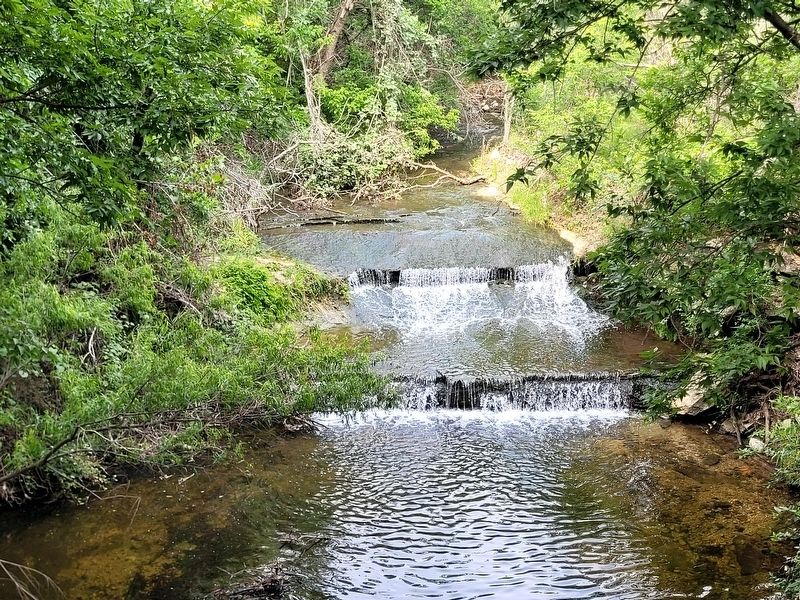
The view of the waterfalls east of the marker from the bridge.
Also see . . . Ferdinand Ludwig Herff. Wikipedia (Submitted on May 3, 2026, by James Hulse of Medina, Texas.)
Credits. This page was last revised on May 3, 2026. It was originally submitted on May 2, 2026, by James Hulse of Medina, Texas. This page has been viewed 30 times since then. Photos: 1, 2, 3, 4. submitted on May 3, 2026, by James Hulse of Medina, Texas.
