Aurora in Kane County, Illinois — The American Midwest (Great Lakes)
The Illiniwek and “The Illinois Country”
Photographed by Sean P. Flynn, May 3, 2026
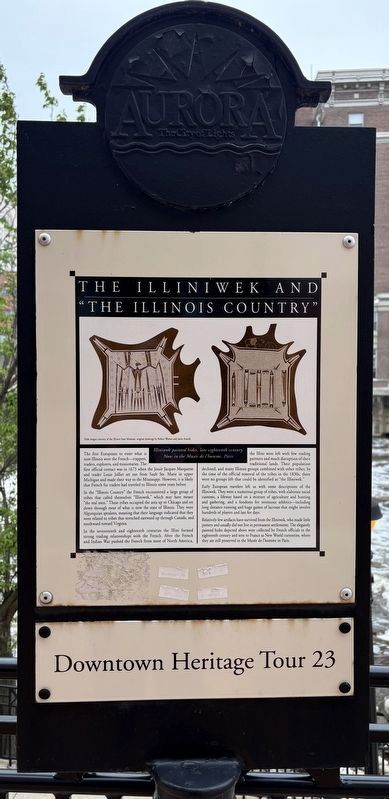
1. The Illiniwek and "The Illinois Country" Marker
In the "Illinois Country" the French encountered a large group of tribes that called themselves "Illiniwek," which may have meant "the real men." These tribes occupied the area up to Chicago and on down through most of what is now the state of Illinois. They were Algonquian speakers, meaning that their language indicated that they were related to tribes that stretched eastward up through Canada, and southward toward Virginia.
In the seventeenth and eighteenth centuries the Illini formed strong trading relationships with the French. After the French and Indian War pushed the French from most of North America, the Illini were left with few trading partners and much disruption of their traditional lands. Their population declined, and many Illinois groups combined with other tribes; by the time of the official removal of the tribes in the 1830s, there were no groups left that could be identified as "the Illiniwek."
Early European travelers left us with some descriptions of the Illiniwek. They were a numerous group of tribes, with elaborate social customs, a lifeway based on a mixture of agriculture and hunting and gathering, and a fondness for strenuous athletics—including long distance running and huge games of lacrosse that might involve hundreds of players and last for days.
Relatively few artifacts have survived from the Illiniwek, who made little pottery and usually did not live in permanent settlements. The elegantly
this page online
[Caption below photo:]
Illiniwek painted hides, late eighteenth century. Now in the Musée de l'homme, Paris
Topics. This historical marker is listed in these topic lists: Exploration • Indigenous Peoples and Communities • Sports • War, French and Indian. A significant historical year for this entry is 1673.
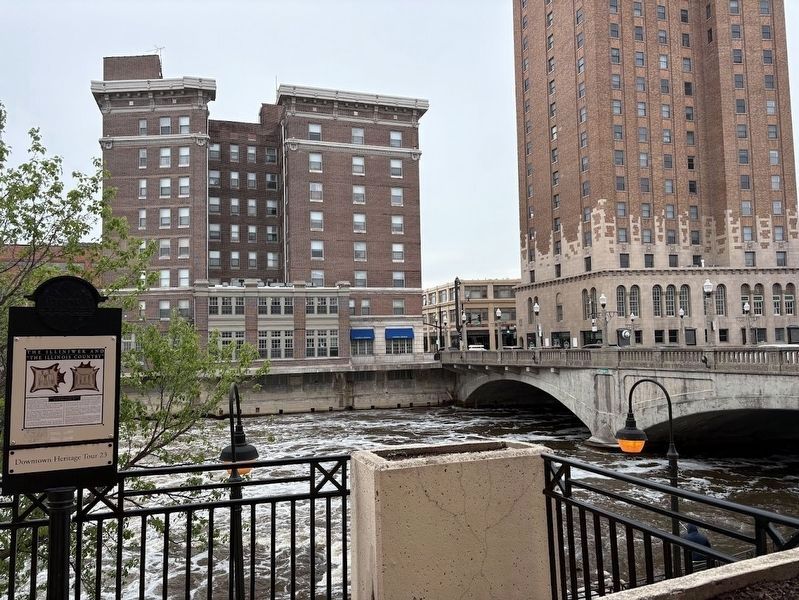
Location. 41° 45.532′ N, 88° 18.938′ W. Marker is in Aurora, Illinois, in Kane County. It is on Galena Boulevard east of River Street, on the left when traveling east. The marker is in a plaza that overlooks the Fox River and its walking trail. Touch for map. Marker is at or near this postal address: 43 West Galena Boulevard, Aurora IL 60506, United States of America. Touch for directions.

Regionally, this marker is in Greater Chicago. It is also in the American Midwest. Globally, it is in North America, on the Great Lakes, in the Western Hemisphere, in the Western World, and in the Anglosphere. Historically,
Photographed by Sean P. Flynn, May 3, 2026
2. The Illiniwek and “The Illinois Country” Marker overlooking the Fox River
Other nearby markers. At least 8 other markers are within walking distance of this marker: Tivoli Theatre (within shouting distance of this marker); Block & Kuhl Store (within shouting distance of this marker); Aurora Hotel • Leland Hotel (about 300 feet away, measured in a direct line); Memorial Bridge (about 300 feet away); Leland Hotel (about 300 feet away); Millennium Plaza (about 300 feet away); Hobbs Building (about 400 feet away); Millennium Tower (about 400 feet away). Touch for a list and map of all markers in Aurora.
Also see . . . The Illinois, aka Illiniwek & Illini: A Chronicle of Power, Demise, and Women's Roles. A blog from the Digital Research Library of the Illinois History Journal explores the history of the Illiniwek, a native group that is the namesake of Illinois.
Excerpt: "To fully comprehend the Illiniwek Confederacy, we must delve into its foundation – the constituent tribes. The Peoria, Kaskaskia, and Cahokia were just a few prominent groups that united under the banner of the Illiniwek.(Submitted on May 4, 2026, by Sean P. Flynn of Oak Park, Illinois.)Interestingly, the name 'Illiniwek,' signifying 'the men,' originated from their own designation. Upon encountering this powerful alliance, French explorers bestowed upon them the name Illinois, a moniker that has endured. The arrival of Marquette and Jolliet in 1673, the voyage etched a path down the Mississippi River, marked a significant chapter in the annals of European-Illiniwek interaction."Photographed by Sean P. Flynn, May 3, 20263. The Illiniwek and “The Illinois Country” Marker overlooking the Fox River
Photographed by Sean P. Flynn, May 3, 2026
4. The Illiniwek and “The Illinois Country” Marker
Credits. This page was last revised on May 4, 2026. It was originally submitted on May 3, 2026, by Sean P. Flynn of Oak Park, Illinois. This page has been viewed 28 times since then. Photos: 1. submitted on May 3, 2026, by Sean P. Flynn of Oak Park, Illinois. 2, 3, 4. submitted on May 4, 2026, by Sean P. Flynn of Oak Park, Illinois.
