Near Fort Hunter in Montgomery County, New York — The American Northeast (Mid-Atlantic)
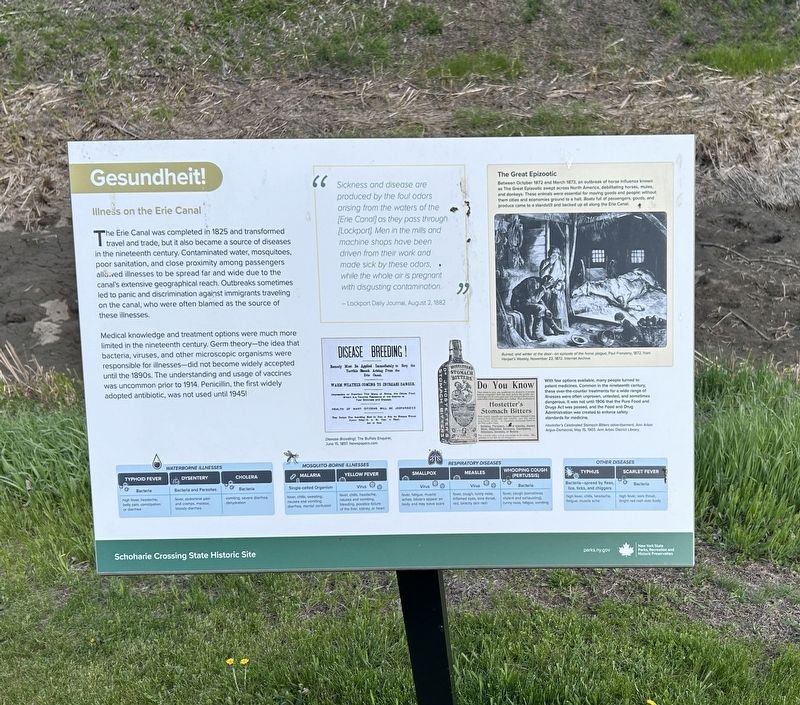
Gesundheit!
Illness on the Erie Canal
| — | Schoharie Crossing State Historic Site | — |
Photographed by Steve Stoessel, May 2, 2026
1. Gesundheit! Marker
Medical knowledge and treatment options were much more limited in the nineteenth century. Germ theory-the idea that bacteria, viruses, and other microscopic organisms were responsible for illnesses-did not become widely accepted until the 1890s. The understanding and usage of vaccines was uncommon prior to 1914. Penicillin, the first widely adopted antibiotic, was not used until 1945
"Sickness and disease are produced by the foul odors arising from the waters of the (Erie Canal] as they pass through [Lockport]. Men in the mills and machine shops have been driven from their work and made sick by these odors, while the whole air is pregnant with disgusting contamination."
this page online
The Great Epizootic
Between October 1872 and March 1873, an outbreak of horse influenza known as The Great Epizootic swept across North Americe, debilitating horses, mules. and donkeys. These animals were essential for moving goods and people; without them cities and economies ground to a halt. Boats full of passengers, goods, and produce came to a standstill and backed up all along the Erie Canal.
[Illustration Caption: ] Ruined, and winter at the door- an episode of the horse plague, Paul Frenzeny, 1872. from Harper's Weekly, November 23, 1872. Internet Archive
With few options available, many people turned to patent medicines. Common in the nineteenth century. these over-the-counter treatments for a wide range of illnesses were often unproven, untested, and sometimes dangerous. It was not until 1906 that the Pure Food and Drugs Act was passed, and the Food and Drug Administration was created to enforce safety standards for medicine.
[ Illustration Captions: ]
Hostetter's Celebrated Stomach Bitters advertisement, Ann Arbor Argus-Democrat, May 15, 1903. Ann Arbor District Library
Disease Breeding!, The Buffalo Enquirer, June 15, 1897. Newspapers.com
Waterborne Illnesses
Typhoid Fever
Photographed by Steve Stoessel, May 2, 2026
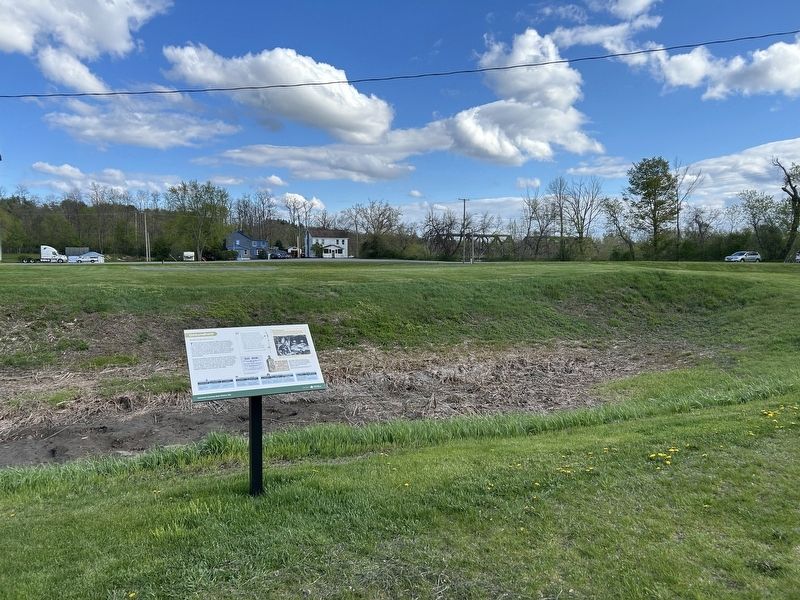
2. Gesundheit! Marker
Dysentery - Bacteria and Parasites - fever, abdominal pain and cramps, malaise, bloody diarrhea
Cholera – Bacteria - vomiting, severe diarrhea, dehydration
Mosquito-Borne Illnesses
Malaria - Single-celled Organism - fever, chills, sweating nausea and vomiting, diarrhea, mental confusion
Yellow Fever – Virus - fever, chills, headache, bleeding, possible failure of the liver, kidney, or heart
Respiratory Diseases
Smallpox – Virus - fever, fatigue, muscle aches, blisters appear on body and may leave scars
Measles – Virus - fever, cough, runny nose. inflamed eyes, sore throat. red, blotchy skin rash
Whooping Cough (Pertussis) – Bacteria – fever, cough (sometimes violent and exhausting), runny nose, fatigue, vomiting
Other Diseases
Typhus - Bacteria-spread by fleas, lice, ticks, and chiggers - high fever, chills, headache, fatigue, muscle ache
Scarlet Fever – Bacteria - high fever, sore throat, bright red rash over
Erected by New York State Parks, Recreation and Historic Preservation.
Topics. This historical marker is listed in these
Photographed by Steve Stoessel, May 2, 2026
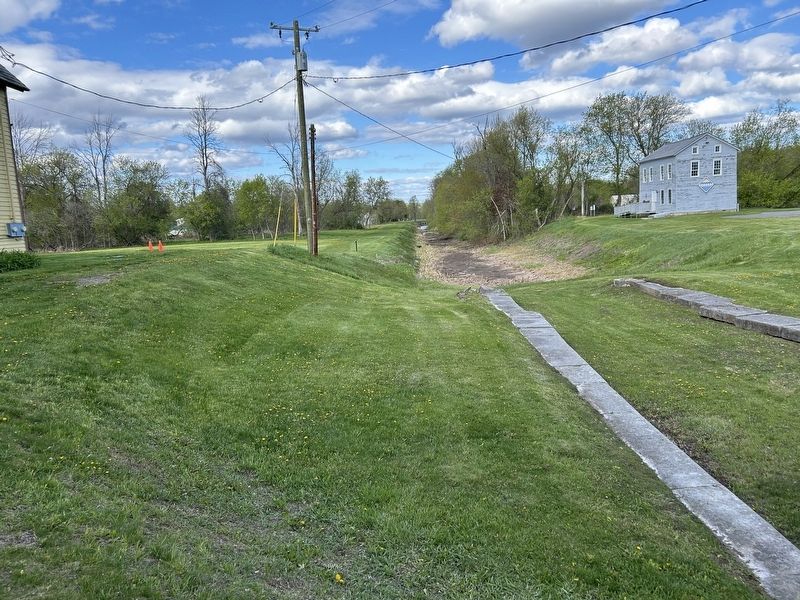
3. Old Canal and Marker
Marker is just to the right of the telephone poles.
Location. 42° 56.391′ N, 74° 16.884′ W. Marker is near Fort Hunter, New York, in Montgomery County. It can be reached from Schoharie Street north of Railroad Street, on the right when traveling north. Marker is beside old canal on the Woodchuck trail about 100 yards from the road.. Touch for map. Marker is at or near this postal address: 129 Schoharie Street, Fort Hunter NY 12069, United States of America. Touch for directions.

Regionally, this marker is in Upstate New York and in the Mohawk Valley. It is also in the American Northeast and in the Mid-Atlantic. Globally, it is in North America, the Western Hemisphere, the Western World, and the Anglosphere. Historically, it finds itself in what was once the Haudenosaunee (Iroquois) Confederacy, New Netherland, and one of the original Thirteen Colonies.
Other nearby markers. At least 8 other markers are within walking distance of this marker: Building Block of the Erie Canal (within shouting distance of this marker); East Guard Lock (within shouting distance of this marker); Original Erie Canal (within shouting distance of this marker); Site of Old Fort Hunter (within shouting distance of this marker); Site of Queen Anne Chapel (within shouting distance of this marker); Site of Last Mohawk Indian Village (within shouting distance of this marker); A Mohawk House Unearthed (within shouting distance of this marker); The Fort by the Village (within shouting distance of this marker). Touch for a list and map of all markers in Fort Hunter.
Credits. This page was last revised on May 4, 2026. It was originally submitted on May 4, 2026, by Steve Stoessel of Niskayuna, New York. This page has been viewed 13 times since then. Photos: 1, 2, 3. submitted on May 4, 2026, by Steve Stoessel of Niskayuna, New York.
