
Grimsby in Niagara Region, Ontario — Central Canada (North America)
The Hamilton, Grimsby & Beamsville Electric Railway Company
Photographed by Tim Boyd, May 4, 2026
1. The Hamilton, Grimsby & Beamsville Electric Railway Company Marker
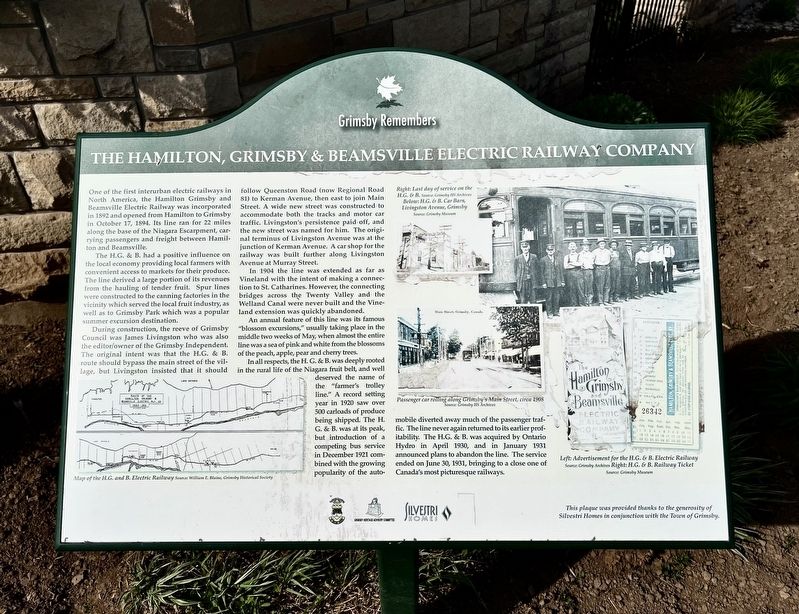
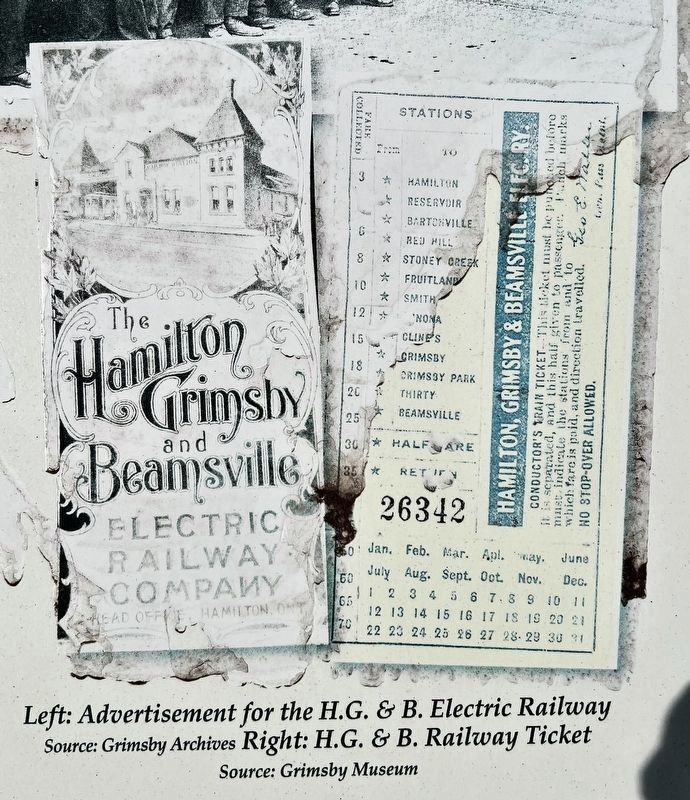
One of the first interurban electric railways in North America, the Hamilton Grimsby and Beamsville Electric Railway was incorporated in 1892 and opened from Hamilton to Grimsby in October 17, 1894. Its line ran for 22 miles along the base of the Niagara Escarpment, carrying passengers and freight between Hamilton and Beamsville.
The H.G. & B. had a positive influence on the local economy providing local farmers with convenient access to markets for their produce. The line derived a large portion of its revenues from the hauling of tender fruit. Spur lines were constructed to the canning factories in the vicinity which served the local fruit industry, as well as to Grimsby Park which was a popular summer excursion destination.
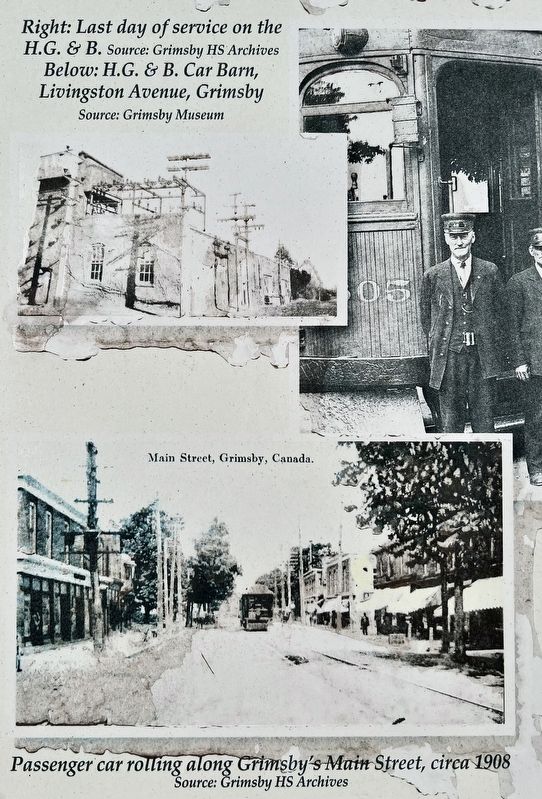
During construction, the reeve of Grimsby Council was James Livingston who was also the editor/owner of the Grimsby Independent. The original intent was that the H.G. & B. route should bypass the main street of the village, but Livingston insisted that it should follow Queenston Road (now Regional Road 81) to Kerman Avenue, then east to join Main Street. A wide new street was constructed
this page online
In 1904 the line was extended as far as Vineland with the intent of making a connection to St. Catharines. However, the connecting bridges across the Twenty Valley and the Welland Canal were never built and the Vineland extension was quickly abandoned.
An annual feature of this line was its famous "blossom excursions," usually taking place in the middle two weeks of May, when almost the entire line was a sea of pink and white from the blossoms of the peach, apple, pear and cherry trees.
In all respects, the H. G. & B. was deeply rooted in the rural life of the Niagara fruit belt, and well deserved the name of the "farmer's trolley line." A record setting year in 1920 saw over 500 carloads of produce being shipped. The H. G. & B. was at its peak, but introduction of a competing bus service in December 1921 combined with the growing popularity

Photographed by Tim Boyd, May 4, 2026
2. The Hamilton, Grimsby & Beamsville Electric Railway Company Marker
Erected by Town of Grimsby.
Topics. This historical marker is listed in these topic lists: Agriculture • Railroads & Streetcars. A significant historical year for this entry is 1892.
Location. 43° 11.858′ N, 79° 34.563′ W. Marker is in Grimsby, Ontario, in Niagara Region. It is at the intersection of Livingstone Avenue and Kerman Avenue, on the right when traveling west on Livingstone Avenue. Touch for map. Marker is at or near this postal address: 43 Kerman Avenue, Grimsby ON L3M 0G2, Canada. Touch for directions.

Regionally, this marker is on Ontario’s Golden Horseshoe and in Niagara Canada. It is also in Central Canada. Globally, it is in North America, on the Great Lakes, in the Western Hemisphere, in the Western World, and in the Anglosphere. Historically, it finds

3. The Hamilton, Grimsby & Beamsville Electric Railway Company marker photo and caption detail (left)
Other nearby markers. At least 8 other markers are within walking distance of this marker: Melrose Gardens ca. 1892 (about 180 meters away, measured in a direct line); Avonlea - Edwardian Architectural Style - Circa 1922 (approx. 0.6 kilometers away); The Stone Shop 1800 (approx. 0.7 kilometers away); St. Andrew’s Anglican Church (approx. 0.7 kilometers away); The White House c. 1830 (approx. 0.7 kilometers away); Nelles Manor 1798 (approx. 0.8 kilometers away); The H.G.& B. Electric Railway Car Barn (approx. 0.9 kilometers away); Colonel Robert Nelles 1761-1842 (approx. 0.9 kilometers away). Touch for a list and map of all markers in Grimsby.
Photographed by Tim Boyd, May 4, 2026
4. Hamilton, Grimsby & Beamsville Electric Railway Company marker photos and captions detail (centre)
5. The Hamilton, Grimsby & Beamsville Electric Railway Company marker photo and caption detail (right)
Credits. This page was last revised on May 9, 2026. It was originally submitted on May 8, 2026, by Tim Boyd of Hamilton, Ontario. This page has been viewed 18 times since then. Photos: 1, 2, 3, 4, 5. submitted on May 8, 2026, by Tim Boyd of Hamilton, Ontario. • Andrew Ruppenstein was the editor who published this page.
