Victoria Boulevard Historic District in Hampton, Virginia — The American South (Mid-Atlantic)
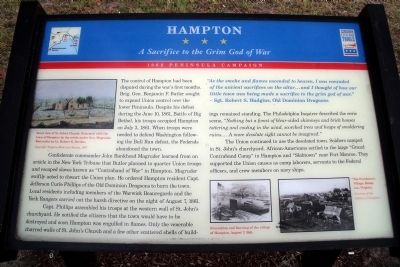
Hampton
A Sacrifice to the Grim God of War
| — | 1862 Peninsula Campaign | — |
Photographed by Bernard Fisher, July 31, 2010
1. Hampton CWT Marker
Confederate commander John Bankhead Magruder learned from an article in the New York Tribune that Butler planned to quarter Union troops and escaped slaves known as “Contraband of War” in Hampton. Magruder swiftly acted to thwart the Union plan. He ordered Hampton resident Capt. Jefferson Curle Phillips of the Old Dominion Dragoons to burn the town. Local residents including members of the Warwick Beauregards and the York Rangers carried out the harsh directive On the night of August 7, 1861.
Capt. Phillips assembled his troops at the western wall of St. John’s churchyard. He notified the citizens that the town would have to be destroyed and soon Hampton was engulfed in flames. Only the venerable charred walls of St. John’s Church and a few
this page online
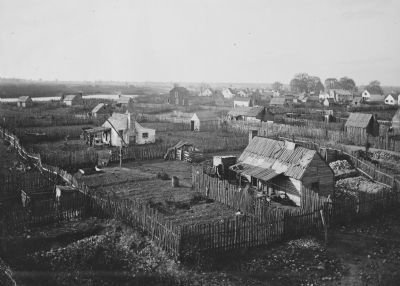
The Union continued to use the desolated town. Soldiers camped in St. John’s churchyard. African-Americans settled in the large “Grand Contraband Camp” in Hampton and “Slabtown” near Fort Monroe. They supported the Union causes as camp laborers, servants to the Federal officers, and crew members on navy ships.
“As the smoke and flames ascended to heaven, I was reminded of the ancient sacrifices on the altar…and I thought of how our little town was being made a sacrifice to the grim god of war.” – Sgt. Robert S. Hudgins, Old Dominion Dragoons
(captions)
Front view of St. John’s Church. Destroyed with the town of Hampton by the rebels under Gen. Magruder. Watercolor by Let. Robert K. Sneden. Copyright Virginia Historical Society, 1997
Evacuation and Burning of the village of Hampton, August 7, 1861.
“The Freedman’s Village, Hampton, Virginia.” Courtesy of the Library of Congress
Erected by Virginia
Photographed by Bernard Fisher, July 31, 2010
2. Carousel Park
Topics and series. This historical marker is listed in these topic lists: African Americans • Notable Events • War, US Civil. In addition, it is included in the Virginia Civil War Trails series list. A significant historical date for this entry is August 7, 1861.
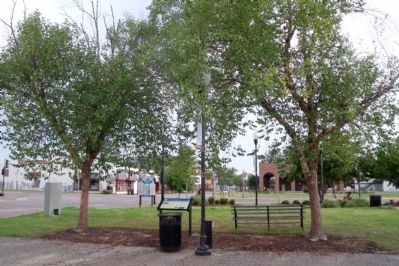
Location. This marker has been replaced by another marker nearby. It was located near 37° 1.459′ N, 76° 20.612′ W. Marker was in Hampton, Virginia. It was in the Victoria Boulevard Historic District. It could be reached from the intersection of Settlers Landing Road (U.S. 60) and South King Street, on the left when traveling west. This CWT Panel is located in Carousel Park. Touch for map. Marker was in this post office area: Hampton VA 23669, United States of America. Touch for directions.

Regionally, this marker was on Virginia’s Peninsula and in Coastal Virginia. It was also in the American South, specifically in the Upper South, in the Tidewater, and on the Eastern Seaboard. Globally, it was in the North Atlantic Region, North America, the Western Hemisphere, the Western World, and the Anglosphere. Historically, it found itself in what was
December 1864
3. Hampton, Virginia. Slab-town
Library of Congress Collection [LC-B815- 841 [P&P] LOT 4164-F]
Click for more information.
Click for more information.
Other nearby markers. At least 8 other markers are within walking distance of this location: Dr. Katherine G. Johnson (a few steps from this marker); Langley Field: Discovering Aerospace (a few steps from this marker); Ninteenth-Century Hampton (a few steps from this marker); Langley Field: Creating an Air Force (a few steps from this marker); Eighteenth-Century Hampton (a few steps from this marker); Twentieth-Century Hampton (within shouting distance of this marker); Indian / African / Settler (within shouting distance of this marker); Seventeenth-Century Hampton (within shouting distance of this marker). Touch for a list and map of all markers in Hampton.
Also see . . . Tidewater Virginia - The 1862 Peninsula Campaign. Virginia Civil War Trails (Submitted on August 1, 2010, by Bernard Fisher of Richmond, Virginia.)
Credits. This page was last revised on June 2, 2026. It was originally submitted on August 1, 2010, by Bernard Fisher of Richmond, Virginia. This page has been viewed 1,654 times since then and 43 times this year. Last updated on May 8, 2026, by Evan Dwyer of Richmond, Virginia. Photos: 1, 2, 3. submitted on August 1, 2010, by Bernard Fisher of Richmond, Virginia.
