Hingham in Plymouth County, Massachusetts — The American Northeast (New England)
Great Abolitionist Pic Nic of 1844
Tranquility Grove
| — | Burns Memorial Park | — |
Photographed by G.W.Bartlett, May 3, 2026
1. Great Abolitionist Pic Nic Marker
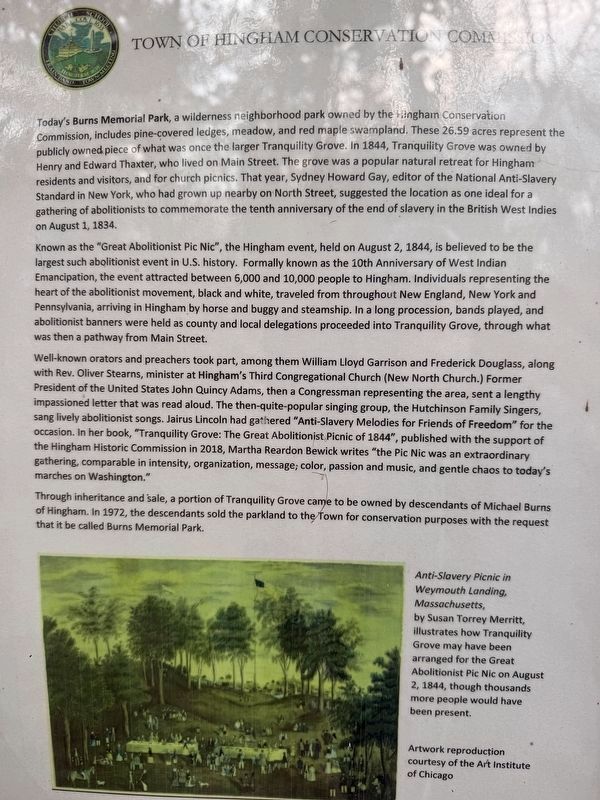
Today's Burns Memorial Park, a wilderness neighborhood park owned by the Hingham Conservation Commission, includes pine-covered ledges, meadow, and red maple swampland. These 26.59 acres represent the publicly owned piece of what was once the larger Tranquility Grove. In 1844, Tranquility Grove was owned by Henry and Edward Thaxter, who lived on Main Street. The grove was a popular natural retreat for Hingham residents and visitors, and for church picnics. That year, Sydney Howard Gay, editor of the National Anti-Slavery Standard in New York, who had grown up nearby on North Street, suggested the location as one ideal for a gathering of abolitionists to commemorate the tenth anniversary of the end of slavery in the British West Indies on August 1, 1834.
Known as the "Great Abolitionist Pic Nic", the Hingham event, held on August 2, 1844, is believed to be the largest such abolitionist event in U.S. history. Formally known as the 10th Anniversary of West Indian Emancipation, the event attracted between 6,000 and 10,000 people to Hingham. Individuals representing the heart of the abolitionist movement, black and white, traveled
this page online
Well-known orators and preachers took part, among them William Lloyd Garrison and Frederick Douglass, along with Rev. Oliver Stearns, minister at Hingham's Third Congregational Church (New North Church). Former President of the United States John Quincy Adams, then a Congressman representing the area, sent a lengthy impassioned letter that was read aloud. The then-quite-popular singing group, the Hutchinson Family Singers, sang lively abolitionist songs. Jairus Lincoln had gathered "Anti-Slavery Melodies for Friends of Freedom" for the occasion. In her book, "Tranquility Grove: The Great Abolitionist Picnic of 1844", published with the support of the Hingham Historic Commission in 2018, Martha Reardon Bewick writes "the Pic Nic was an extraordinary gathering, comparable in intensity, organization, message, color, passion and music and gentle
Photographed by G.W.Bartlett, May 3, 2026
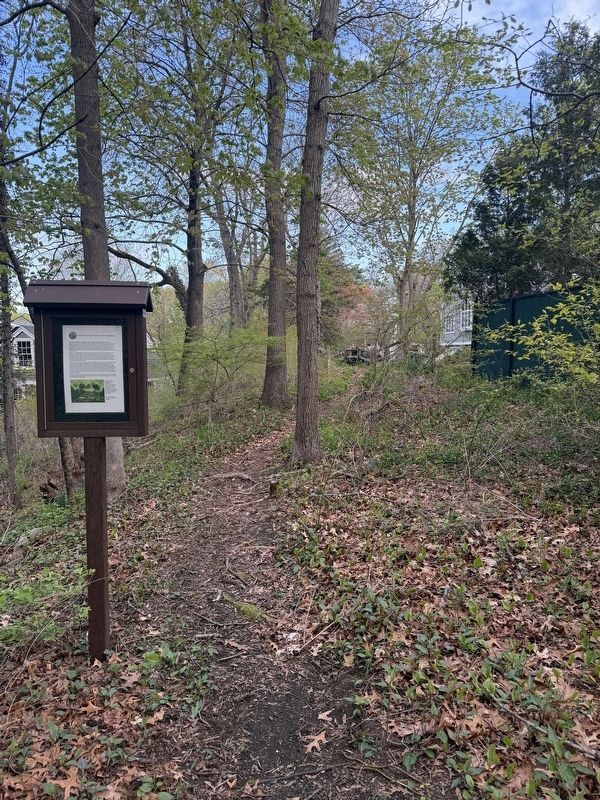
2. Great Abolitionist Pic Nic Marker (wide)
Through inheritance and sale, a portion of Tranquility Grove came to be owned by descendants of Michael Burns of Hingham. In 1972, the descendants sold the parkland to the Town for conservation purpose with the request that it be called Burns Memorial Park.
Erected 2019 by Town of Hingham Conservation Commission.
Topics. This historical marker is listed in these topic lists: Abolition & Underground RR • Parks & Recreational Areas. A significant historical date for this entry is August 2, 1844.
Location. 42° 14.09′ N, 70° 53.516′ W. Marker is in Hingham, Massachusetts, in Plymouth County. It can be reached from Hersey Street north of Lewis Court, on the right when traveling north. Touch for map. Marker is at or near this postal address: 94 Hersey Street, Hingham MA 02043, United States of America. Touch for directions.

Regionally, this marker is on the South Shore. It is also in the American Northeast, in New England, and on the Eastern Seaboard. Globally, it is in the North Atlantic Region, North America, the Western Hemisphere, the Western World, and the Anglosphere. Historically, it
Photographed by G.W.Bartlett, May 3, 2026
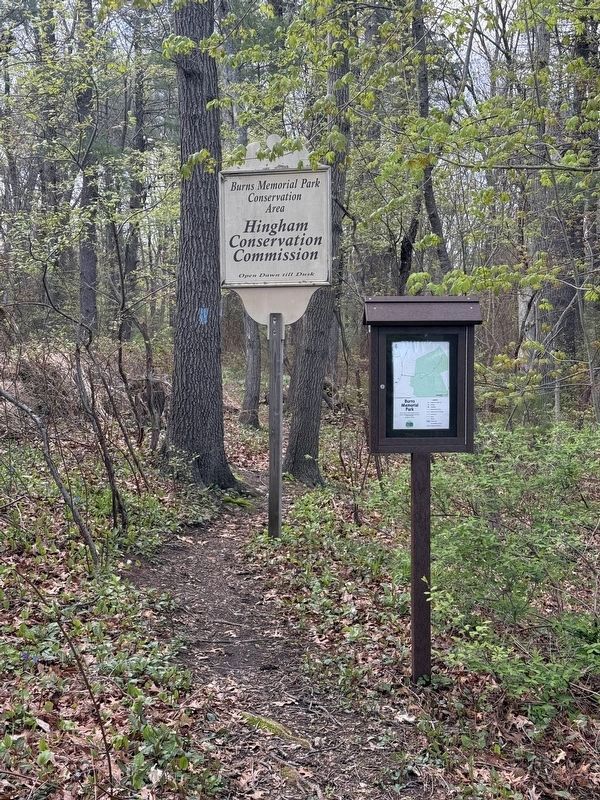
3. Burns Memorial Park Signage
Other nearby markers. At least 8 other markers are within walking distance of this marker: Old Ship Church (approx. half a mile away); Samuel Lincoln House (approx. half a mile away); Abraham Lincoln (approx. 0.6 miles away); General Benjamin Lincoln House (approx. 0.6 miles away); Benjamin Lincoln (approx. 0.6 miles away); Hingham Massachusetts (approx. 0.6 miles away); Buttonwood Tree (approx. 0.6 miles away); Hingham Center Training Field (approx. 0.6 miles away). Touch for a list and map of all markers in Hingham.
Also see . . .
1. Powerful Words in the Name of Freedom.
On August 1, 1844, the Hingham Anti-Slavery Society hosted a large regional rally to mark the tenth anniversary of the abolition of slavery in the British West Indies. The rally featured a speech by Frederick Douglass at the First Baptist Church and a procession down Hingham’s Elm Street to Tranquility Grove.(Submitted on May 3, 2026, by G.W.Bartlett of Hingham, Massachusetts.)
2. 1844: Hingham Anti-Slavery Society hosts the largest anti-slavery rally in the United States.
Photographed by G.W.Bartlett, May 3, 2026
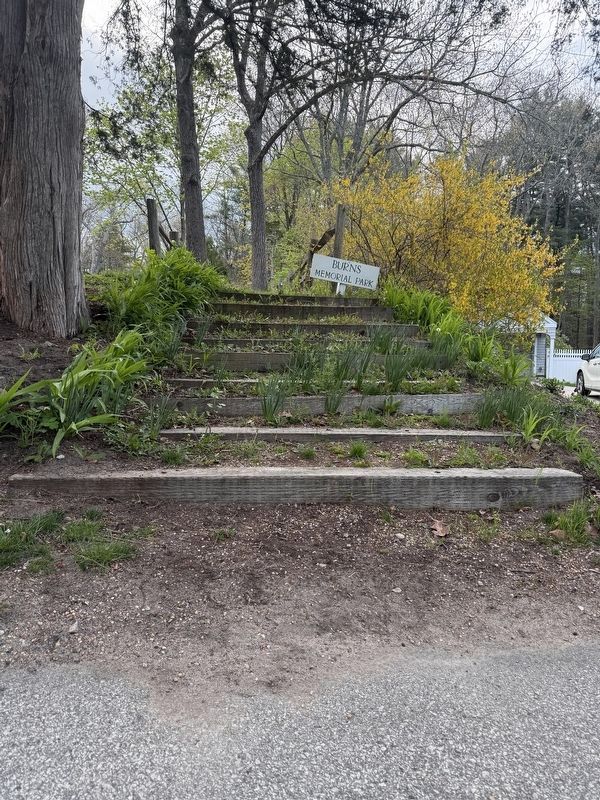
4. Burns Memorial Path Access Point
See and Hear: Watch a documentary video about Tranquility Grove.
The event was referred to as the “Great Abolitionist Pic Nic” and took place in Tranquility Grove (known today as Burns Memorial Park on Hersey Street). Frederick Douglass, William Lloyd Garrison, and other luminaries of the abolition movement traveled to Hingham, where an estimated 10,000 people had gathered in support of the anti-slavery cause. (Submitted on May 3, 2026, by G.W.Bartlett of Hingham, Massachusetts.)
3. Atlantic Slave Trade - Wikipedia. <blockquote>The Atlantic slave trade or transatlantic slave trade involved the transportation by slave traders of enslaved African people to the Americas. European slave ships regularly used the triangular trade route and its Middle Passage. Europeans established a coastal slave trade in the 15th century, and trade to the Americas began in the 16th century, lasting through the 19th century. (Submitted on May 3, 2026, by G.W.Bartlett of Hingham, Massachusetts.)
4. Anti-Slavery Melodies for Friends of Freedom by Jairus Lincoln. <blockquote>
"Music speaks the heart's emotion,
Music
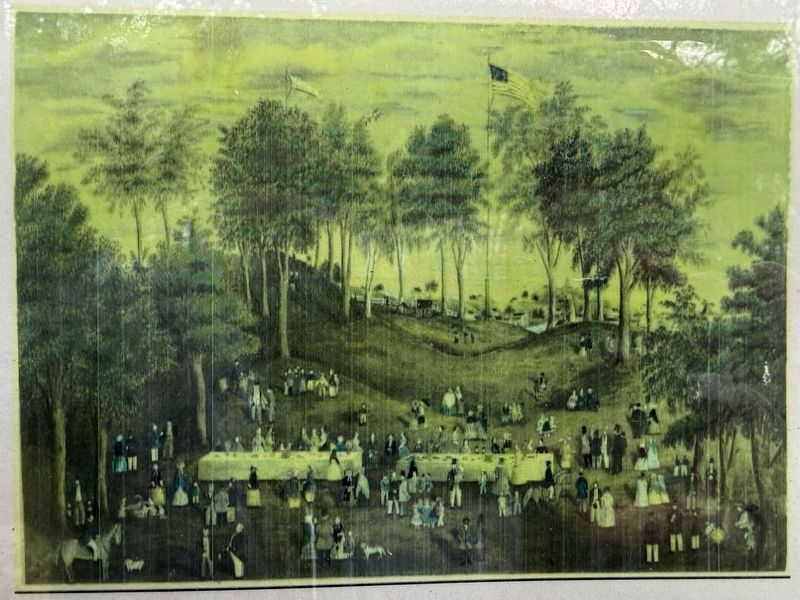
Photographed by Susan Torrey Merritt, circa 1844
5. Anti-Slavery Picnic in Weymouth Landing Massachusetts
Anti-Slavery Picnic in Weymouth Landing Massachusetts, by Susan Torrey Merritt, illustrates how Tranquility Grove may have been arranged for the Great Abolitionist Pic Nic on August 2, 1844, though thousands more people would have been present. Artwork reproduction courtesy of the Art Institute of Chicago
Music heavenly harps employs,
Music wakens heavenly joys."
This little book is intended, in some measure, to advance the cause of Emancipation, and to urge those, who have engaged in the cause, to go forward with renewed zeal in accomplishing the work of their holy mission. (Submitted on May 3, 2026, by G.W.Bartlett of Hingham, Massachusetts.)
5. The Anti-Slavery Poems of John Pierpont. <blockquote>"Though some of my friends may grieve, and wish that I had been more prudent than to write the pieces that touch thus upon Human Liberty, and upon the outrageous wrongs that, in these days and in this our land, it has suffered, their grandchildren will thank me, and may be freer men for them." (Submitted on May 3, 2026, by G.W.Bartlett of Hingham, Massachusetts.)
6. John Quincy Adams and Abolitionism. <blockquote>John Quincy Adams was born into a family that never owned slaves, and was hostile to the practice. His mother, Abigail Adams, held strong anti-slavery views. His father, President John Adams, despite opposing a 1777 bill in Massachusetts to emancipate slaves, opposed slavery on principle and considered the practice of slavery abhorrent.... ...He became an important antislavery voice in the Congress and was regarded by Southern legislators as the "hell hound of abolition". (Submitted on May 3, 2026, by G.W.Bartlett of Hingham, Massachusetts.)
7. A Narrative of the Life of Frederick Douglass an American Slave.
In the month of August, 1841, I attended an anti-slavery convention in Nantucket, at which it was my happiness to become acquainted with Frederick Douglass, the writer of the following Narrative. He was a stranger to nearly every member of that body ; but, having recently made his escape from the southern prison-house of bondage, and feeling his curiosity excited to ascertain the principles and measures of the abolitionists, — of whom he had heard a somewhat vague description while he was a slave, — he was induced to give his attendance, on the occasion alluded to, though at that time a resident in New Bedford.(Submitted on May 3, 2026, by G.W.Bartlett of Hingham, Massachusetts.)
8. Hingham's First Glimpse of Frederick Douglass. <blockquote>On November 4, 1841, a young Frederick Douglass—only three years removed from slavery—gave one of his first recorded speeches at a meeting of the Plymouth County Anti-Slavery Society at the First Baptist Church here in Hingham. On August 10, 1841, only three months earlier, Douglass had appeared on Nantucket Island, at a meeting of the island’s Anti-Slavery Society, where he first met William Lloyd Garrison and launched a career as an abolitionist lecturer and activist. (Submitted on May 3, 2026, by G.W.Bartlett of Hingham, Massachusetts.)
9. John Pierpont - Wikipedia.
John Pierpont (April 6, 1785 – August 27, 1866) was an American poet, who was also successively a teacher, lawyer, merchant, and Unitarian minister. His poem The Airs of Palestine made him one of the best-known poets in the U.S. in his day. He was the maternal grandfather of J. P. Morgan.(Submitted on May 3, 2026, by G.W.Bartlett of Hingham, Massachusetts.)
Credits. This page was last revised on May 11, 2026. It was originally submitted on May 3, 2026, by G.W.Bartlett of Hingham, Massachusetts. This page has been viewed 56 times since then. Last updated on May 9, 2026, by G.W.Bartlett of Hingham, Massachusetts. Photos: 1, 2, 3, 4, 5. submitted on May 3, 2026, by G.W.Bartlett of Hingham, Massachusetts. • Devry Becker Jones was the editor who published this page.
