Downtown in New Haven in South Central Region, Connecticut — The American Northeast (New England)
The Stone that was Rejected
Photographed by Conrad Ward
1. The Stone that was Rejected Marker
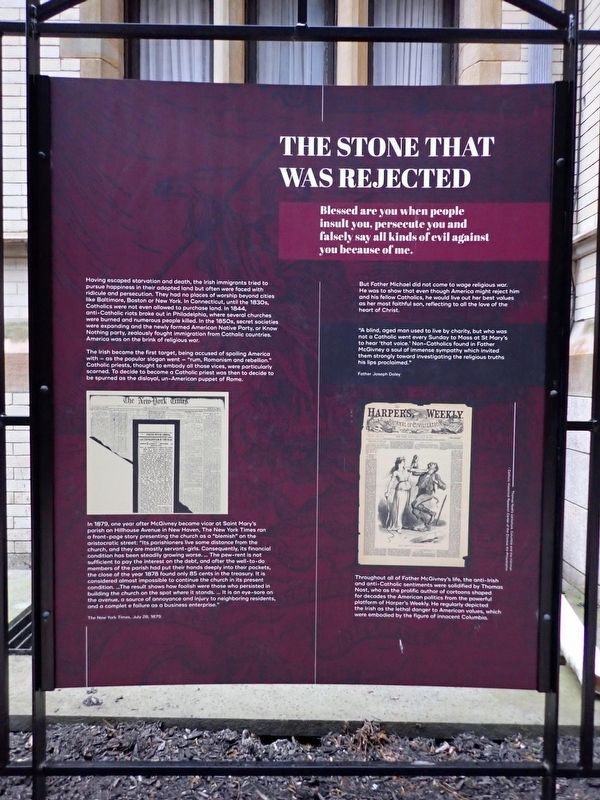
Blessed are you when people insult you, persecute you and falsely say all kinds of evil against you because of me.
Having escaped starvation and death, the Irish immigrants tried to pursue happiness in their adopted land but often were faced with ridicule and persecution. They had no places of worship beyond cities like Baltimore, Boston or New York. In Connecticut, until the 1830s, Catholics were not even allowed to purchase land. In 1844, anti-Catholic riots broke out in Philadelphia, where several churches were burned and numerous people killed. In the 1850s, secret societies were expanding and the newly formed American Native Party, or Know Nothing party, zealously fought immigration from Catholic countries. America was on the brink of religious war.
The Irish became the first target, being accused of spoiling America with - as the popular slogan went - "rum, Romanism and rebellion." Catholic priests, thought to embody all those vices, were particularly scorned. To decide to become a Catholic priest was then to decide to be spurned as the disloyal, un-American puppet of Rome.
In 1879, one year after
this page online
The New York Times, July 28, 1879.
But Father Michael did not come to wage religious war. He was to show that even though America might reject him and his fellow Catholics, he would live out her best values as her most faithful son,
Photographed by Conrad Ward, May 21, 2025
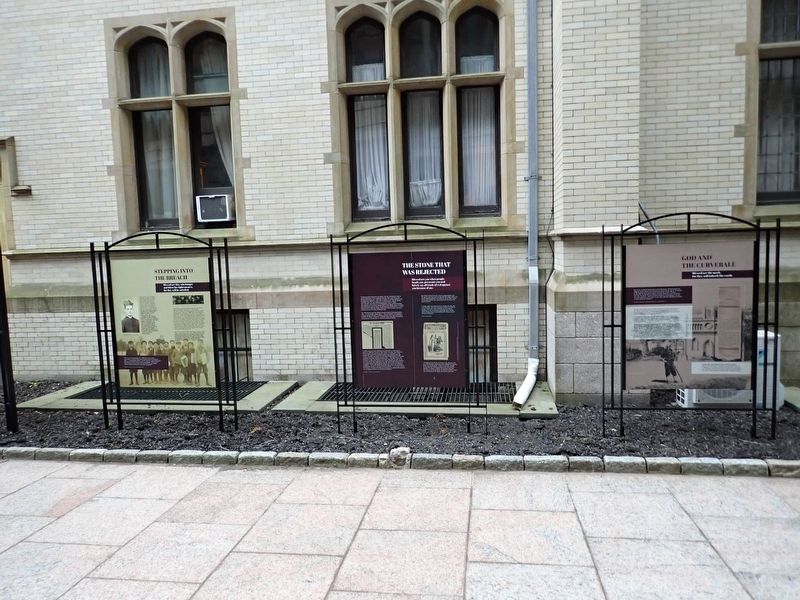
2. The Stone that was Rejected Marker
"A blind, aged man used to live by charity, but who was not a Catholic went every Sunday to Mass at St Mary's to hear 'that voice.' Non-Catholics found in Father McGivney a soul of immense sympathy which invited them strongly toward investigating the religious truths his lips proclaimed."
Father Joseph Daley
Throughout all of Father McGivney's life, the anti-Irish and anti-Catholic sentiments were solidified by Thomas Nast, who as the prolific author of cartoons shaped for decades the American politics from the powerful platform of Harper's Weekly. He regularly depicted the Irish as the lethal danger to American values, which were embodied by the figure of innocent Columbia.
Erected by St. Mary Church.
Topics. This historical marker is listed in these topic lists: Arts, Letters, Music • Civil Rights • Immigration • Religion & Religious Structures. A significant historical year for this entry is 1879.
Location. 41° 18.706′ N, 72° 55.432′ W. Marker is in New Haven in South Central Region, Connecticut. It is in Downtown. It is on Hillhouse Avenue north of Grove Street, on the left when traveling south. Located at St. Mary Church. Touch for map. Marker is at or near this postal address: 5 Hillhouse Avenue, New Haven CT 06511, United States of America. Touch for directions.

Regionally, this marker is in the Connecticut River Valley and on the Connecticut Shoreline. It is also in the American Northeast, in New England, and on the Eastern Seaboard. Globally, it is in the North Atlantic Region, North America, the Western Hemisphere, the Western World, and the Anglosphere. Historically, it finds itself in what was once New Haven County and also one of the original Thirteen Colonies.
Other nearby markers. At least 8 other markers are within walking distance of this marker: God and the Curveball (here, next to this marker); Stepping into the Breach (here, next to this marker); The Cost of Life (here, next to this marker); Let Us Pray (here, next to this marker); Blessed Is He (here, next to this marker); Two Homes (here, next to this marker); Into The Light (here, next to this marker); The Strong Right Arm of the Church (here, next to this marker). Touch for a list and map of all markers in New Haven.
More about this marker. Part of a series of 12 panels about Father Michael J. McGivney
Also see . . . Michael J. McGivney (Wikipedia). (Submitted on May 9, 2026.)
Credits. This page was last revised on May 19, 2026. It was originally submitted on May 9, 2026, by Conrad Ward of Guilford, Connecticut. This page has been viewed 15 times since then. Photos: 1, 2. submitted on May 9, 2026, by Conrad Ward of Guilford, Connecticut. • Michael Herrick was the editor who published this page.
