Altavista in Campbell County, Virginia — The American South (Mid-Atlantic)
Privy (Latin for private)
Photographed by C. Ryan Dodson, May 9, 2026
1. Privy (Latin for private) Marker
Inscription.
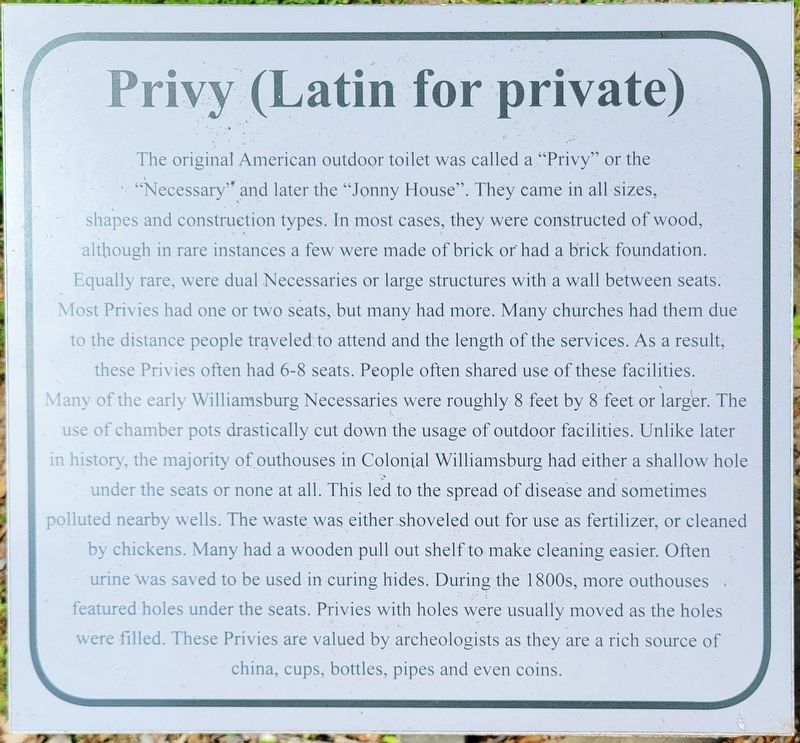
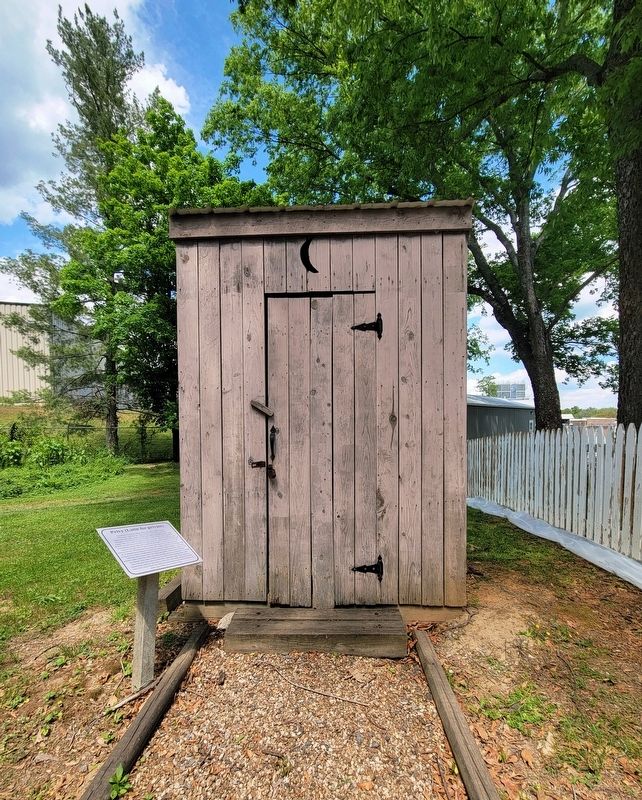
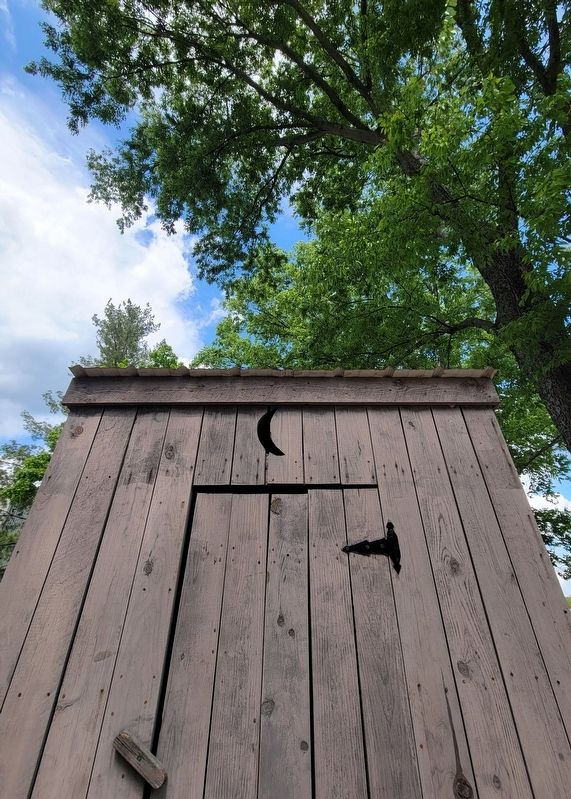
Privy (Latin for private). . The original American outdoor toilet was called a "Privy" or the "Necessary'" and later the "Jonny House". They came in all sizes, shapes and construction types. In most cases, they were constructed of wood, although in rare instances a few were made of brick or had a brick foundation. Equally rare, were dual Necessaries or large structures with a wall between seats. Most Privies had one or two seats, but many had more. Many churches had them due to the distance people traveled to attend and the length of the services. As a result, these Privies often had 6 - 8 seats. People often shared use of these facilities. Many of the early Williamsburg Necessaries were roughly 8 feet by 8 feet or larger. The use of chamber pots drastically cut down the usage of outdoor facilities. Unlike later in history, the majority of outhouses in Colonial Williamsburg had either a shallow hole under the seats or none at all. This led to the spread of disease and sometimes polluted nearby wells. The waste was either shoveled out for use as fertilizer, or cleaned by chickens. Many had a wooden pull out shelf to make cleaning easier. Often urine was saved to be used in curing hides. During the 1800s, more outhouses featured holes under the seats. Privies with holes were usually moved as the holes were filled. These Privies are valued by archeologists as they are a rich source of china, cups, bottles, pipes and even coins.
The original American outdoor toilet was called a "Privy" or the "Necessary'" and later the "Jonny House". They came in all sizes, shapes and construction types. In most cases, they were constructed of wood, although in rare instances a few were made of brick or had a brick foundation. Equally rare, were dual Necessaries or large structures with a wall between seats. Most Privies had one or two seats, but many had more. Many churches had them due to the distance people traveled to attend and the length of the services. As a result,
these Privies often had 6 - 8 seats. People often shared use of these facilities. Many of the early Williamsburg Necessaries were roughly 8 feet by 8 feet or larger. The use of chamber pots drastically cut down the usage of outdoor facilities. Unlike later in history, the majority of outhouses in Colonial Williamsburg had either a shallow hole under the seats or none at all. This led to the spread of disease and sometimes polluted nearby wells. The waste was either shoveled out for use as fertilizer, or cleaned by chickens. Many had a wooden pull out shelf to make cleaning easier. Often urine
Click or scan to see this page online
was saved to be used in curing hides. During the 1800s, more outhouses featured holes under the seats. Privies with holes were usually moved as the holes were filled. These Privies are valued by archeologists as they are a rich source of
china, cups, bottles, pipes and even coins.
Location. 37° 7.84′ N, 79° 16.214′ W. Marker is in Altavista, Virginia, in Campbell County. It can be reached from Main Street. The Marker is located on the grounds of the Avoca Museum. Touch for map. Marker is at or near this postal address: 1514 Main Street, Altavista VA 24517, United States of America. Touch for directions.
Regionally, this marker is in the Piedmont and in Central Virginia. It is also in the American South and specifically in the Upper South. Globally, it is in North America, the Western Hemisphere, the Western World, and the Anglosphere. Historically,
Photographed by C. Ryan Dodson, May 9, 2026
2. Privy (Latin for private) Marker
it finds itself in what was once the territory of the Mississippian Culture, one of the original Thirteen Colonies, one of the Confederate States of America, and the Antebellum South.
Credits. This page was last revised on May 14, 2026. It was originally submitted on May 11, 2026, by C. Ryan Dodson of Danville, Virginia. This page has been viewed 16 times since then. Photos:1, 2, 3, 4. submitted on May 11, 2026, by C. Ryan Dodson of Danville, Virginia. • Bill Pfingsten was the editor who published this page.