East End in Melbourne, Victoria, Australia — Oceania
Bourke Street c1900.
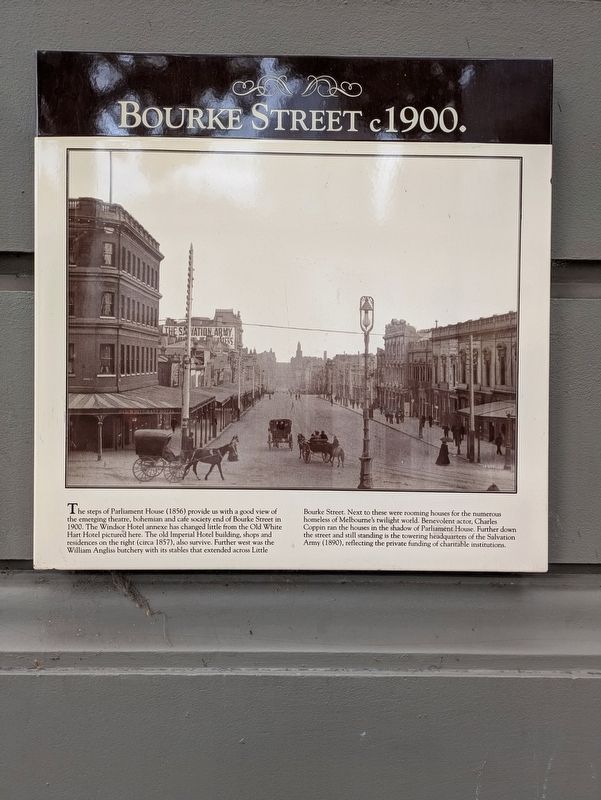
Photographed by Dean Barton-Ancliffe, May 5, 2026
1. Bourke Street c1900. Marker
Topics. This historical marker is listed in these topic lists: Colonial Era • Roads & Vehicles • Settlements & Settlers. A significant historical year for this entry is 1900.
Location. 37° 48.694′ S, 144° 58.365′ E. Marker is in Melbourne, Victoria. It is in East End. It is at the intersection of Bourke Street and Spring Street, on the left when traveling west
this page online

Regionally, it is in Oceania, in Australasia, in the Pacific Ocean, in South Pacific, on the Pacific Rim, in the Western World, and in the Anglosphere. Historically, it finds itself in what was once a British colony.
Other nearby markers. At least 8 other markers are within walking distance of this marker: The Palace 1934 - 2007 (within shouting distance of this marker); The Palace 1840 - 1919 (within shouting distance of this marker); 32-38 Bourke Street (within shouting distance of this marker); The Windsor Hotel (within shouting distance of this marker); Victorian Houses of Parliament (within shouting distance of this marker); Adam Lindsay Gordon 1932 (about 120 meters away, measured in a direct line); The Salvation Army Temple (about 120 meters away); Scotch College (about 120 meters away). Touch for a list and map of all markers in Melbourne.
Also see . . . Bourke Street East - Historic Area.
The Bourke Street east precinct comprises those buildings and the resultant(Submitted on May 11, 2026, by Dean Barton-Ancliffe of Rowville, Victoria.)space on both sides of Bourke Street between Exhibition and Spring Street that frame the view of Parliament House as seen at eye level from the Exhibition/Bourke Street intersection.Photographed by Dean Barton-Ancliffe, May 5, 20262. Bourke Street c1900. Markerwith a view along Bourke Street today
The precinct includes the streetscapes on both sides of Bourke Street between Exhibition and Spring Steets and the space above and around the street that affects the quality of the view corridor to Parliament House. This area and the quality of the precinct itself are two aspects that presently play important roles in appreciating this area. This appreciation is centred around Parliment House which is one of the finest examples of Victorian Architecture in the world. The important position of Parliment House as terminating Bourke Street, must be appreciated in relationship to the buildings that frame the view of this masterpiece.
At present the top end of Bourke Street with its buildings of relatively low height and small scale enhance the giant aspects of Parliament House. The unity of the streetscape and their relative size to the main features of the area may not be exhibited as strongly as for instance in Paris, where the Avenue de l'Opera with its uniform row of plain facades is grandly terminated by the giant and elaborated facade of the Opera House. However, the effect is undoubtedly comparable. It is therefore important that this effect remains at the top of Bourke Street and is not destroyed by the intrusion of out of scale modern buildings. new buildings should be permitted to be erected only on the basis that any higher portion be set back sufficiently from the street boundary so as not to destroy this positive aspect of the streetscape. A suitable low rise structure enhancing this streetscape should be located on the street boundary with no forecourts.

Credits. This page was last revised on May 13, 2026. It was originally submitted on May 11, 2026, by Dean Barton-Ancliffe of Rowville, Victoria. This page has been viewed 16 times since then. Photos: 1, 2. submitted on May 11, 2026, by Dean Barton-Ancliffe of Rowville, Victoria. • Andrew Ruppenstein was the editor who published this page.
