James Island in Charleston County, South Carolina — The American South (South Atlantic)
The First Shot of the War of Secession
Photographed by Mike Stroud, April 20, 2010
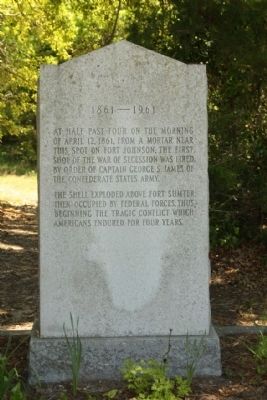
1. The First Shot of the War of Secession Marker
At half past four on the morning
of April 12, 1861, from a mortar near
this spot on Fort Johnson, the first
shot of the War of Secession was fired,
by order of Captain George S. James of
the Confederate States Army.
The shell exploded above Fort Sumter,
then occupied by Federal Forces, thus
beginning the tragic conflict which
Americans endured for four years.
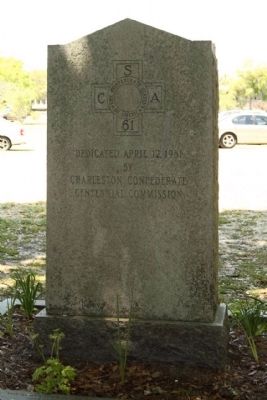
(Back side)
(Emblem: CSA 61 The Confederate States of America)
Dedicated April 12, 1961
by
Charleston Confederate
Centennial Commission
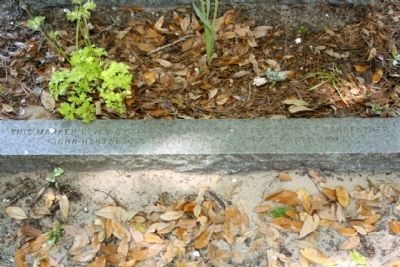
This marker given by Mrs. J.C. Long in memory of her Grandfather
John Hartnett, a soldier in the Confederate Army
Topics. This historical marker is listed in these topic lists: Notable Places • War, US Civil. A significant historical date for this entry is April 12, 1861.
Location. 32° 45.097′ N, 79° 53.876′ W. Marker is on James Island, South Carolina, in Charleston County. It is on Fort Johnson Road. Located Approx. 900 feet from Northern Terminus Fort Johnson Road at S.C. Department of Natural Resources Complex, College of Charleston, Grice Marine Laboratory Building 9 parking lot. Touch for map. Marker is at or near this postal address: 205 Fort Johnson Road, Charleston SC 29412, United States of America. Touch for directions.

Regionally, this marker is in Historic Charleston and in the Lowcountry. It is also in the American South, specifically in the Deep South, and on the Eastern Seaboard. Globally, it is in the North Atlantic Region, North America, the Western Hemisphere, the Western World, and the Anglosphere. Historically, it finds itself in what was once the territory of the Mississippian Culture, one of the original Thirteen Colonies, one of the Confederate States of America, and the Antebellum South.
Other nearby markers. At least 8 other markers
this page online
More about this marker. The majority of the Fort Johnson property was transferred to the S.C. Wildlife and Marine Resources Department in 1970. A small portion of land was retained by the College of Charleston for the Grice Marine Laboratory, which is currently used as a teaching and research facility. The Medical University, the successor to the Medical College, kept title to a large dwelling on the northwestern point.
Also see . . .
1. South Carolina Department of Natural Resources:The History of Fort Johnson. During early 1861, South Carolina state troops erected two 10-inch mortar batteries of two mortars each
Photographed by Mike Stroud, April 20, 2010
2. The First Shot of the War of Secession Marker, back
2. The Regimental Courier. Captain/Colonel George S. James “had the honor of firing the first shell at Fort Sumter, and his conduct and that of those under him was commendable during the action.” (Submitted on April 21, 2010, by Mike Stroud of Bluffton, South Carolina.)
Photographed by Mike Stroud, April 20, 2010
3. Ground Marker
This marker given by Mrs. J.C. Long in memory of her Grandfather
John Hartnett, a soldier in the Confederate Army
John Hartnett, a soldier in the Confederate Army
Photographed by Mike Stroud, April 20, 2010
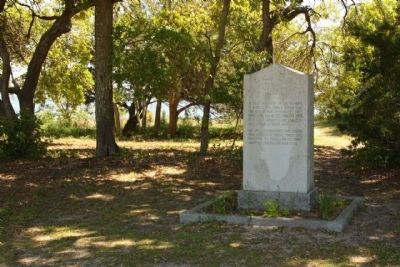
4. The First Shot of the War of Secession Marker
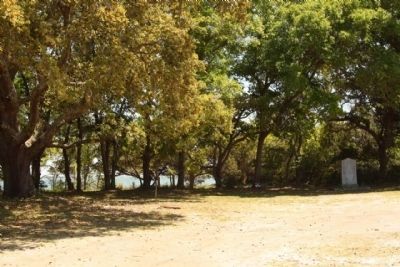
Photographed by Mike Stroud, April 20, 2010
5. The First Shot of the War of Secession Marker
seen in the Grice Marine Laboratory
Building 9 parking lot, Fort Johnson
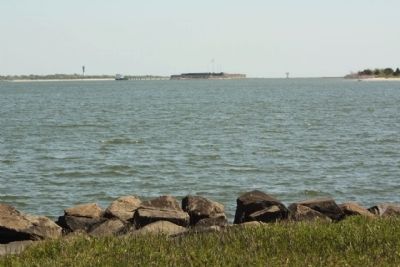
Photographed by Mike Stroud, April 20, 2010
6. The view of Fort Sumter
from about 20 yards behind the marker, waterside
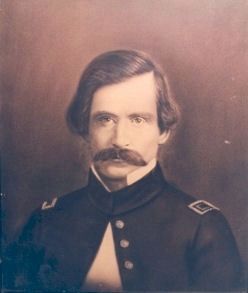
The Regimental Courier
7. Captain, later Lt.Colonel George S. James
the honor of firing the first shell at Fort Sumter
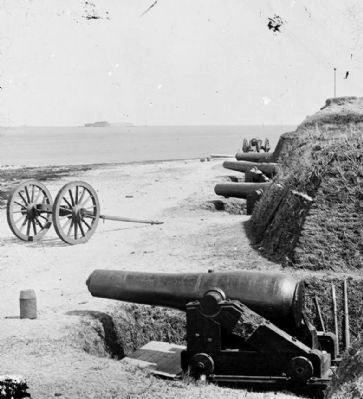
by George N. Barnard,(from old-picture.com), 1865
8. S.C. Battery Fort Johnson
Fort Sumter in distance.
Photographed by Mike Stroud, April 20, 2010
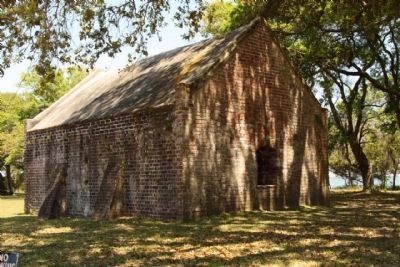
9. Powder magazine
This 18th century powder magazine was discovered in the 20th century after spending about 200 years underground. The fort that once stood here covered this magazine with earth to protect it from shelling, and when that got covered up, people forgot about the magazine underneath. It was found during construction and has been preserved. Workers and students at Grice Marine lab park all around it.
S.C. Dept of Archives and History, 1972
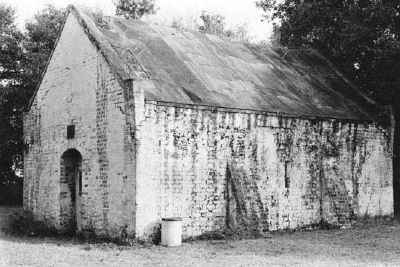
10. Powder Magazine
National Register of Historic Places:
Fort Johnson/Powder Magazine *** (added 1972 - Site - #72001197) Fort Johnson is significant both militarily and politically, especially as the site of the first raising of the South Carolina flag in 1775 and as the site of the first shots fired upon Fort Sumter in 1861. Of the fort itself, only considerably eroded
Confederate earthworks remain, although other elements of the fort’s foundations are discernable from ground swells and rubble. Fort Johnson was one of the first defensive works constructed to protect the harbor or Charleston against naval attack. The initial fortification was constructed by the British during the years 1704-08 for defense against the
French fleet during Queen Anne’s War. The fort was named for Sir Nathaniel Johnson, Proprietary Governor of the Carolinas from 1703 to 1709. There was continual reconstruction of the fort from 1704 to 1865, due primarily to damage incurred by storms and to ever-changing military situations. Although the fort itself is in ruins, the powder magazine,
erected in 1765, is intact.
Photographed by Mike Stroud, April 20, 2010
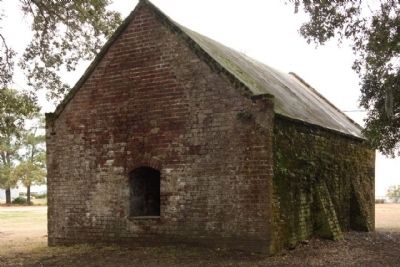
11. Powder Magazine
The powder magazine was buried until 1961; this fact probably saved the building from destruction (the magazine was buried during the Civil War by Confederate soldiers). The building is 27 feet long and 20 feet wide, constructed of brick in Flemish bond, and was originally whitewashed. The front and rear gables are high, with one-dimensional linear extension at their bases on the roofline; the roof is covered with a cement-like coating to prevent it from taking fire. While the exterior is original, the interior is barrel vaulted, probably by the Confederate forces during the early 1860s, to enable the roof to withstand the pressure of the earth when the building was buried.
(South Carolina Department of Archives and History)
Photographed by Mike Stroud, April 20, 2010
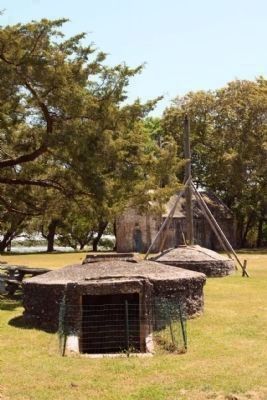
12. Cisterns
In this view, you see two freshwater cisterns from the original Fort Johnson, with the powder magazine in the
background. The First Shot of the War of Secession marker is just out of view at right
Credits. This page was last revised on February 16, 2023. It was originally submitted on April 21, 2010, by Mike Stroud of Bluffton, South Carolina. This page has been viewed 3,051 times since then and 56 times this year. Photos: 1, 2, 3, 4, 5, 6, 7, 8, 9, 10, 11, 12. submitted on April 21, 2010, by Mike Stroud of Bluffton, South Carolina.
