Madison in Dane County, Wisconsin — The American Midwest (Great Lakes)
Lake Farm Archaeological District
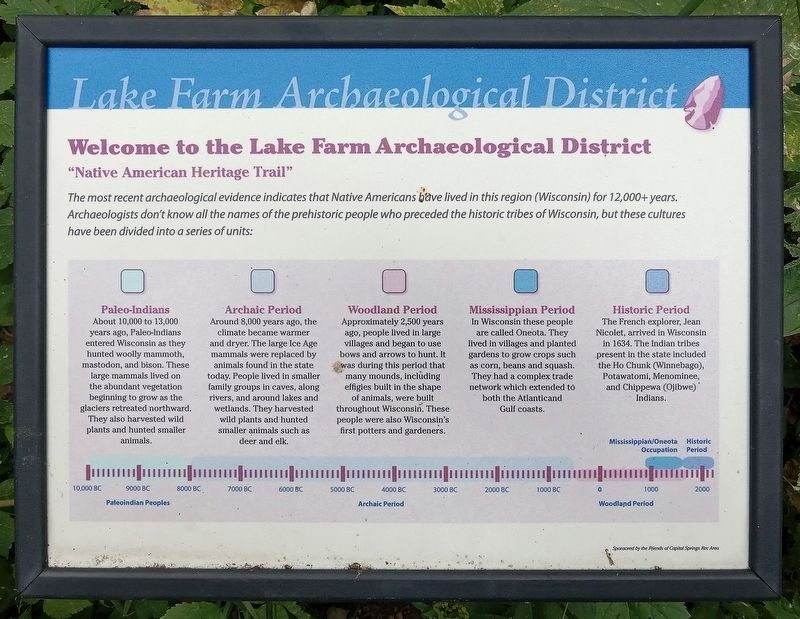
Welcome to the Lake Farm Archaeological District
| — | "Native American Heritage Trail" | — |
Photographed by McGhiever, July 24, 2025
1. Lake Farm Archaeological District Marker
The most recent archaeological evidence indicates that Native Americans have lived in this region (Wisconsin) for 12,000+ years. Archaeologists don't know all the names of the prehistoric people who preceded the historic tribes of Wisconsin, but these cultures have been divided into a series of units:
Paleo-Indians
About 10,000 to 13,000 years ago, Paleo-Indians entered Wisconsin as they hunted woolly mammoth, mastodon, and bison. These large mammals lived on the abundant vegetation beginning to grow as the glaciers retreated northward. They also harvested wild plants and hunted smaller animals.
Archaic Period
Around 8,000 years ago, the climate became warmer and dryer. The large Ice Age mammals were replaced by animals found in the state today. People lived in smaller family groups in caves, along rivers, and around lakes and wetlands. They harvested wild plants and hunted smaller animals such as deer and elk.
Woodland Period
Approximately 2,500 years ago, people lived in large villages and began to use bows and arrows to hunt. It was during this period that many mounds, including effigies built in the shape
this page online
Mississippian Period
In Wisconsin these people are called Oneota. They lived in villages and planted gardens to grow crops such as corn, beans and squash. They had a complex trade network which extended to both the Atlantic and Gulf coasts.
Historic Period
The French explorer, Jean Nicolet, arrived in Wisconsin in 1634. The Indian tribes present in the state included the Ho Chunk (Winnebago), Potawatomi, Menominee, and Chippewa (Ojibwe) Indians.
Erected by the Friends of Capital Springs Recreation Area.
Topics. This historical marker is listed in these topic lists: Anthropology & Archaeology • Indigenous Peoples and Communities.
Location. 43° 1.573′ N, 89° 19.858′ W. Marker is in Madison, Wisconsin, in Dane County. It can be reached from Libby Road, on the left when traveling east. The marker is in William G. Lunney Lake Farm County Park, on a trail between the boat launch and the observatory tower. Touch for map. Marker is in this post office area: Madison

Photographed by McGhiever, July 24, 2025
2. Lake Farm Archaeological District Marker in Lake Farm County Park

Regionally, this marker is in Southeast Wisconsin. It is also in the American Midwest and in the Corn Belt. Globally, it is in North America, the Western Hemisphere, the Western World, and the Anglosphere. Historically, it finds itself in what was once the territory of the Mississippian Culture and also the Northwest Territory.
Other nearby markers. At least 8 other markers are within walking distance of this marker: Carlos J. Martin Memorial Native American Interpretive Site (about 400 feet away, measured in a direct line); In Memory of Bud Morton 1907-1992 (approx. 0.9 miles away); Lewis Nine Springs E-Way (approx. one mile away); MMSD Wildlife Observation Area (approx. one mile away); The Lewis Nine Springs E-Way / Philip and Elizabeth Lewis (approx. one mile away); The Madison Metropolitan Sewerage District Wildlife Observation Area / From Wastewater to Habitat (approx. one mile away); Mounds for the Future (approx. one mile away); The Gilman Mounds (approx. one mile away). Touch for a list and map of all markers in Madison.
Credits. This page was last revised on May 13, 2026. It was originally submitted on May 13, 2026, by McGhiever of Minneapolis, Minnesota. This page has been viewed 21 times since then. Photos: 1, 2. submitted on May 13, 2026, by McGhiever of Minneapolis, Minnesota.
